Kentucky Commercial Sublease Agreement
Rent out all or part of your office, retail or industrial space to another business while you remain the tenant.
Includes 30 days of edits
- 5 to 20 minutes
- Print-ready PDF
- Tailored to Kentucky
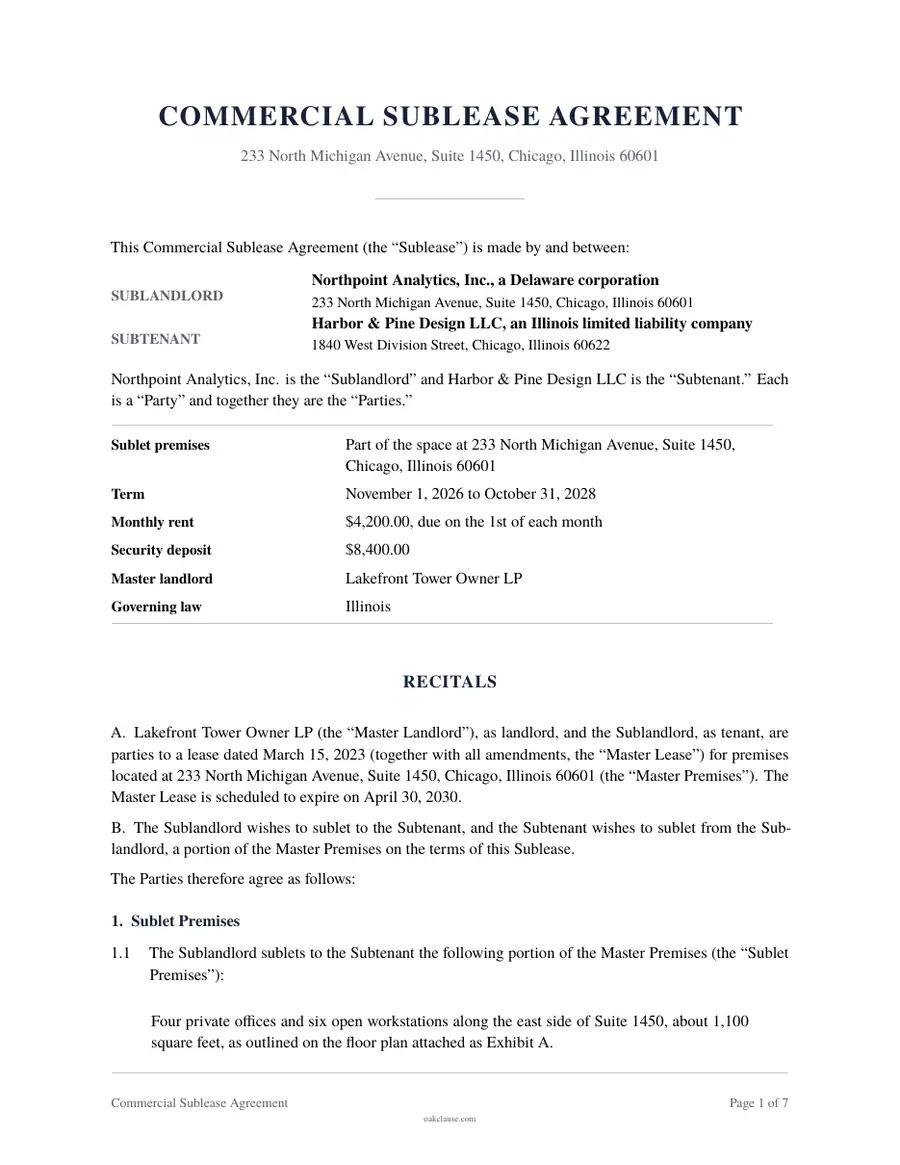
Commercial Sublease rules in Kentucky
Subleases of commercial space are mainly governed by the master lease and general contract law, but state law still affects several points: whether a tenant needs the landlord's consent to sublet when the lease is silent, whether a landlord may withhold consent unreasonably, the procedures for recovering possession from a subtenant after a default, and whether a subtenant can be held directly liable to the owner. This sublease is governed by the law of the state where the property is located and defers to that law wherever specific procedures or limits apply. Always read the master lease first, since it usually controls whether and how you may sublet.
When you create this document for Kentucky, the questionnaire uses Kentucky as the governing law and adds wording that defers to Kentucky requirements where they apply. Laws change, so confirm current rules with official Kentucky sources or a local attorney for anything critical.
What is a Commercial Sublease Agreement?
A commercial sublease agreement is a contract in which a business that leases space (the sublandlord) rents some or all of that space to another business (the subtenant). The original lease between the sublandlord and the property owner, often called the master lease or prime lease, stays in place, and the sublandlord remains responsible to the owner for the rent and every other obligation in it.
Because the subtenant's rights can never be greater than the sublandlord's, a good sublease is built around the master lease. It confirms that the sublease ends no later than the master lease, requires the subtenant to follow the master lease rules for its part of the space, and makes clear which services the subtenant must look to the owner for. It also records the owner's consent, which most commercial leases require before any subletting.
Subleasing is a common way for a business to reduce costs when it has more space than it needs, has relocated before its lease ends, or wants to share a suite with a related company. For the subtenant, a sublease can offer a shorter commitment and furnished, ready-to-use space at a lower price than a direct lease.
When to use it
- Your business has more office, retail or warehouse space than it currently needs and wants to rent the extra space to another company.
- You are moving out before your commercial lease ends and want someone to take over the space for the rest of the term.
- You are a business looking for short-term space and have found a tenant willing to sublet to you.
- Two related or friendly companies want to share a suite under one master lease.
- Your landlord has approved a sublease and you need the agreement in writing.
What is included
- Sublandlord, subtenant and master landlord details
- Recitals describing the master lease
- Entire premises or a described portion, with shared areas
- Sublease term that ends before the master lease
- Rent, payment method, increases and late charges
- Share of operating expenses and utilities
- Security deposit and furniture or equipment included
- Incorporation of the master lease and excluded provisions
- Insurance, indemnity, alterations and default
- Master landlord consent block and signatures
How to make your Commercial Sublease
Answer the questions
Tell us about the parties and the terms you want. Most documents take about 5 to 20 minutes.
Review the preview
Check the draft as you go and change any answer. The document updates instantly.
Download, sign and keep a copy
Download a print-ready PDF, sign it with the other parties, and give everyone a copy.
Commercial Sublease in another state
Back to the general commercial sublease page51 states shown
- ALAlabama
- AKAlaska
- AZArizona
- ARArkansas
- CACalifornia
- COColorado
- CTConnecticut
- DEDelaware
- DCDistrict of Columbia
- FLFlorida
- GAGeorgia
- HIHawaii
- IDIdaho
- ILIllinois
- INIndiana
- IAIowa
- KSKansas
- KYKentucky
- LALouisiana
- MEMaine
- MDMaryland
- MAMassachusetts
- MIMichigan
- MNMinnesota
- MSMississippi
- MOMissouri
- MTMontana
- NENebraska
- NVNevada
- NHNew Hampshire
- NJNew Jersey
- NMNew Mexico
- NYNew York
- NCNorth Carolina
- NDNorth Dakota
- OHOhio
- OKOklahoma
- OROregon
- PAPennsylvania
- RIRhode Island
- SCSouth Carolina
- SDSouth Dakota
- TNTennessee
- TXTexas
- UTUtah
- VTVermont
- VAVirginia
- WAWashington
- WVWest Virginia
- WIWisconsin
- WYWyoming
Frequently asked questions
Do I need my landlord's permission to sublease commercial space?
Almost always. Most commercial leases require the landlord's written consent before the tenant sublets any part of the space, and subletting without consent can be a default under the master lease. This sublease includes an optional consent block that the master landlord can sign on the same document.
Who is responsible to the landlord after I sublease?
You are. As the sublandlord, you remain fully liable to the property owner for rent and all other obligations under the master lease, even if the subtenant fails to pay you. The subtenant is generally responsible only to you, unless the landlord's consent or the master lease says otherwise.
What is the difference between a sublease and a lease assignment?
In a sublease, you keep your lease and become a landlord to the subtenant, usually for part of the space or part of the remaining term. In an assignment, you transfer your entire interest in the lease to a new tenant, who then deals directly with the landlord. Whether you are released from liability after an assignment depends on the landlord's agreement.
Can the sublease last longer than my lease?
No. A sublandlord cannot give a subtenant more rights than it has, so the sublease must end on or before the day the master lease ends. This agreement states that the sublease ends automatically if the master lease ends for any reason.
Can I charge the subtenant more rent than I pay?
Sometimes. Many master leases require the tenant to share any profit from subletting with the landlord, or forbid charging more than the master lease rent. Check your master lease before setting the sublease rent.
Should the subtenant see a copy of the master lease?
Yes. The subtenant agrees to follow the master lease for its part of the space, so it needs to know what that lease requires. It is common to attach a copy, with confidential financial terms redacted if both parties agree.
What happens if the master lease is terminated?
If the master lease ends, the sublease generally ends with it, even if the subtenant has done nothing wrong. That is a key risk for subtenants, who may ask the landlord to agree to recognize the sublease if the master lease ends early.
Does a commercial sublease need to be notarized?
Generally no. A commercial sublease is usually valid once the parties sign it. Some long-term subleases are recorded, which generally requires notarization, but that is uncommon.
More Kentucky documents
Other documents people prepare for Kentucky, each with the state’s rules where we have checked them.
All Kentucky documents and rules