Independent Contractor Agreement
Hire a freelancer or contractor with terms that spell out the work, the pay and who owns the results, while documenting that the relationship is not employment.
Includes 30 days of edits
- 5 to 20 minutes
- Print-ready PDF
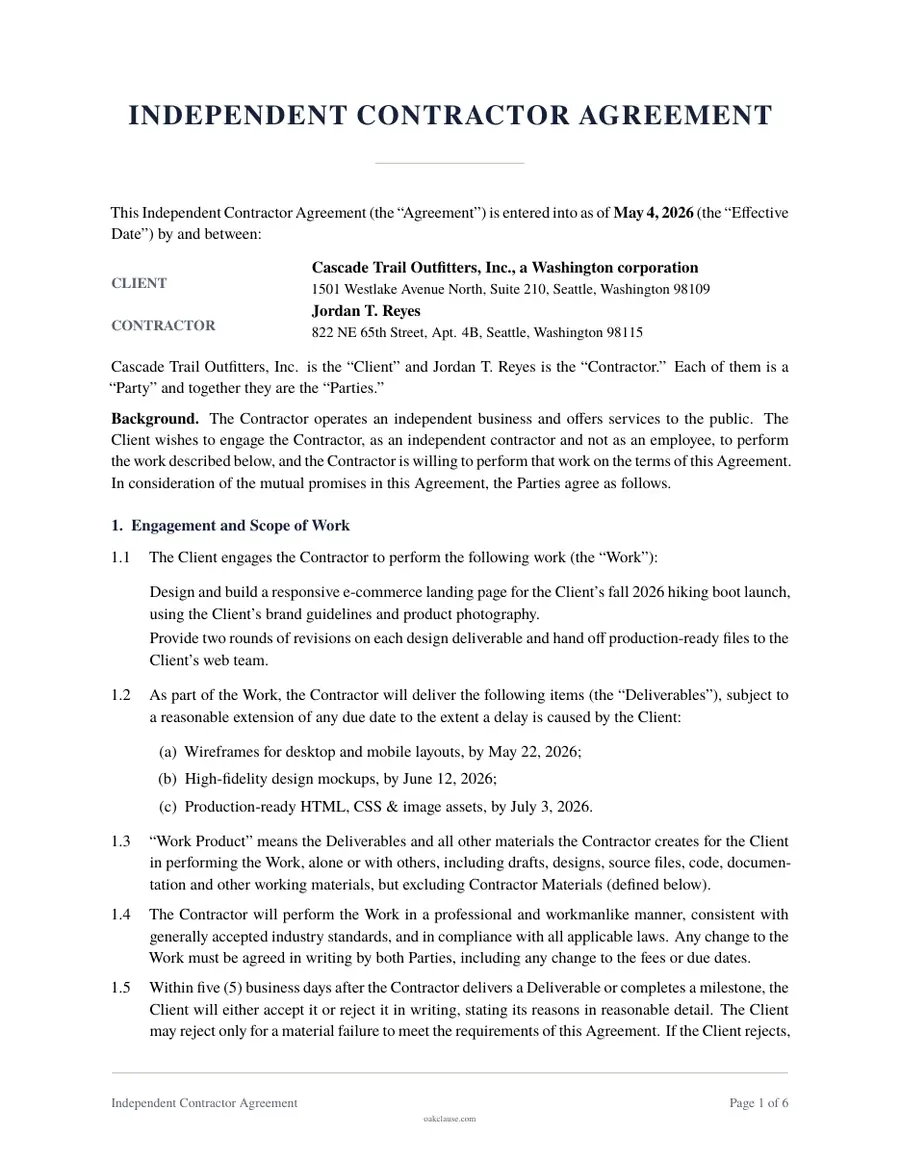
What is an Independent Contractor Agreement?
An independent contractor agreement is a contract between a business (or individual) and a self-employed worker who performs specific work without becoming an employee. It is sometimes called a freelance contract, a contractor agreement or a 1099 agreement, after the tax form many businesses use to report payments to contractors.
The agreement covers the practical side of the engagement, such as the scope of work, deadlines, rates, invoicing and expenses. It also records the features of an independent relationship: the contractor decides how to do the work, uses their own tools, pays their own taxes, receives no employee benefits and is free to work for other clients.
Because the contractor creates work for the hiring party, the agreement also makes clear who owns that work, how confidential information is protected and what happens when the engagement ends. A written agreement does not by itself make someone a contractor, since government agencies and courts look at how the relationship works in practice, but it is strong evidence of what the parties intended.
When to use it
- You are hiring a freelancer, such as a designer, writer, developer or tradesperson, for a project or ongoing work.
- You work for yourself and want clients to agree to your rates, deadlines and payment terms in writing.
- You need to make sure your business owns the copyright in work a contractor creates for it.
- You want confidential information and client relationships protected during and after the engagement.
- You want to document that a worker is engaged as an independent contractor rather than an employee.
What is included
- Description of the work and a list of deliverables with due dates
- Hourly, fixed-fee, milestone or retainer compensation
- Invoicing, payment deadlines and expense reimbursement
- Detailed independent contractor status and tax responsibility
- Assignment of intellectual property in all work product
- Carve-out for the contractor's pre-existing materials
- Confidentiality with the federal trade secret immunity notice
- Optional non-solicitation, insurance and subcontracting terms
- Termination rights, return of property and survival
- Dispute resolution, governing law and signature blocks
How to make your Contractor Agreement
Answer the questions
Tell us about the parties and the terms you want. Most documents take about 5 to 20 minutes.
Review the preview
Check the draft as you go and change any answer. The document updates instantly.
Download, sign and keep a copy
Download a print-ready PDF, sign it with the other parties, and give everyone a copy.
Frequently asked questions
What makes someone an independent contractor instead of an employee?
Generally, an independent contractor controls how, when and where the work is done, supplies their own tools, can work for other clients, and bears the financial risk of their business. Employees are usually directed and controlled by the employer. The IRS and state agencies each apply their own tests, so the actual working relationship matters more than the label in the contract.
What happens if a contractor is misclassified?
If a worker who should have been treated as an employee is classified as a contractor, the hiring business can owe back payroll taxes, unpaid overtime or minimum wage, benefits and penalties. Rules vary by state, so businesses with doubts about a role often consult an employment attorney.
Who owns the work a contractor creates?
Under US copyright law, the creator of a work generally owns it unless there is a written agreement saying otherwise. When you choose client ownership, this agreement assigns all rights in the work product to the client once it is paid for. Outside California it also describes eligible work as work made for hire; in California it relies on the assignment alone, because a work-made-for-hire agreement with an individual can have employment consequences there.
Does the client withhold taxes from contractor payments?
Usually not. Contractors are responsible for their own income and self-employment taxes. Clients generally collect a Form W-9 from the contractor and file IRS information returns for payments that meet the reporting threshold.
Can a contractor work for other clients at the same time?
Yes. Freedom to serve other clients is one of the hallmarks of independent contractor status. This agreement allows it, while still prohibiting the contractor from using the client's confidential information for anyone else.
Can I include a non-compete in a contractor agreement?
Non-competes are restricted or banned in some states, and courts are often skeptical of them for contractors because they can look like employer control. This agreement offers a narrower non-solicitation clause instead, which applies only to the extent the chosen state allows.
How do I end an independent contractor agreement?
You can end it as the agreement allows: either party may give the written notice you choose, and either can terminate quickly if the other breaches and does not fix the problem. The client pays for work completed up to the termination date, and the contractor returns client property.
Does a contractor agreement need to be notarized?
No. It becomes binding once both parties sign. Electronic signatures are generally valid for this type of agreement.