Non-Disclosure Agreement (NDA)
Protect confidential information before you share it.
Includes 30 days of edits
- 5 to 20 minutes
- Print-ready PDF
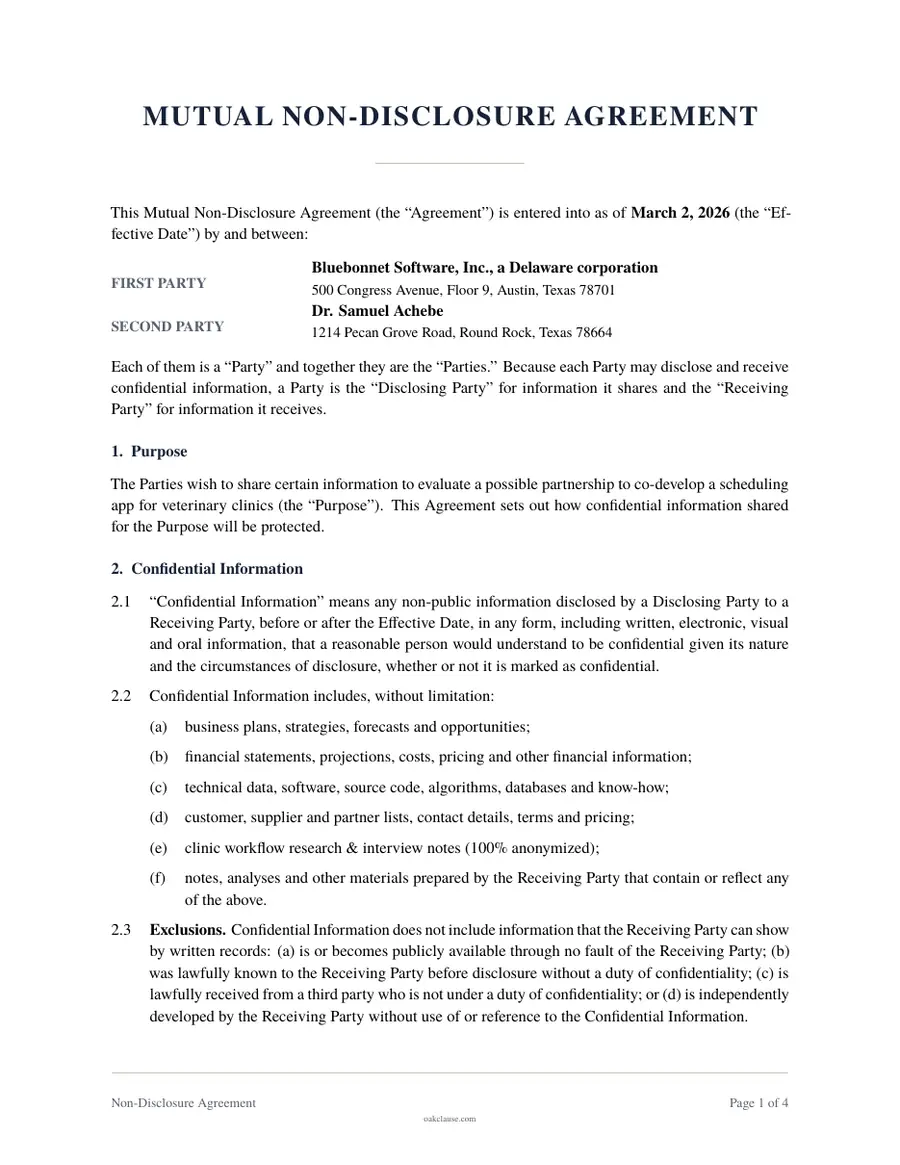
What is a Non-Disclosure Agreement?
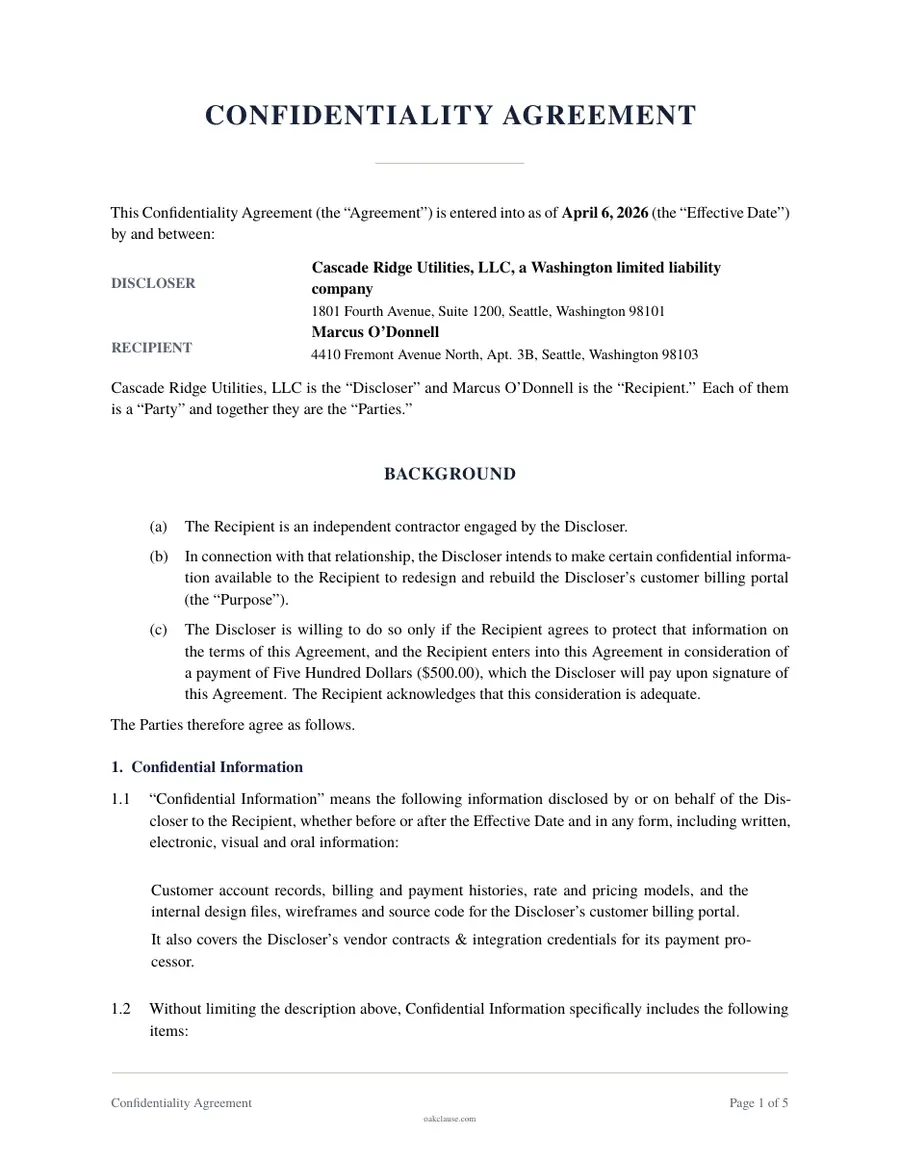
A non-disclosure agreement, often called an NDA or confidentiality agreement, is a contract in which one or both parties promise to keep certain information private and to use it only for an agreed purpose.
NDAs come in two main forms. In a one-way (unilateral) NDA, only one party shares confidential information, for example a company disclosing plans to a contractor. In a mutual NDA, both parties expect to share sensitive information, such as two businesses exploring a partnership, and both take on the same obligations.
A well-drafted NDA defines what counts as confidential, lists the usual exceptions (such as information that is already public), sets how long the duty of confidentiality lasts, and explains what happens to the information when the relationship ends. It also preserves the disclosing party's ability to ask a court to stop a breach quickly.
When to use it
- You are pitching an idea, product or invention to a potential partner, manufacturer or investor.
- You are hiring an employee, contractor or consultant who will see internal business information.
- Two companies are exploring a merger, acquisition, joint venture or supply relationship.
- You are sharing customer lists, pricing, source code or financial records with an outside adviser.
- You want to remind someone in writing that information they already received must stay private.
What is included
- One-way or mutual structure, with the right roles for each party
- Purpose of the disclosure and permitted use
- Definition of confidential information with the categories you choose
- Standard exclusions, such as public or independently developed information
- Rules for sharing with employees and advisers on a need-to-know basis
- Compelled disclosure procedure and federal whistleblower immunity notice
- Return or destruction of materials, plus optional non-solicitation
- Term, survival period and indefinite protection for trade secrets
- Injunctive relief, dispute resolution and governing law
- Signature blocks for individuals or business signers
How to make your NDA
Answer the questions
Tell us about the parties and the terms you want. Most documents take about 5 to 20 minutes.
Review the preview
Check the draft as you go and change any answer. The document updates instantly.
Download, sign and keep a copy
Download a print-ready PDF, sign it with the other parties, and give everyone a copy.
Frequently asked questions
What is the difference between a one-way and a mutual NDA?
In a one-way NDA, only one party discloses confidential information and only the receiving party promises to protect it. In a mutual NDA, both parties share information and both take on the same confidentiality obligations. Choose mutual when information will flow in both directions.
Is an NDA the same as a confidentiality agreement?
The terms are used interchangeably. Some people use “confidentiality agreement” for a narrower agreement covering specific information, but legally both are contracts to keep information private.
How long should an NDA last?
Many NDAs protect information for two to five years after the relationship ends, which is long enough for most business information to lose its value. Trade secrets are different: they can be protected for as long as they remain secret, so this NDA lets you protect them indefinitely.
What information is not covered by an NDA?
Standard exclusions cover information that is already public through no fault of the recipient, that the recipient knew before the disclosure, that the recipient developed independently, or that the recipient received lawfully from someone else without a duty of confidentiality.
Can an NDA stop someone from reporting illegal activity?
No. Federal law protects people who report suspected legal violations to the government, and the Defend Trade Secrets Act provides immunity for certain confidential disclosures to government officials or attorneys. This NDA includes a notice of that immunity. Some states add further protections for discussing unlawful workplace conduct.
Does an NDA need to be notarized?
No. An NDA is valid when signed by the parties. Electronic signatures are generally acceptable for NDAs under federal and state e-signature laws.
What happens if someone breaks an NDA?
The disclosing party can sue for breach of contract and may recover damages for losses caused by the breach. Because damage from leaked information is hard to undo, NDAs usually let the disclosing party ask a court for an injunction to stop further disclosure quickly.
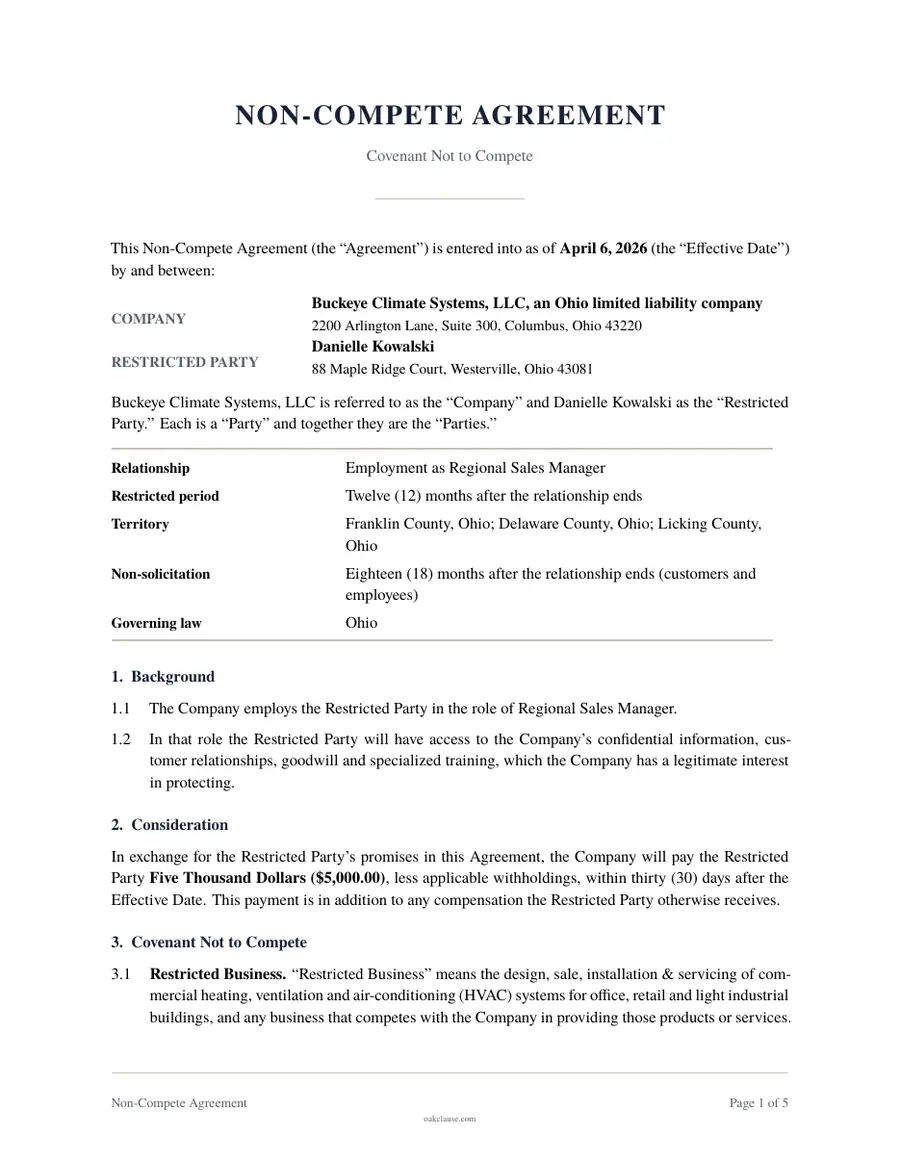
Should an employee sign an NDA or a non-compete?
They do different jobs. An NDA protects information; a non-compete restricts where someone can work after they leave. Non-competes are restricted or banned in some states, while NDAs are broadly enforceable, so many employers rely on an NDA alone.