California Vehicle Lease Agreement
Lease a car, truck, SUV or van to another person or business on clear written terms.
Includes 30 days of edits
- 5 to 20 minutes
- Print-ready PDF
- Tailored to California
Vehicle Lease rules in California
States regulate vehicles closely, and the points that most often differ are who must register and title the vehicle, how sales or use tax applies to lease payments, the minimum auto insurance every driver must carry, the steps a lessor must follow before repossessing a vehicle after a default, and any consumer-lease disclosures required when the lessor regularly leases vehicles as a business. This agreement uses the state you select for governing law and defers to that state's requirements on each of these points rather than stating fixed limits. Check with your state's motor vehicle agency about registration and tax before the vehicle changes hands.
When you create this document for California, the questionnaire uses California as the governing law and adds wording that defers to California requirements where they apply. Laws change, so confirm current rules with official California sources or a local attorney for anything critical.
What is a Vehicle Lease Agreement?
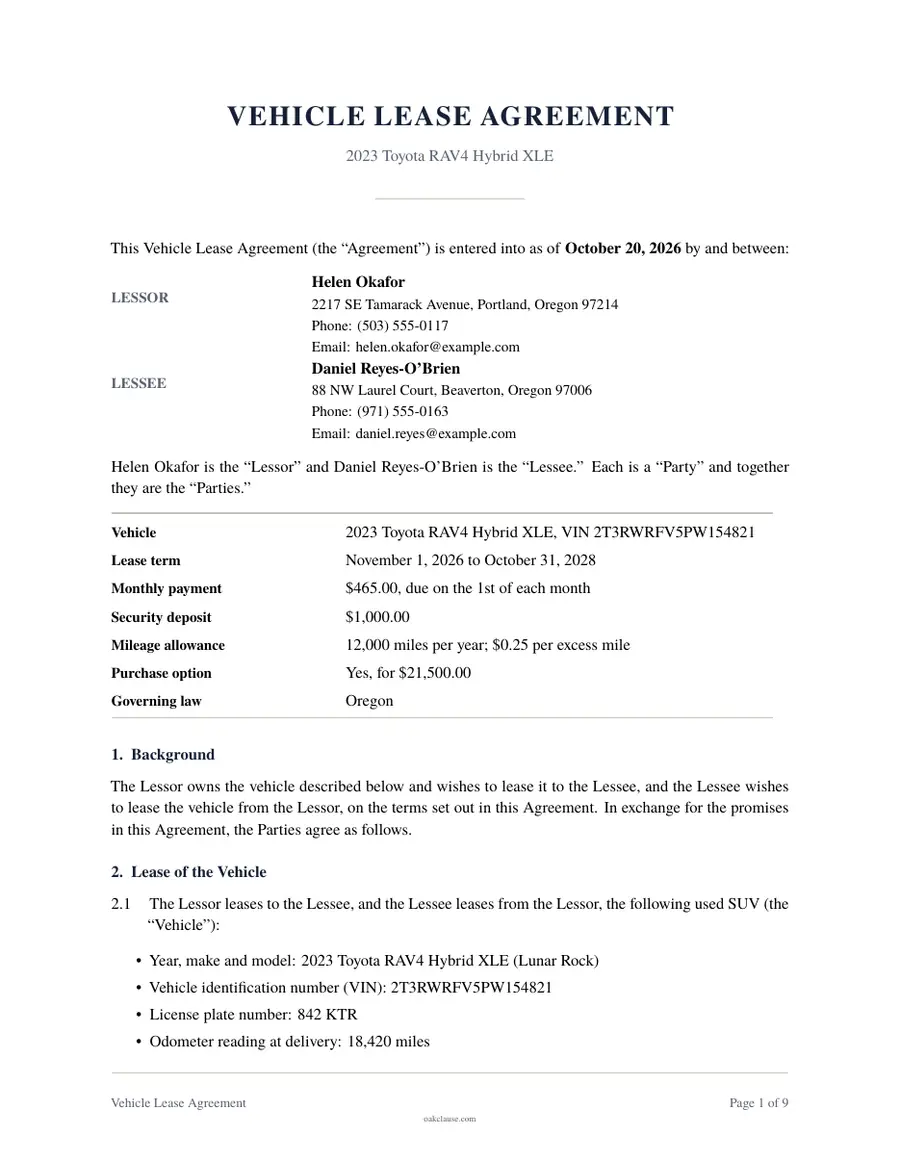
A vehicle lease agreement is a contract in which the owner of a vehicle (the lessor) lets another person or business (the lessee) use it for a set period in exchange for regular payments. The lessor keeps ownership of the vehicle the whole time, and the lessee returns it at the end of the term, or buys it if the agreement includes a purchase option.
Unlike a short rental, a lease usually runs for months or years, so the details matter: how many miles the lessee may drive, who pays for insurance and repairs, what counts as excess wear, and what happens if a payment is missed or the vehicle is damaged. Writing these points down at the start avoids most of the disputes that come up when the vehicle is handed back.
This agreement is designed for private and small-business leases, such as a family member leasing a car to a relative, a small company leasing a work truck to an employee, or an owner leasing a vehicle they no longer drive. It asks for the state whose law will govern and defers to that state's rules on registration, taxes, repossession and notices.
When to use it
- You own a car, truck, SUV or van and want to lease it to someone else for several months or longer.
- You are leasing a vehicle from a private owner and want the payment, mileage and condition terms in writing.
- A business is providing a vehicle to an owner, employee or contractor in exchange for monthly payments.
- You want to give the lessee the option to buy the vehicle at the end of the lease for an agreed price.
- You are replacing an informal arrangement with a family member or friend with a written agreement.
What is included
- Lessor, lessee and authorized additional drivers
- Vehicle description with VIN, plate and starting odometer reading
- Lease term, delivery and return details
- Monthly payment, amount due at signing and security deposit
- Annual mileage allowance and excess mileage charge
- Permitted use, travel limits and prohibited uses
- Insurance minimums, maintenance and repair responsibilities
- Accidents, tickets, tolls, default and early termination
- Optional purchase option at the end of the lease
- Governing law, signatures and optional notary acknowledgment
How to make your Vehicle Lease
Answer the questions
Tell us about the parties and the terms you want. Most documents take about 5 to 20 minutes.
Review the preview
Check the draft as you go and change any answer. The document updates instantly.
Download, sign and keep a copy
Download a print-ready PDF, sign it with the other parties, and give everyone a copy.
Vehicle Lease in another state
Back to the general vehicle lease page51 states shown
- ALAlabama
- AKAlaska
- AZArizona
- ARArkansas
- CACalifornia
- COColorado
- CTConnecticut
- DEDelaware
- DCDistrict of Columbia
- FLFlorida
- GAGeorgia
- HIHawaii
- IDIdaho
- ILIllinois
- INIndiana
- IAIowa
- KSKansas
- KYKentucky
- LALouisiana
- MEMaine
- MDMaryland
- MAMassachusetts
- MIMichigan
- MNMinnesota
- MSMississippi
- MOMissouri
- MTMontana
- NENebraska
- NVNevada
- NHNew Hampshire
- NJNew Jersey
- NMNew Mexico
- NYNew York
- NCNorth Carolina
- NDNorth Dakota
- OHOhio
- OKOklahoma
- OROregon
- PAPennsylvania
- RIRhode Island
- SCSouth Carolina
- SDSouth Dakota
- TNTennessee
- TXTexas
- UTUtah
- VTVermont
- VAVirginia
- WAWashington
- WVWest Virginia
- WIWisconsin
- WYWyoming
Frequently asked questions
What is the difference between leasing and renting a vehicle?
Renting usually covers a short period, such as a few days or weeks, with insurance and maintenance handled by the owner. A lease typically runs for many months or years, the lessee often handles insurance and routine maintenance, and the agreement sets a mileage allowance and return condition. For short, informal use, a rental agreement may fit better.
Who owns the vehicle during the lease?
The lessor does. The lessee has the right to use the vehicle under the agreement's terms but builds no ownership unless the agreement includes a purchase option and the lessee exercises it by paying the agreed price.
Who should insure a leased vehicle?
In most private leases the lessee buys insurance and names the lessor as an additional insured and loss payee, because the lessee is the one driving. Every state sets its own minimum liability coverage, and the parties can agree on higher limits. This agreement lets you set the minimum coverage the lessee must carry.
How do mileage limits work?
The agreement sets a number of miles the lessee may drive each year. When the vehicle is returned, the odometer reading is compared with the starting reading, and any miles above the allowance for the time the lessee had the vehicle are charged at the per-mile rate you choose.
Can the lessee end the lease early?
Only if the agreement allows it. You can choose to prohibit early termination, allow it with written notice, or allow it with notice and an early termination fee. Without an early termination clause, the lessee generally remains responsible for the payments through the end of the term.
What happens if the lessee stops making payments?
Missing payments is a default. The lessor can end the lease and take the vehicle back, but repossession and any claim for remaining amounts must follow the procedures and notices required by state law. Some states restrict how and when a vehicle may be repossessed, so check your state's rules first.
Does a vehicle lease agreement need to be notarized?
A private vehicle lease is generally valid without notarization. Some parties choose to notarize it for extra proof of signatures, and a motor vehicle agency or lender may ask for notarized paperwork in certain situations. This agreement includes an optional notary acknowledgment.
Do I need to register the vehicle in the lessee's name?
Usually the vehicle stays titled in the lessor's name because the lessor still owns it. Registration rules vary by state, and some states allow or require the lessee to be listed as the registered user. Check with the motor vehicle agency in the state where the vehicle will be kept.
Can the lessee buy the vehicle at the end of the lease?
Yes, if you include a purchase option. You set the price and whether the option can be used only at the end of the term or at any time during the lease. The sale is then completed with a bill of sale and a title transfer under state law.
More California documents
Other documents people prepare for California, each with the state’s rules where we have checked them.
All California documents and rules