Trademark Assignment
Transfer ownership of a brand name, logo or slogan to a new owner in writing, together with the goodwill behind it, in a form ready to record with the USPTO.
Includes 30 days of edits
- 5 to 20 minutes
- Print-ready PDF
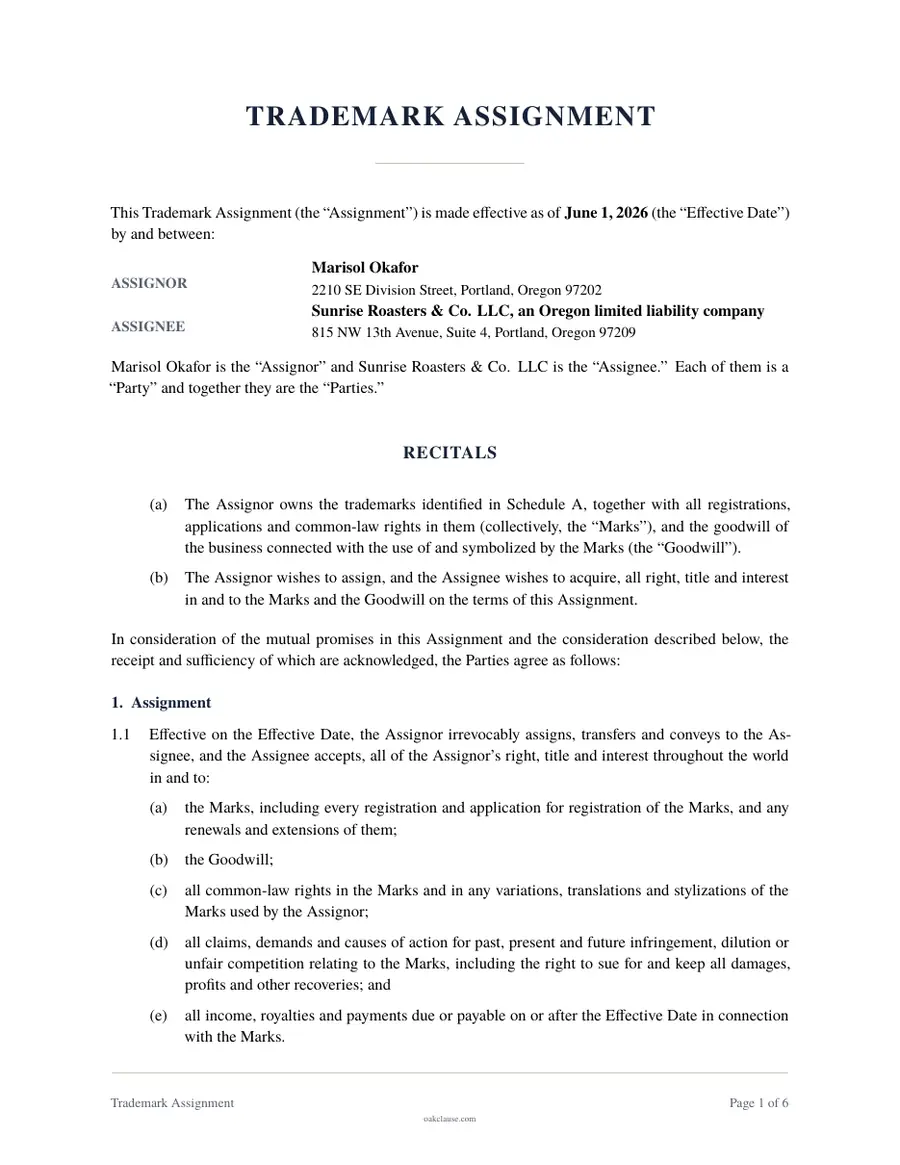
What is a Trademark Assignment?
A trademark assignment is a written agreement in which the current owner of a trademark (the assignor) transfers all of its ownership rights in the mark to a new owner (the assignee). The mark can be a word, a logo, a slogan or a combination, and it can be federally registered, the subject of a pending application, registered with a state, or used only under common-law rights.
Trademarks are different from most property because they identify the source of goods or services. For that reason, a trademark is normally transferred together with the goodwill of the business it represents. An assignment that tries to transfer the bare mark without its goodwill risks being treated as invalid, so this document expressly conveys the goodwill along with the marks.
Once signed, the assignment is the new owner's proof of title. For federally registered marks and pending applications, the assignee can record the assignment with the United States Patent and Trademark Office so that the public record shows the new owner. The document also covers payment, warranties about the marks, any existing licenses, cooperation with filings and signature formalities.
When to use it
- You are selling a business, or a product line, and the buyer needs to own the brand that goes with it.
- A founder registered a trademark personally and wants to move it into the company that actually uses it.
- Companies within the same group are reorganizing which entity holds the brand portfolio.
- You are buying a brand name or logo from another business and want clear, recordable proof of ownership.
- A trademark application is pending and ownership needs to move to the business that will use the mark.
What is included
- Identification of each mark, its status and the goods or services it covers
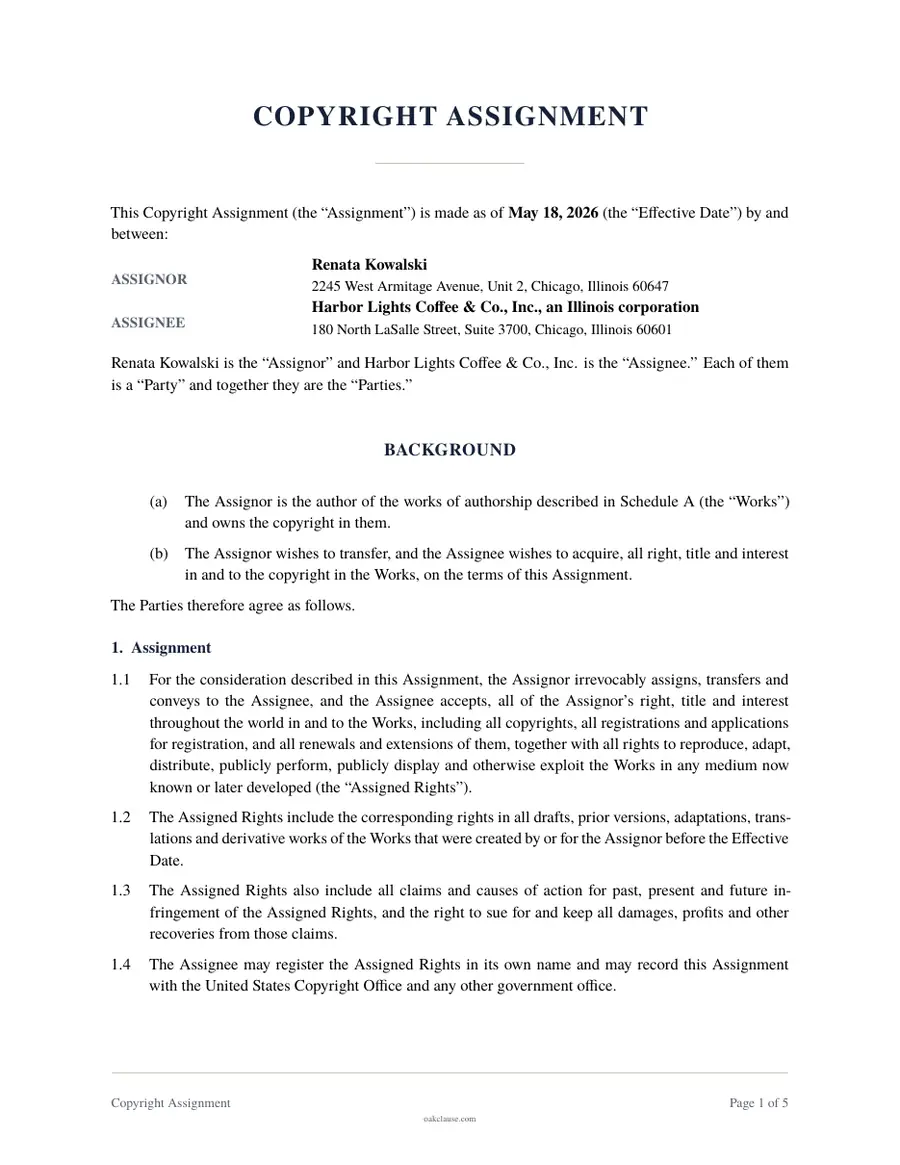
- Assignment of the marks together with the associated goodwill
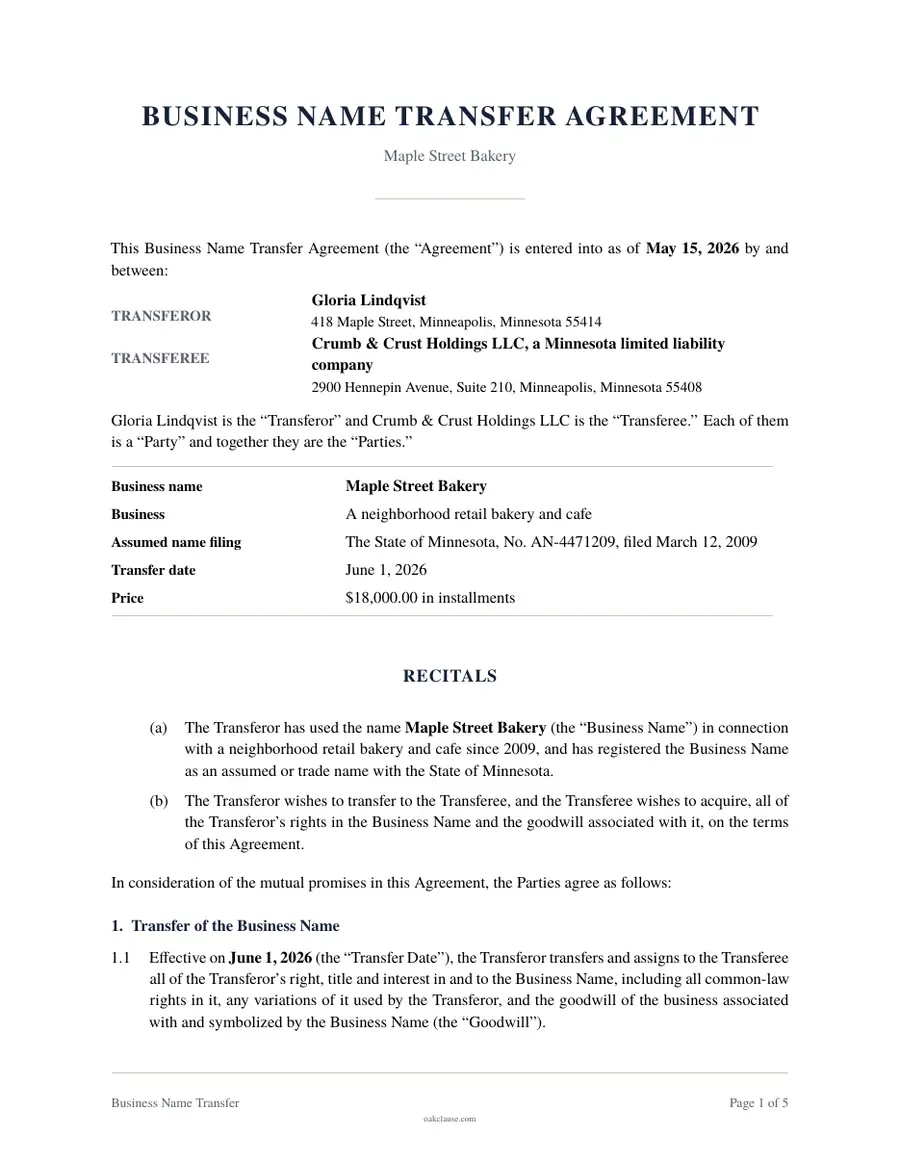
- Optional transfer of related domain names, social media accounts and logo artwork
- Right to sue for past infringement
- Purchase price and payment terms, or reference to a larger transaction
- Assignor warranties backed by an indemnity, or an as-is transfer
- Disclosure and transfer of existing licenses
- Recordation with the USPTO, further assurances and an optional power of attorney
- Optional sell-off period for existing inventory
- Governing law, signatures and optional notary acknowledgment
How to make your Trademark Assignment
Answer the questions
Tell us about the parties and the terms you want. Most documents take about 5 to 20 minutes.
Review the preview
Check the draft as you go and change any answer. The document updates instantly.
Download, sign and keep a copy
Download a print-ready PDF, sign it with the other parties, and give everyone a copy.
Frequently asked questions
What is the difference between a trademark assignment and a trademark license?
An assignment permanently transfers ownership of the mark to the new owner. A license lets someone use the mark while the original owner keeps ownership and control over quality. If you want to keep the brand but allow someone else to use it, a licensing agreement is the better fit.
Why does a trademark assignment include goodwill?
A trademark stands for the reputation and source of a business's goods or services. US courts have long held that a mark should be transferred together with the goodwill it symbolizes. An assignment of the mark alone, without goodwill, is often called an assignment in gross and may be challenged as invalid.
Do I have to record a trademark assignment with the USPTO?
Recording is not what makes the assignment valid between the parties; signing does that. However, recording a federally registered mark or pending application with the USPTO puts the public on notice of the new owner and helps protect the assignee against later conflicting transfers. Recording can be done online through the USPTO.
Can I assign a trademark application that has not registered yet?
Generally yes. One important exception is an application filed on an intent-to-use basis: federal law restricts assigning it before use of the mark has been shown to the USPTO, unless the assignment goes to a successor of the applicant's business, or the part of the business the mark relates to. This document includes language for that situation, but an attorney should review intent-to-use transfers.
Does a trademark assignment need to be notarized?
Notarization is not usually required for the assignment to be valid or to record it with the USPTO. Many parties still have the assignor's signature notarized because an acknowledged assignment is easier to prove later. You can choose whether to add a notary acknowledgment.
Can I transfer an unregistered trademark?
Yes. Common-law trademark rights arise from actually using a mark in business and can be transferred together with the related goodwill. There is nothing to record with the USPTO for an unregistered mark, so the signed assignment itself is the key proof of the transfer.
What happens to existing licenses when a trademark is assigned?
Licenses do not simply disappear when ownership changes. This document lets the assignor disclose any existing licenses and transfers the licensor's rights under them to the assignee, so the new owner steps into the assignor's position and collects any future royalties.
Should domain names and social media accounts be transferred too?
Often they should, because customers find the brand through them. Domain names and social media handles are not trademarks, so they are listed separately. Transfer of an account is also subject to the terms of the registrar or platform.