SWOT Analysis
Take an honest look at your business by mapping its strengths, weaknesses, opportunities and threats, then turn what you find into a short list of strategies and next steps.
Includes 30 days of edits
- 5 to 20 minutes
- Print-ready PDF
What is a SWOT Analysis?
A SWOT analysis is a simple planning framework that sorts the factors affecting a business, product or project into four groups. Strengths and weaknesses are internal: things you control, such as your team, your costs or your reputation. Opportunities and threats are external: conditions in the market, the economy, technology or regulation that you cannot control but can prepare for.
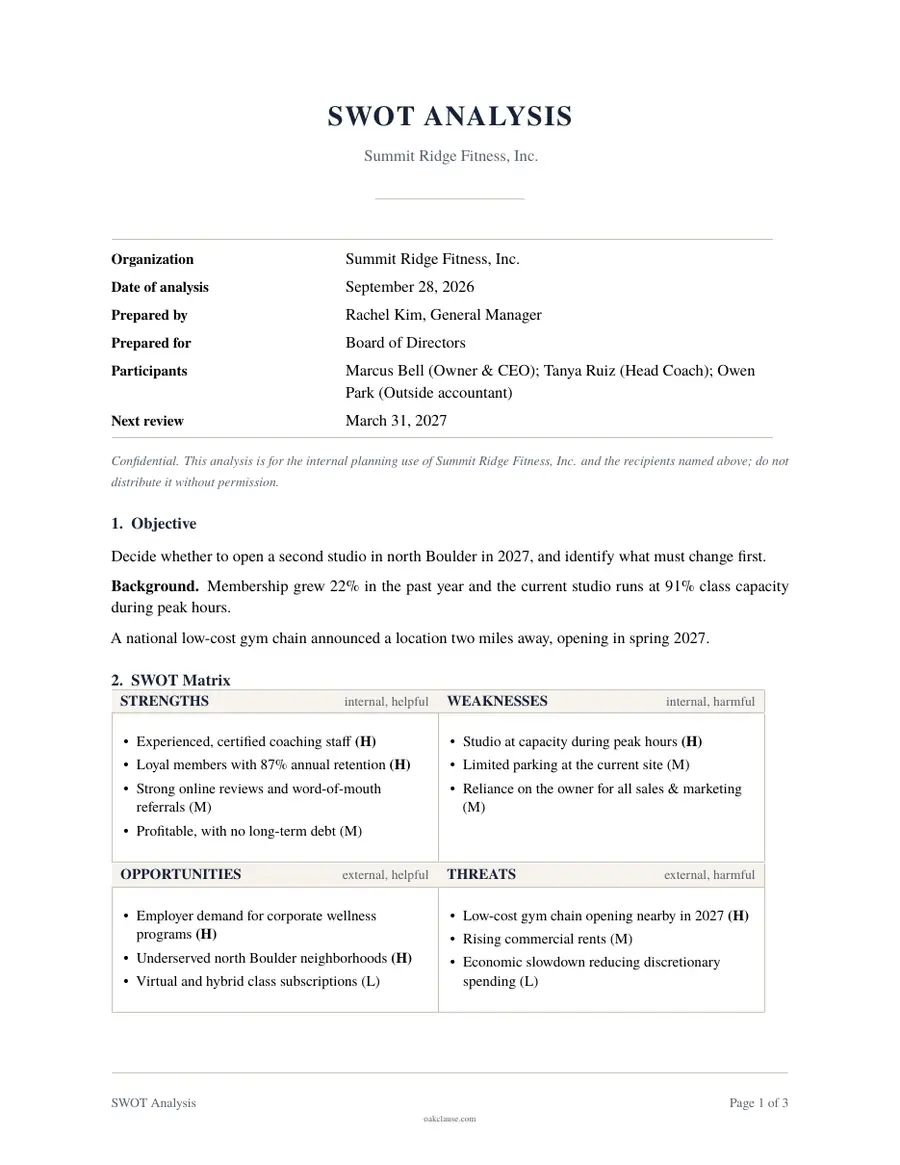
Laying the four groups out side by side in a grid makes patterns easy to spot. A strength may let you seize an opportunity, while a weakness may leave you exposed to a particular threat. Rating each factor by impact helps you focus on what matters most rather than treating every item equally.
This template produces a clean SWOT matrix, a detailed list of each factor with your supporting evidence, an optional strategy section that pairs the quadrants together, and an action plan with owners and deadlines so the analysis leads to real decisions.
When to use it
- You are writing a business plan and need to show lenders or investors you understand your position.
- You are deciding whether to launch a new product, enter a new market or open a new location.
- You are holding an annual strategy or planning session with your team or board.
- A new competitor, regulation or economic change is affecting your business and you need to respond.
- You are evaluating a department, project or nonprofit program to decide where to invest next.
What is included
- Subject, objective and context of the analysis
- Four-quadrant SWOT matrix
- Impact rating for every factor
- Supporting details and evidence for each factor
- Optional strategy pairings (strengths with opportunities, and more)
- Prioritized action plan with owners and due dates
- Participants and next review date
How to make your SWOT Analysis
Answer the questions
Tell us about the parties and the terms you want. Most documents take about 5 to 20 minutes.
Review the preview
Check the draft as you go and change any answer. The document updates instantly.
Download, sign and keep a copy
Download a print-ready PDF, sign it with the other parties, and give everyone a copy.
Frequently asked questions
What does SWOT stand for?
SWOT stands for strengths, weaknesses, opportunities and threats. Strengths and weaknesses describe the inside of your organization, while opportunities and threats describe the outside environment in which it operates.
What is the difference between a weakness and a threat?
A weakness is internal and within your control, such as limited cash, an outdated website or reliance on one key employee. A threat is external, such as a new competitor, rising supplier prices or a change in regulations. The same issue can sometimes be framed either way, so focus on whether you can directly change it.
How many items should each quadrant have?
There is no fixed rule, but three to seven items per quadrant is usually enough to be useful without becoming a long, unfocused list. If you have many items, rate their impact and concentrate on the high-impact ones.
Who should take part in a SWOT analysis?
Including people from different parts of the business, such as owners, managers, front-line staff and sometimes trusted customers or advisers, gives a more balanced picture. People close to customers often see opportunities and threats that leadership misses.
What are SO, WO, ST and WT strategies?
They are ways of combining the quadrants, sometimes called a TOWS matrix. SO strategies use strengths to capture opportunities, WO strategies fix weaknesses to pursue opportunities, ST strategies use strengths to defend against threats, and WT strategies reduce weaknesses to avoid threats.
How often should I do a SWOT analysis?
Many businesses repeat it once a year as part of annual planning, and again whenever there is a major change such as a new competitor, a funding round, an acquisition or an economic shift. Setting a review date in the document helps keep it current.
Is a SWOT analysis a legal document?
No. It is a planning and decision-making tool, so it does not need to be signed, witnessed or notarized. If you share it outside the business, consider whether it contains sensitive information and mark it confidential if needed.