Business Proposal
Win the work with a clear, professional proposal that explains the client's problem, your solution, the price and the next steps, with an optional acceptance page the client can sign.
Includes 30 days of edits
- 5 to 20 minutes
- Print-ready PDF
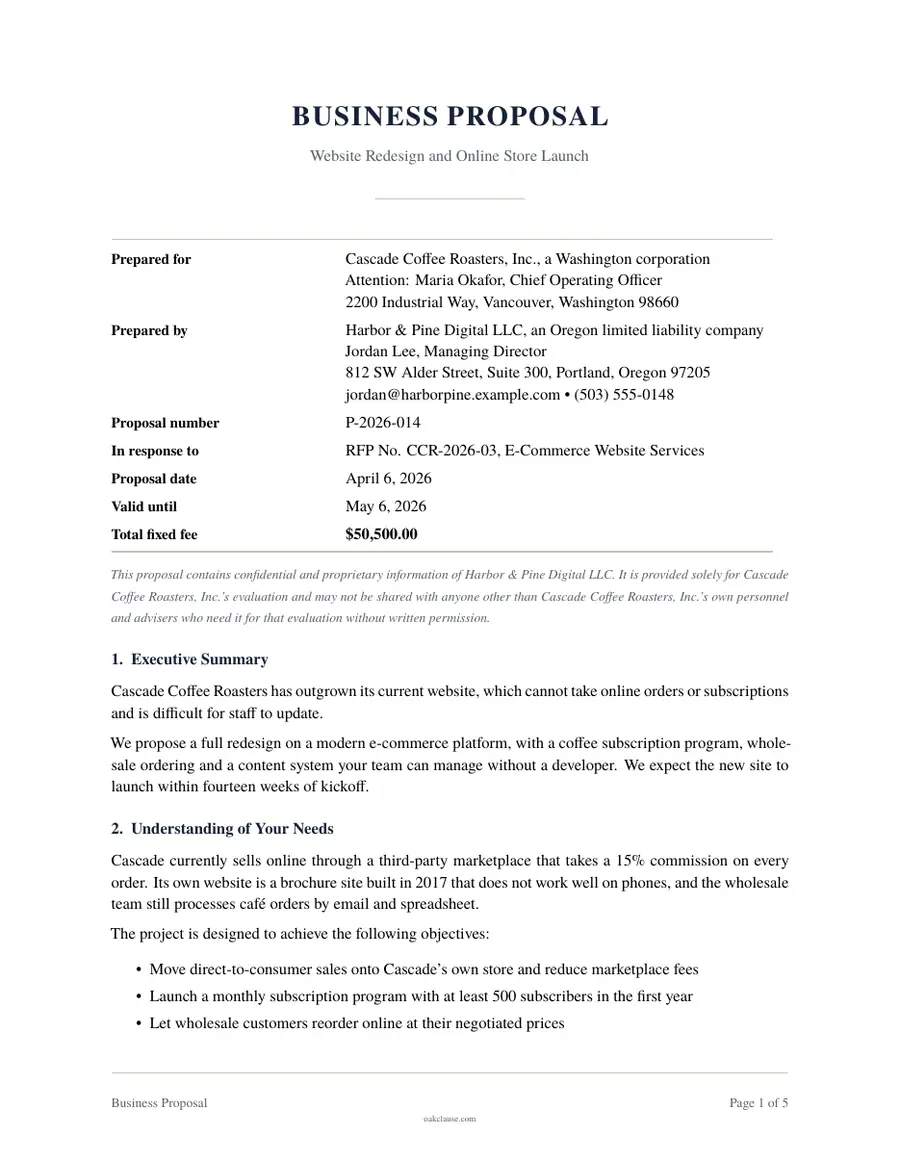
What is a Business Proposal?
A business proposal is a written offer from one business to a prospective client to provide specific products or services for a stated price. It is the document that turns an early conversation, or a request for proposal, into a concrete plan the client can evaluate, compare and approve.
A strong proposal is organized around the client rather than the seller. It restates the client's situation and goals, describes how you will meet them, lists exactly what will be delivered and when, explains why your team is qualified, and sets out the investment and payment terms in plain numbers. Being specific about what is and is not included prevents misunderstandings later.
Proposals are usually not contracts on their own, but they can become one. This template lets you choose whether a signed acceptance creates a binding agreement on the proposal's terms, or simply confirms that the client wants to move forward and that the parties will sign a separate service agreement.
When to use it
- A prospective client has asked you for a quote or a written plan before deciding to hire you.
- You are responding to a request for proposal (RFP) and need a structured, complete reply.
- You want to pitch a new project, product or service to an existing customer.
- You are a freelancer or agency who wants clients to approve scope and pricing in writing before work starts.
- You need a document a client can circulate internally to get budget approval.
What is included
- Cover details, proposal number and validity period
- Executive summary and the client's needs and objectives
- Proposed approach and solution
- Deliverables with optional due dates and project milestones
- Exclusions and client responsibilities
- Company background, relevant experience and project team
- Fixed-fee, hourly or retainer pricing with a cost table
- Payment schedule, taxes and expenses
- Terms of the proposal, including confidentiality
- Optional acceptance page with signature blocks
How to make your Business Proposal
Answer the questions
Tell us about the parties and the terms you want. Most documents take about 5 to 20 minutes.
Review the preview
Check the draft as you go and change any answer. The document updates instantly.
Download, sign and keep a copy
Download a print-ready PDF, sign it with the other parties, and give everyone a copy.
Frequently asked questions
What is the difference between a business proposal and a business plan?
A business plan describes your own company's strategy, market and finances, usually for investors or lenders. A business proposal is an offer to a specific client to do specific work for a specific price. The proposal is about the client's needs; the plan is about your business.
Is a business proposal legally binding?
On its own, a proposal is generally treated as an offer. If the client accepts it in a way the proposal allows, a contract can be formed on its terms. This template lets you choose whether a signed acceptance is binding or whether the parties will first sign a separate agreement.
How long should a proposal stay valid?
Many businesses keep proposals open for 30 to 90 days, depending on how quickly costs and availability change. A validity date protects you from a client accepting old pricing months later. You can set any date that suits your business.
What should I put in the executive summary?
Keep it to a few short paragraphs: the client's main problem or goal, your proposed solution, the key outcome they can expect and the total investment. Many decision makers read only this section, so it should stand on its own.
Should I include exclusions in my proposal?
Listing what is not included is one of the best ways to avoid scope disputes. If the client later asks for something excluded, you can treat it as a change and price it separately, rather than arguing about what the original price covered.
How do I price a proposal: fixed fee, hourly or retainer?
A fixed fee works when the scope is well defined and gives the client budget certainty. Hourly pricing suits work that is hard to estimate. A monthly retainer fits ongoing services. This template supports all three and calculates the total of itemized fees for you.
Can a proposal be signed electronically?
Yes. Federal and state electronic signature laws generally treat electronic signatures as valid for ordinary business agreements, so a client can accept your proposal by e-signature in most cases.
Do I still need a contract if the client signs the proposal?
For small or simple projects, a signed proposal with clear terms may be enough. For larger or higher-risk work, many businesses follow up with a full service agreement covering liability, intellectual property and termination. Consider having an attorney review significant engagements.