One-Page Business Plan
Sum up your business on a single page: the problem you solve, who you serve, how you make money and the goals you are working toward.
Includes 30 days of edits
- 5 to 20 minutes
- Print-ready PDF
What is an One-Page Business Plan?
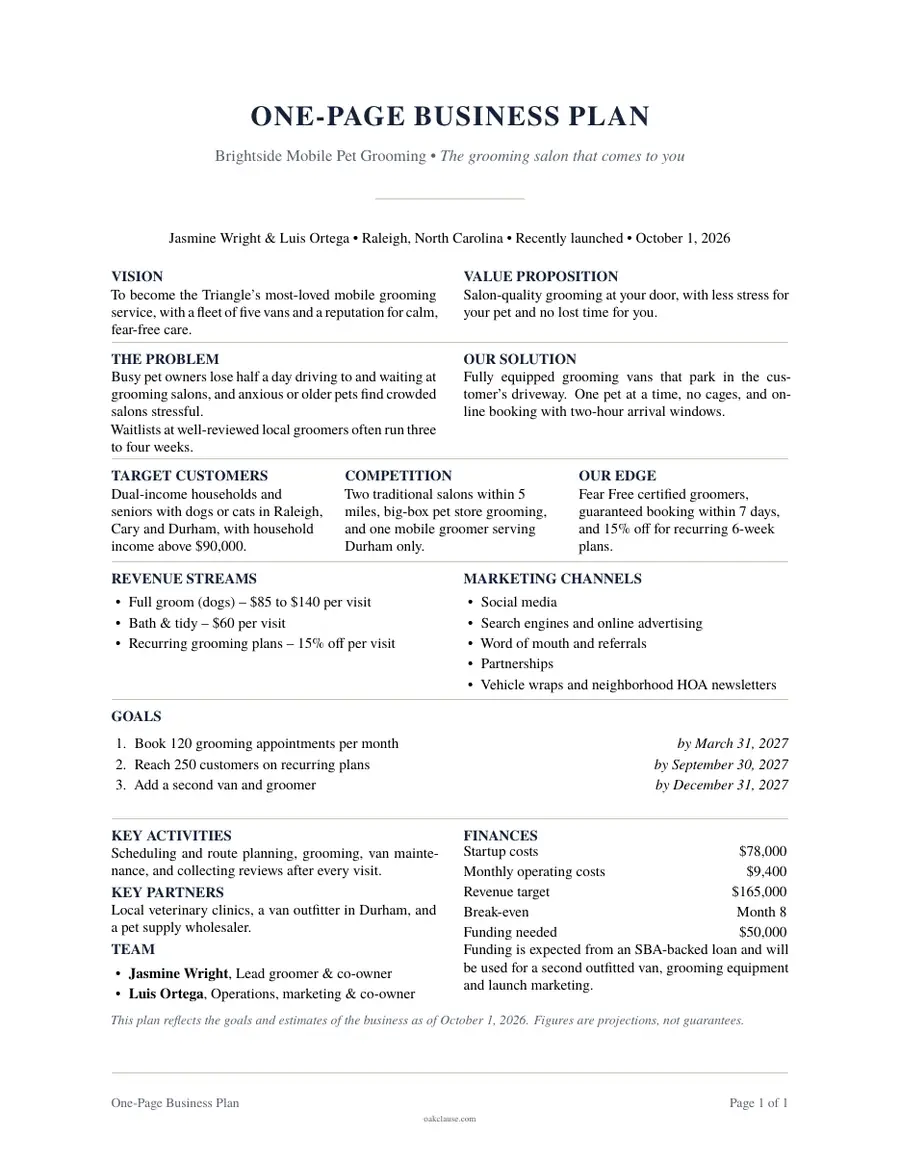
A one-page business plan is a condensed version of a traditional business plan. Instead of twenty or thirty pages of narrative, it uses short, focused answers to capture the essentials of a business: the customer problem, your solution, the target market, the revenue model, the key goals and the money needed to get there.
Because it is short, a one-page plan is easy to write, easy to share and easy to update. Founders use it to test an idea before investing in a full plan, to brief a co-founder, mentor or adviser, or as a handout at a meeting with a potential partner or lender. Many established businesses use one as a yearly planning snapshot that the whole team can keep in view.
This template walks you through each building block with guided questions and lays your answers out in a clean, scannable format. The length limits on each answer are deliberate: they help you keep the plan to roughly one page and force you to say what matters most.
When to use it
- You have a new business idea and want to see whether the pieces fit together before going further.
- You need a quick summary to share with a mentor, adviser, co-founder or potential partner.
- You are preparing for a pitch meeting or networking event and want a concise leave-behind.
- You want a yearly snapshot of goals and priorities for your existing business and your team.
- You plan to write a full business plan later and want an outline to build from.
What is included
- Business name, owner, location and stage
- Vision statement and tagline
- Customer problem and your solution
- Value proposition and competitive edge
- Target customers and competition
- Revenue streams and pricing
- Marketing channels
- Measurable goals with target dates
- Key activities, partners and team
- Startup costs, revenue target and funding needs
How to make your One-Page Business Plan
Answer the questions
Tell us about the parties and the terms you want. Most documents take about 5 to 20 minutes.
Review the preview
Check the draft as you go and change any answer. The document updates instantly.
Download, sign and keep a copy
Download a print-ready PDF, sign it with the other parties, and give everyone a copy.
Frequently asked questions
What is the difference between a one-page plan and a full business plan?
A full business plan explains every part of the business in detail and usually includes extensive financial projections, which lenders and investors often expect. A one-page plan covers the same core questions in a few sentences each. It is faster to prepare and easier to read, but it is usually not enough on its own for a loan application or a formal investment round.
Can I use a one-page business plan to get a loan?
It can be a helpful introduction, but most lenders want more detail, such as financial statements, cash flow projections and a description of collateral. Ask your lender what it requires. You can use your one-page plan as the starting point for a full business plan.
What should I put in the problem and solution sections?
Describe the specific pain point or unmet need your customers have, in their terms, and then explain how your product or service addresses it. The clearer the link between the two, the more convincing the plan will be to anyone who reads it.
How do I write good goals for my plan?
Effective goals are specific and measurable and have a deadline, for example reaching 200 paying customers by June 30 rather than simply growing sales. Limit yourself to a handful of goals so the plan stays focused on what matters most.
Does a one-page business plan need to be signed?
No. A business plan is a planning tool, not a contract, so it does not need signatures, witnesses or notarization. Still, keep the information accurate, especially if you share the plan with potential investors.
What if my answers do not fit on one page?
The question limits are set to keep most plans close to a single page. If your plan runs a little long, try tightening your wording and focusing on the most important points. If you truly need more room, a full business plan may be the better format.
How often should I update a one-page plan?
Because it is so short, many owners revisit it every quarter or at least once a year, and whenever a major assumption changes, such as pricing, the target customer or the funding situation. Dating each version makes it easy to track how the business has evolved.