Risk Management Plan
Identify what could go wrong in your business or project, score each risk by likelihood and impact, and set out who will do what to prevent it or respond if it happens.
Includes 30 days of edits
- 5 to 20 minutes
- Print-ready PDF
What is a Risk Management Plan?
A risk management plan is a written framework for finding, assessing and controlling the risks that could disrupt a business, a project or a single location. It turns vague worries into a structured register: each risk is described, scored for how likely it is and how badly it would hurt, assigned an owner and paired with specific actions.
Most plans follow the same cycle. First, risks are identified across categories such as operations, finances, technology, safety, compliance and reputation. Each risk is then rated, usually by multiplying likelihood by impact, so that the most serious ones rise to the top. Finally, the organization chooses a response for each risk (avoid it, reduce it, transfer it through insurance or contracts, or accept it) and commits to monitoring it over time.
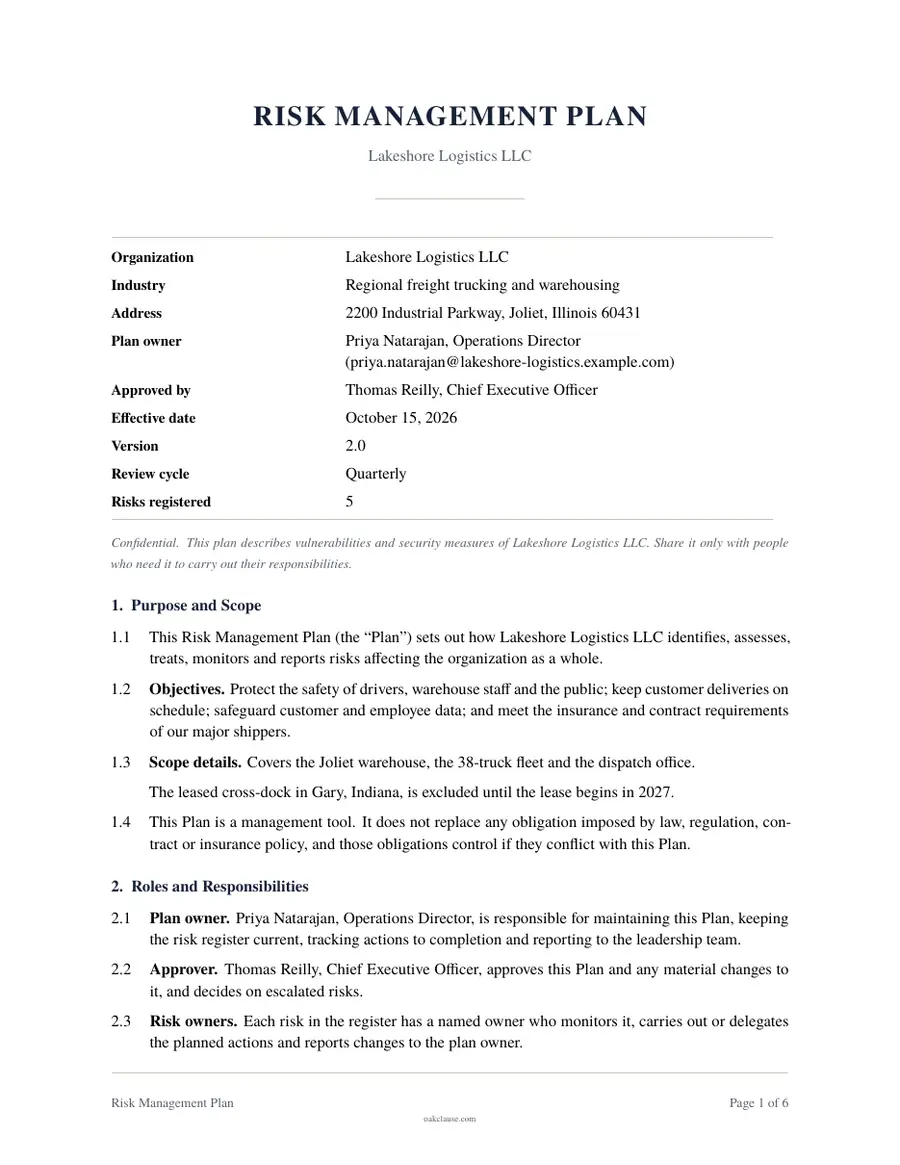
This template builds a complete plan with defined roles, a clear five-point scoring method, a color-coded heat map, a risk register, detailed treatment plans, insurance coverage, incident reporting, business continuity notes and a review schedule, followed by approval signatures.
When to use it
- You are launching a new business, product, location or major project and want to plan for setbacks.
- A lender, investor, insurer, landlord or major customer has asked how you manage risk.
- You are preparing for an insurance renewal and want to show what controls you have in place.
- Your board or owners want a regular, documented review of the organization's key risks.
- You recently experienced an incident, such as a data breach, injury or supply disruption, and want to prevent a repeat.
What is included
- Purpose, scope and objectives
- Roles and responsibilities for managing risk
- Five-point likelihood and impact scales with scoring bands
- Risk appetite statement and categories considered
- Color-coded risk heat map
- Risk register with scores, ratings and owners
- Treatment plans with actions, contingencies and target dates
- Insurance and risk transfer summary
- Incident reporting, emergency contacts and continuity planning
- Monitoring, escalation, review schedule and approval signatures
How to make your Risk Management Plan
Answer the questions
Tell us about the parties and the terms you want. Most documents take about 5 to 20 minutes.
Review the preview
Check the draft as you go and change any answer. The document updates instantly.
Download, sign and keep a copy
Download a print-ready PDF, sign it with the other parties, and give everyone a copy.
Frequently asked questions
What is the difference between a risk assessment and a risk management plan?
A risk assessment is the step of identifying and rating risks. A risk management plan includes that assessment but goes further: it assigns owners, sets out how each risk will be treated, explains how incidents are reported and describes how the plan will be monitored and updated over time.
How is a risk score calculated?
This plan rates likelihood and impact on a scale of one to five and multiplies them, giving a score from 1 to 25. Scores are then grouped into low, medium, high and critical bands so you can see at a glance which risks need attention first. The bands are defined in the plan itself so every reader applies them the same way.
What are the four ways to respond to a risk?
You can avoid the risk by not doing the activity that causes it, reduce it by adding controls that lower its likelihood or impact, transfer it to someone else through insurance or contract terms, or accept it when the cost of acting outweighs the benefit. Many risks call for a combination of responses.
What is risk appetite?
Risk appetite is the amount of risk an organization is willing to take on in pursuit of its goals. A business with a low appetite will act on even moderate risks, while one with a higher appetite may accept more uncertainty in exchange for growth. Stating it in writing helps owners and managers make consistent decisions.
Who should own each risk?
Each risk should have one named person who is responsible for tracking it and making sure the planned actions happen, usually the manager closest to the activity involved. Shared ownership often means no ownership, so naming a single owner is generally more effective.
Does a risk management plan satisfy legal or insurance requirements?
Not automatically. Some industries have specific legal requirements for safety programs, data security or emergency plans, and insurers or contracts may impose their own conditions. A general plan is a strong foundation, but check the rules that apply to your industry and location, and consider speaking with an attorney, insurance broker or safety professional.
How often should a risk management plan be reviewed?
Many organizations review their plan quarterly or at least once a year, and immediately after a significant incident, a major change in operations or the start of a large project. The plan lets you set a review frequency so updates are built into your routine.
Should a small business have a risk management plan?
Small businesses are often more vulnerable to a single bad event, such as losing a key customer, a fire or a cyberattack, because they have fewer resources to absorb it. A short, practical plan focused on the handful of risks that matter most can make a real difference without much paperwork.