Workplace Incident Report
Capture the facts of a workplace accident, injury, illness or near miss while memories are fresh.
Includes 30 days of edits
- 5 to 20 minutes
- Print-ready PDF
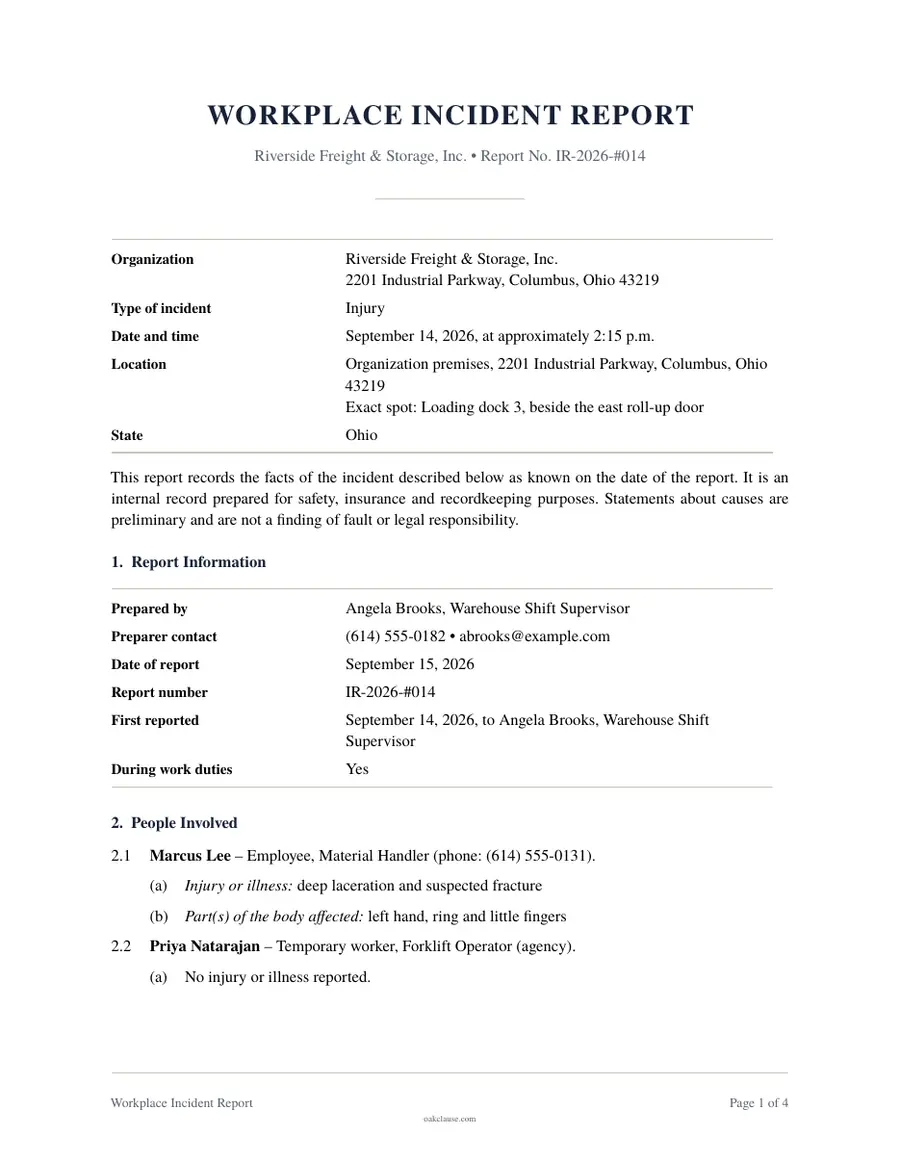
What is a Workplace Incident Report?
A workplace incident report is an internal record of an unplanned event at work, such as an injury, a work-related illness, a near miss, property damage, a vehicle accident or a security incident. It documents the who, what, when, where and how of the event in a consistent format.
A prompt, factual report helps a business respond properly: it supports workers' compensation and insurance claims, helps decide whether the event must be recorded or reported to safety regulators, and gives managers the information they need to fix the underlying hazard so it does not happen again.
This report is organized like the forms safety professionals use. It records the people involved and any injuries, a narrative of what happened and why, first aid and medical treatment, witnesses and their accounts, immediate and corrective actions, and who has been notified, with signature lines for the person preparing the report and the reviewing supervisor.
When to use it
- An employee, contractor or visitor was injured or became ill at work.
- Something almost caused an injury, and you want to record the near miss before it becomes an accident.
- Equipment, a vehicle or property was damaged during work activities.
- A security, violence or harassment-related event happened on the premises and facts need to be recorded.
- Your insurer, workers' compensation carrier or safety program requires written documentation of incidents.
What is included
- Report details, organization and preparer information
- Type, date, time and exact location of the incident
- People involved, their roles and any injuries
- Factual description, activity before the incident and contributing causes
- First aid, medical treatment and time away from work
- Witness list with summaries of their accounts
- Property damage, equipment and protective gear involved
- Immediate actions and corrective action plan with owners and due dates
- Notification log and list of attached evidence
- Signature lines for preparer, supervisor and involved persons
How to make your Incident Report
Answer the questions
Tell us about the parties and the terms you want. Most documents take about 5 to 20 minutes.
Review the preview
Check the draft as you go and change any answer. The document updates instantly.
Download, sign and keep a copy
Download a print-ready PDF, sign it with the other parties, and give everyone a copy.
Frequently asked questions
Who should fill out a workplace incident report?
Usually the supervisor of the area or the person responsible for safety prepares the report, with input from the injured person and any witnesses. The person preparing it should stick to facts they observed or were told, and note the source of each account.
How soon after an incident should a report be completed?
As soon as possible after anyone who needs care has received it, ideally the same day. Details fade quickly, and workers' compensation laws and insurance policies often set reporting deadlines. Check your state's rules and your insurance policy for exact time limits.
Is an incident report the same as the OSHA injury log?
No. An internal incident report is your own record of what happened. Employers covered by OSHA recordkeeping rules must separately decide whether an injury or illness is recordable and, if so, enter it on the required OSHA forms. A completed incident report makes that decision much easier.
When must an incident be reported to OSHA?
Under federal OSHA rules, employers must report a work-related fatality within 8 hours, and an in-patient hospitalization, amputation or loss of an eye within 24 hours. States with their own approved safety plans may have additional or different requirements.
Should near misses be reported?
Yes. A near miss is an event that could have caused injury or damage but did not. Recording near misses is one of the most effective ways to identify hazards before someone gets hurt, and this report has a dedicated incident type for them.
Should the report say who was at fault?
It is generally better to describe facts and contributing causes rather than assign blame. Workers' compensation is usually a no-fault system, and a report that focuses on what happened and how to prevent it is more useful and less likely to discourage future reporting.
How should medical information in the report be handled?
Information about injuries and treatment should be kept confidential, shared only with people who need it, and stored separately from general personnel files where the law requires. Limit medical details to what is needed to describe the injury.
Does the injured employee need to sign the report?
It is not required, but asking the involved person to review and sign the report confirms that their account is accurately recorded. They can note any disagreement instead of signing. This report includes optional signature lines for involved persons.