Software License Agreement
Set out exactly how a customer may install and use your software, what they pay, and what support, warranties and limits on liability apply.
Includes 30 days of edits
- 5 to 20 minutes
- Print-ready PDF
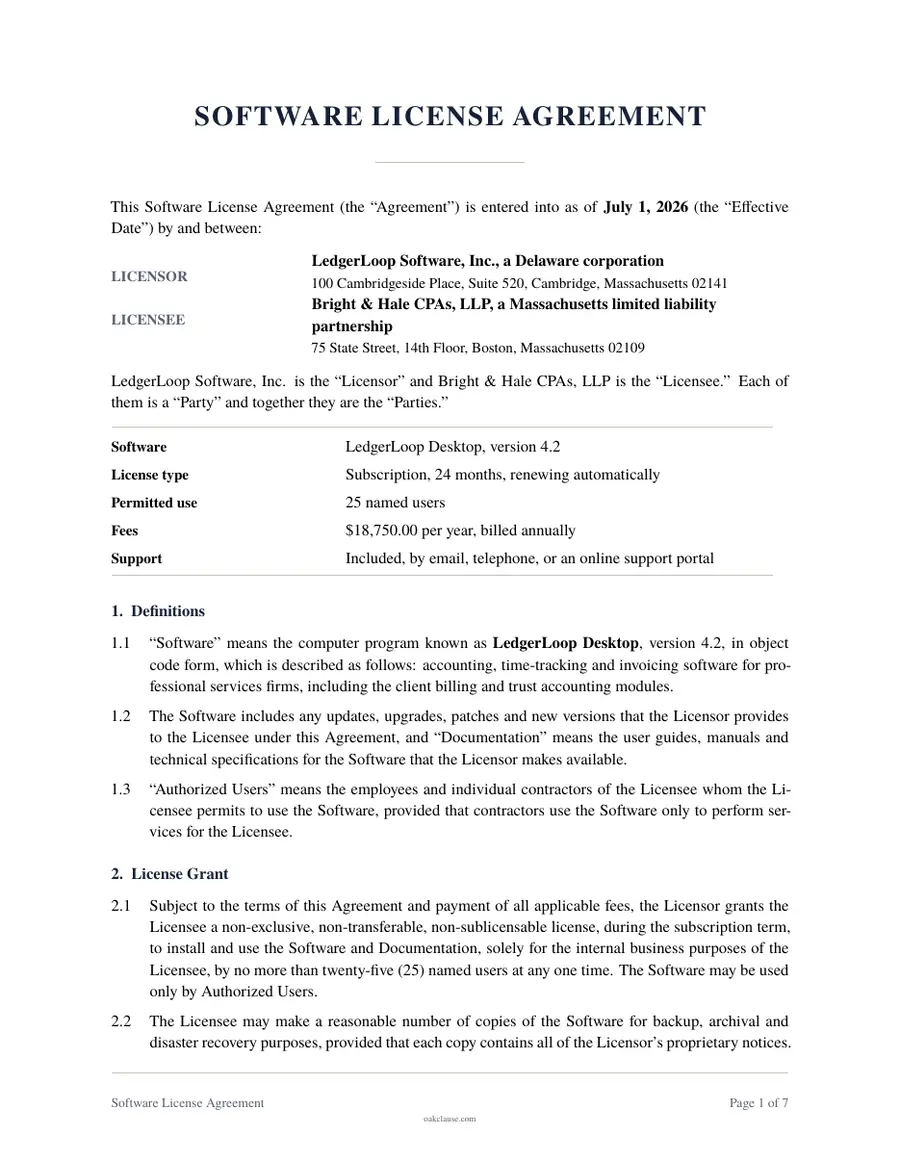
What is a Software License Agreement?
A software license agreement is a contract between the owner of a software program (the licensor) and a customer (the licensee) that grants permission to install and use the software on stated terms. The customer receives a right to use a copy, not ownership of the software itself, which stays with the licensor.
The agreement defines the scope of use, such as the number of users, devices or sites, whether the license is perpetual or for a subscription term, and what the customer may not do, like copying, reverse engineering or reselling the software. It also covers the business terms: license and subscription fees, maintenance and support, updates, and what happens when the agreement ends.
Because software can fail or be accused of infringing someone else's rights, a good license also allocates risk. It typically includes a limited performance warranty, a disclaimer of other warranties, a cap on each party's liability and a promise by the licensor to defend the customer against infringement claims. This template is designed for negotiated business licenses of installed software, rather than click-through terms for consumer apps.
When to use it
- You develop software and are selling licenses to a business customer for installation on its own systems.
- You want to license a desktop application, plug-in, on-premises server product or developer tool.
- A customer has asked for a signed license with defined user counts, support terms and liability limits.
- You are moving from informal permission to a written license that protects your code and income.
- You are buying software and want to put the vendor's promises on support and warranties in writing.
What is included
- Description of the software, version and delivery method
- Perpetual or subscription license with user, device or site limits
- Restrictions on copying, reverse engineering and transfer
- One-time or recurring fees, payment terms and taxes
- Optional maintenance, support and updates
- Limited warranty, disclaimer and liability cap you choose
- Intellectual property indemnity and optional source code escrow
- License compliance audits and confidentiality
- Term, termination, export control and government end-user terms
- Governing law, dispute resolution and signature blocks
How to make your Software License
Answer the questions
Tell us about the parties and the terms you want. Most documents take about 5 to 20 minutes.
Review the preview
Check the draft as you go and change any answer. The document updates instantly.
Download, sign and keep a copy
Download a print-ready PDF, sign it with the other parties, and give everyone a copy.
Frequently asked questions
What is the difference between a software license agreement and an EULA?
An end-user license agreement (EULA) is usually a standard set of terms accepted by clicking or opening the software, mainly for consumers. A software license agreement is often negotiated and signed by a business customer, with specific user counts, fees, support levels and liability terms.
Should I offer a perpetual license or a subscription?
A perpetual license lets the customer use a version of the software indefinitely after a one-time fee, often with separate annual maintenance for updates and support. A subscription gives the right to use the software only while fees are paid. Many vendors now prefer subscriptions for predictable revenue, but the choice depends on your business model.
Can I stop customers from reverse engineering my software?
Licenses commonly prohibit reverse engineering, decompiling and disassembly, and courts generally enforce these terms. Some laws allow limited reverse engineering for interoperability, so the agreement prohibits it except to the extent applicable law expressly permits it.
What is source code escrow?
Source code escrow means the licensor deposits its source code with a neutral escrow agent, who releases it to the customer if certain events occur, such as the licensor going out of business or abandoning support. It protects customers who depend on the software for critical operations.
Why limit liability in a software license?
Software problems can cause losses far larger than the fees paid. A liability cap, together with an exclusion of indirect damages, keeps the risk proportionate. Caps often equal the fees paid over the previous twelve months, with exceptions for things like infringement indemnity and breach of confidentiality.
Is this suitable for software-as-a-service (SaaS)?
This agreement is written for software that the customer installs and runs on its own devices or servers. Hosted SaaS products usually need terms covering uptime, data hosting and security, so a service agreement or terms of service designed for SaaS may fit better.
Does the license agreement need to be signed by both parties?
For a negotiated business license, yes. Both parties sign, and electronic signatures are generally valid under federal and state e-signature laws. Consumer software often relies instead on click-to-accept terms.
Can the customer transfer the license to another company?
Under this agreement, the licensee cannot assign or transfer the license without the licensor's written consent, except that you may choose to let the licensee's affiliates use the software. This prevents licenses from being resold or shared outside the agreed scope.