IT Services Agreement
Agree on exactly what tech support, managed services or development work is covered, how fast problems get fixed and what it all costs.
Includes 30 days of edits
- 5 to 20 minutes
- Print-ready PDF
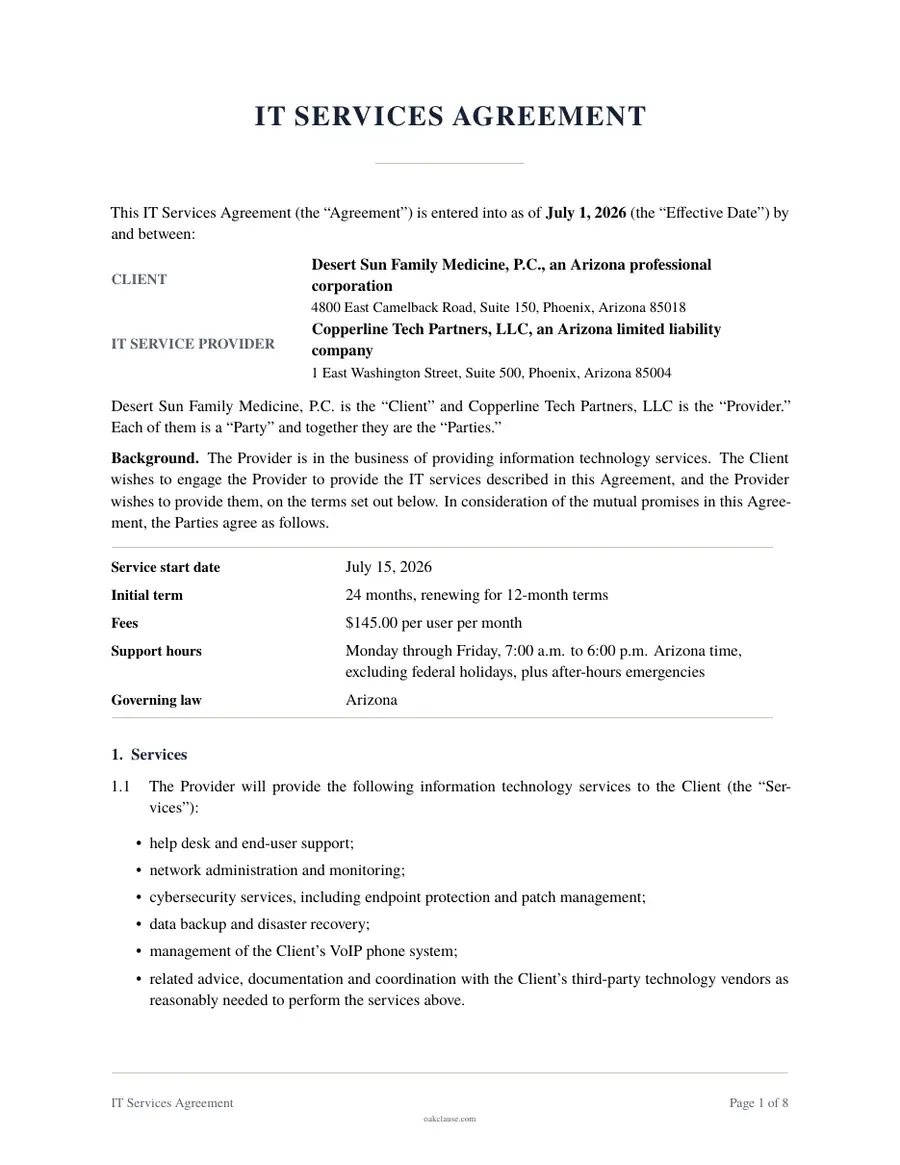
What is an IT Services Agreement?
An IT services agreement is a contract between a business or individual and a technology provider that supports, maintains or builds its computer systems. It is also called a computer services agreement, a managed services agreement or a tech support contract, depending on the kind of work involved.
IT relationships raise questions that ordinary service contracts do not answer. Which devices, users and applications are covered? How quickly must the provider respond to an outage, and what happens if it misses that target? Who is responsible for backups, and who owns the client's data and any custom code? This agreement answers those questions in plain terms.
The document also covers the commercial basics, such as flat monthly, per-user, per-device, hourly or project pricing, third-party software and hardware costs, the initial term and renewals, and help moving to a new provider if the relationship ends. Clear terms make it easier to hold a provider to its commitments and to plan an IT budget.
When to use it
- You are hiring a managed service provider to look after your company's computers, network and cloud accounts.
- You run an IT support business and want a standard agreement that sets your service levels and rates.
- You need a developer or IT firm to build, customize or integrate software for your business.
- You want guaranteed response times for urgent problems and a remedy if they are missed.
- You are switching IT providers and want written rules on data return and transition help.
What is included
- Selected service categories and the systems, users and sites covered
- Support hours, channels and on-site support
- Optional schedule of priority levels with response and resolution targets
- Uptime target with optional service credits
- Flat monthly, per-user, per-device, hourly or project pricing
- Third-party software and hardware cost handling
- Data ownership, security, backups and breach notification
- Ownership of custom software and configurations
- Initial term, renewal, termination and transition assistance
- Limitation of liability, insurance and governing law
How to make your IT Services
Answer the questions
Tell us about the parties and the terms you want. Most documents take about 5 to 20 minutes.
Review the preview
Check the draft as you go and change any answer. The document updates instantly.
Download, sign and keep a copy
Download a print-ready PDF, sign it with the other parties, and give everyone a copy.
Frequently asked questions
What is a service level agreement (SLA)?
An SLA is the part of an IT contract that sets measurable performance targets, such as how quickly the provider must respond to a support request at each priority level, or what percentage of the time a system must be available. This agreement lets you build a list of priority levels with response and resolution targets.
What are service credits?
Service credits are a discount on the next invoice when the provider misses an agreed target, such as an uptime commitment. They give the provider a financial incentive to meet its commitments without the need for a lawsuit. Agreements usually say that credits are the main remedy for missed targets, subject to termination rights for repeated failures.
Who owns the data stored on systems an IT provider manages?
The client should own its data. This agreement says so expressly, limits the provider to using the data only to perform the services, and requires the provider to return the data when the agreement ends.
What happens if there is a data breach?
This agreement requires the provider to keep reasonable security measures, notify the client within the time you choose after becoming aware of an actual or suspected security incident, and cooperate with the investigation. State breach notification laws decide who must be told and when, and those duties apply regardless of the contract.
Should I choose flat monthly or hourly pricing?
Flat monthly or per-user pricing gives predictable costs and encourages the provider to prevent problems. Hourly pricing can be cheaper for businesses that rarely need help but becomes expensive during busy periods. Many agreements combine a flat fee for routine support with an hourly rate for out-of-scope work, which this agreement supports.
Who owns custom software built under an IT services agreement?
It depends on the contract. This agreement lets you choose whether the client owns custom code once it is paid for, or whether the provider keeps ownership and gives the client a license. The provider's pre-existing tools and third-party software stay with their owners either way.
Do I need a separate agreement for health information?
Generally yes. Under federal HIPAA rules, a provider that handles protected health information for a covered entity usually must sign a business associate agreement. This agreement includes an option to require one.
What is transition assistance?
It is help from the outgoing provider in moving systems, passwords, documentation and data to the client or a new provider when the agreement ends. Without it, switching providers can be slow and risky. This agreement lets you require a period of transition assistance at the provider's normal rates.