Social Media Policy
Give your team clear, fair rules for social media.
Includes 30 days of edits
- 5 to 20 minutes
- Print-ready PDF
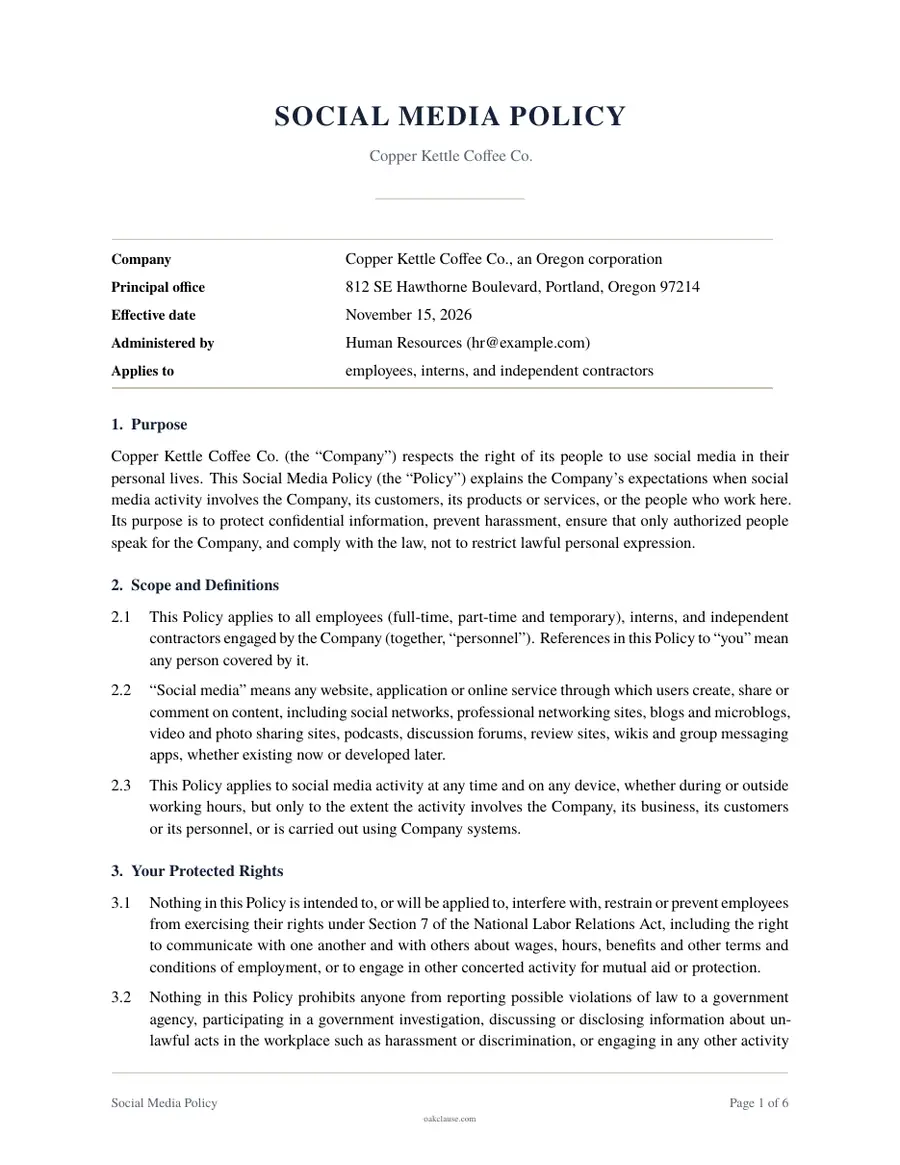
What is a Social Media Policy?
A social media policy is a written workplace policy that explains how employees may use social networks, blogs, forums, video platforms and messaging apps when their activity involves the employer, its customers, its products or their coworkers. It usually covers both personal accounts and any official accounts the company runs.
The goal is to protect the business from real risks, such as leaked confidential information, harassment of coworkers, misleading endorsements or someone speaking for the company without authority, without trying to control what employees do in their private lives. A good policy is specific about what is off-limits and explains why.
Social media policies must be drafted with care. Federal labor law protects most non-supervisory employees' right to discuss wages, hours and working conditions with each other, including online, and many states limit employer access to personal social media accounts or protect lawful off-duty conduct. This policy includes a clear statement that it will not be applied to interfere with those rights.
When to use it
- Your employees post about their work, your industry or your products on their own accounts.
- Staff members manage your company's official social media pages and you want clear ownership and approval rules.
- You want to prevent confidential, customer or patient information from being shared online.
- You run an influencer, referral or employee advocacy program and need endorsement disclosure rules.
- You are building or updating an employee handbook and need a modern social media section.
What is included
- Purpose, scope and covered platforms
- Statement of protected employee rights
- Rules for personal accounts, including personal-opinion disclaimers
- Use of social media during work time and on company devices
- Prohibited content, such as confidential information and harassment
- Endorsement and disclosure rules for posts about the company
- Official company accounts: authorization, approvals and credentials
- Media inquiries and crisis communications
- Monitoring, personal account privacy and reporting concerns
- Employee acknowledgment form
How to make your Social Media Policy
Answer the questions
Tell us about the parties and the terms you want. Most documents take about 5 to 20 minutes.
Review the preview
Check the draft as you go and change any answer. The document updates instantly.
Download, sign and keep a copy
Download a print-ready PDF, sign it with the other parties, and give everyone a copy.
Frequently asked questions
Can an employer discipline employees for what they post on social media?
Often yes, when a post reveals confidential information, harasses or threatens coworkers, or breaks other legitimate workplace rules. But employers generally cannot discipline employees for posts that discuss pay, hours or working conditions with coworkers, which federal labor law protects, and some states protect lawful off-duty conduct or political activity.
Can I ban employees from criticizing the company online?
A broad ban on negative comments about the company is risky, because it can discourage employees from discussing working conditions, which is protected activity for most employees. Policies are more defensible when they target specific harms, such as disclosing trade secrets, making threats or knowingly posting false statements.
Can an employer ask for an employee's social media password?
Many states prohibit employers from requesting usernames, passwords or other access to personal social media accounts, or from requiring employees to add a manager as a friend. This policy states that the company will not request access to personal accounts.
Do employees need to disclose that they work for the company when they promote it?
Yes, in most cases. The Federal Trade Commission expects people who endorse a product to disclose any material connection to the seller, and employment is such a connection. This policy requires employees to disclose their relationship whenever they promote company products or services.
Who owns the company's social media accounts?
The policy states that official accounts, their followers and their content belong to the company, and that login credentials must be stored with the company. This avoids disputes when an employee who managed an account leaves.
Does the policy apply to contractors and interns?
You choose who the policy covers. Many businesses apply it to employees, interns and contractors who have access to company information or manage company accounts. Contractors are usually bound through their contracts as well.
Should employees use a disclaimer when posting about work?
A short statement that the views are their own helps readers understand an employee is not speaking for the company. Requiring one on every post about the employer can discourage protected discussion of working conditions, so this policy either requires it only when employees promote company products or services or could reasonably be taken as speaking for the company, or simply recommends it.
Do employees have to sign the social media policy?
A signature is not usually required for the policy to apply, but a signed acknowledgment helps show that the employee received and read it. This document can include an acknowledgment page.