Employee Privacy Policy
Tell employees and applicants what personal information your business collects about them, why, who sees it, how long you keep it and how workplace monitoring works.
Includes 30 days of edits
- 5 to 20 minutes
- Print-ready PDF
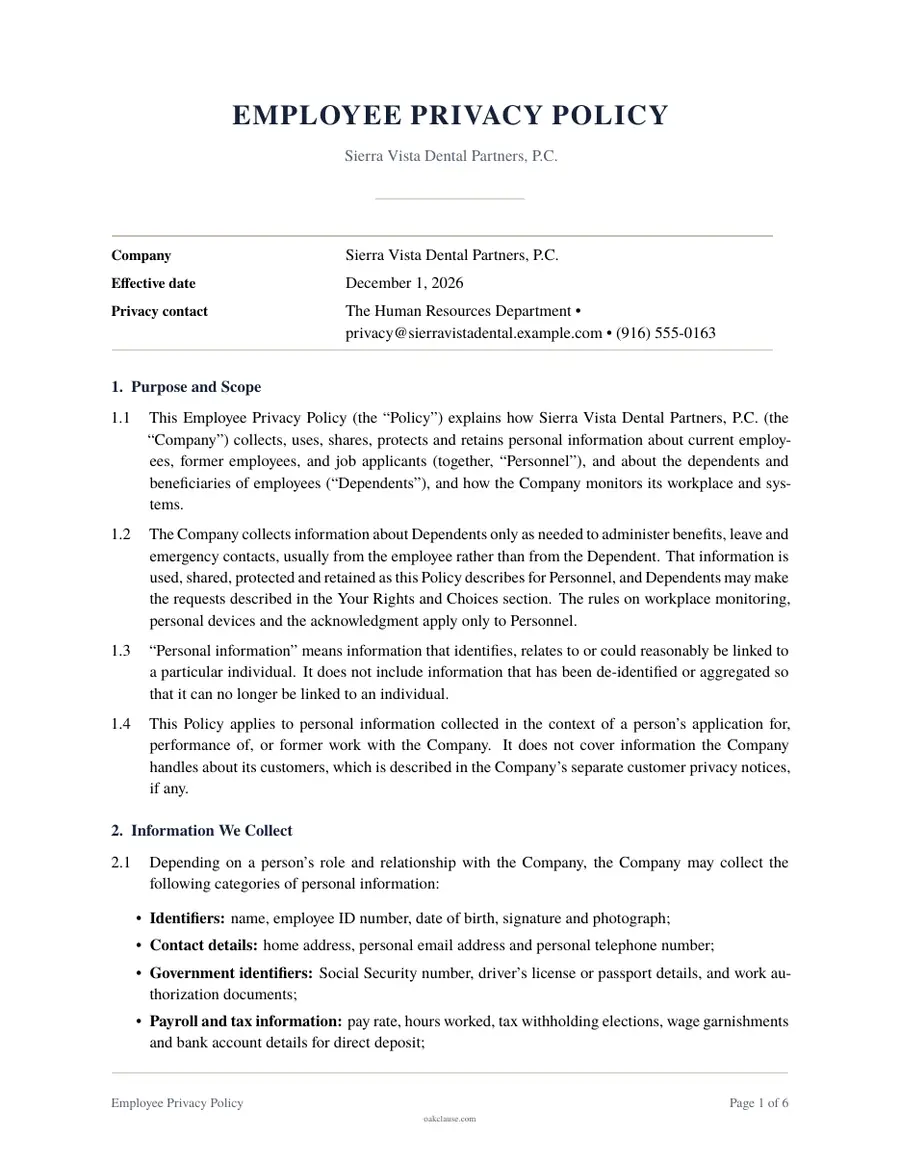
What is an Employee Privacy Policy?
An employee privacy policy is a notice to the people who work for a business, or apply to, explaining how the business handles their personal information. It lists the kinds of information collected, such as contact details, payroll and tax data, benefits information and records of system use, and explains the purposes for which each is used.
The policy also sets expectations about workplace monitoring. Employers commonly monitor company email, devices, networks, building access or vehicles for security and compliance, and telling employees in advance what is monitored, and that they should not expect privacy on company systems, reduces surprises and disputes. Some states require written notice before certain kinds of electronic monitoring.
Privacy rules for employee data differ widely. Some states give employees rights to access their personnel files or regulate biometric data such as fingerprints or face scans, and California's consumer privacy law applies to the personal information of employees and applicants of covered businesses. This policy covers the common elements and commits the business to honoring whatever rights apply where its employees work.
When to use it
- You collect personal information from employees, applicants or contractors and want to explain it in writing.
- You monitor company email, devices, networks, cameras or vehicles and want to give employees notice.
- You use time clocks or access systems that scan fingerprints, hands or faces.
- You allow employees to use personal phones or laptops for work and need clear rules.
- You are updating your handbook and want a standalone privacy notice employees acknowledge.
What is included
- Who the policy covers
- Categories of personal information collected
- Purposes for using the information
- Workplace monitoring notice and no-expectation-of-privacy statement
- Optional biometric information and personal device sections
- Who information is shared with, and a no-sale commitment
- Security safeguards, retention and breach response
- Employee rights requests and privacy contact
- Employee acknowledgment of the policy and monitoring notice
How to make your Employee Privacy Policy
Answer the questions
Tell us about the parties and the terms you want. Most documents take about 5 to 20 minutes.
Review the preview
Check the draft as you go and change any answer. The document updates instantly.
Download, sign and keep a copy
Download a print-ready PDF, sign it with the other parties, and give everyone a copy.
Frequently asked questions
Do I need a privacy policy for my employees?
There is no single federal law requiring one for every employer, but several state laws require notices about employee data or monitoring, and some, such as California's privacy law for covered businesses, require a notice at or before the time information is collected. A written policy is a practical way to meet those obligations and set expectations.
How is this different from a website privacy policy?
A website privacy policy speaks to customers and site visitors. An employee privacy policy speaks to employees, applicants and contractors and covers workplace data such as payroll, benefits, background checks and monitoring. Many businesses need both.
Can employers monitor work email and computers?
Generally, employers may monitor company-owned systems for legitimate business reasons, especially when employees have been told in advance. Some states require written notice or employee acknowledgment before electronic monitoring, and laws on recording phone calls and on audio surveillance are stricter. This policy provides notice and an acknowledgment.
What are the rules for fingerprint time clocks?
Several states regulate biometric identifiers such as fingerprints, hand geometry and face scans. Some require written notice and consent before collection, a published retention schedule and destruction after a set time. If you choose to include biometric data, the policy commits to obtaining any notice and consent the law requires.
Do employees have a right to see their personnel files?
In many states, yes. Rules on who may inspect, how often and whether copies must be provided vary by state. This policy explains how employees can make a request and that the business will respond as the law of their state requires.
How long should employee records be kept?
Different records have different retention requirements under federal and state law, such as payroll, tax, I-9 and benefits records. This policy lets you state a general approach and defers to longer periods required by law or needed for legal claims.
Does this policy cover job applicants?
It can. You choose who the policy covers: current employees, former employees, applicants, contractors and interns. Applicant data, such as resumes and background check results, is often subject to the same rules as employee data.