Remote Work Policy
Put your work-from-home rules in writing.
Includes 30 days of edits
- 5 to 20 minutes
- Print-ready PDF
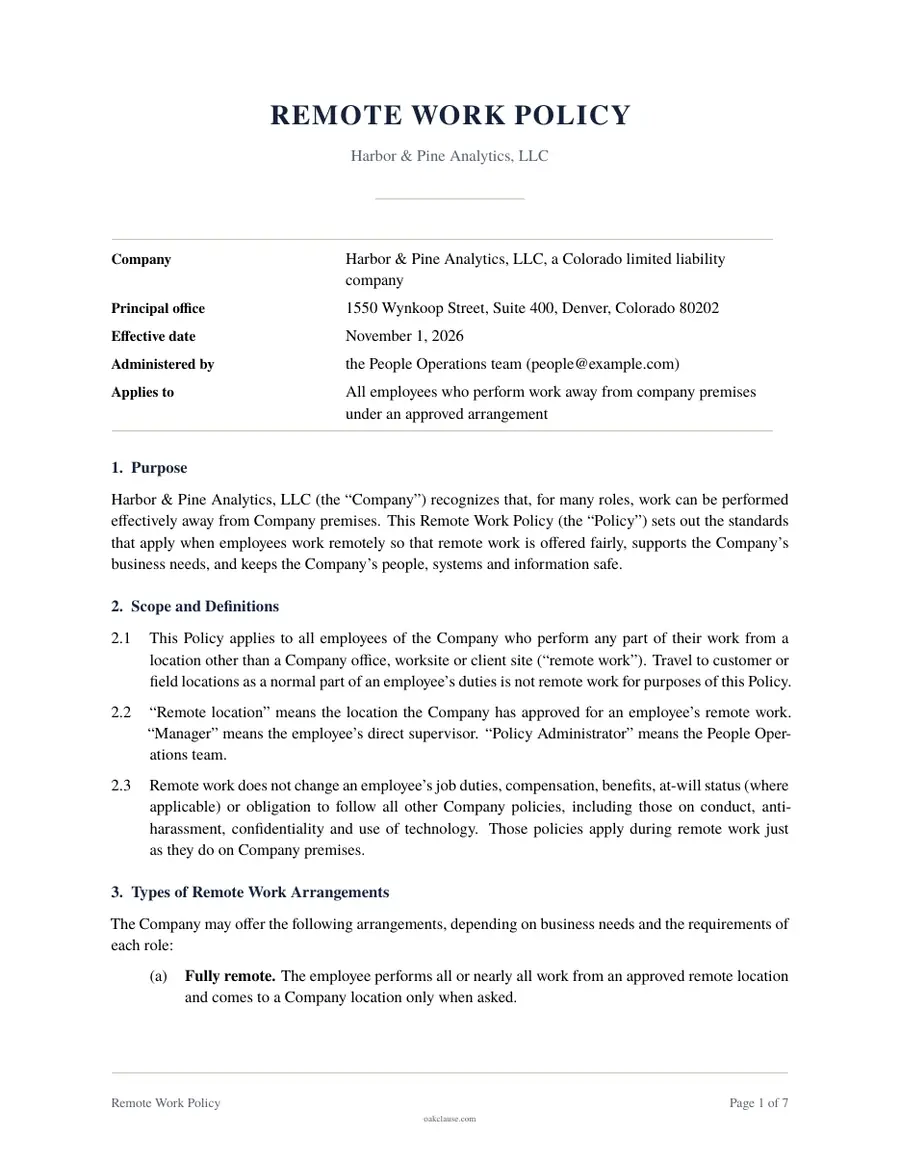
What is a Remote Work Policy?
A remote work policy is a written set of rules that explains how employees may perform their jobs away from the company's offices, whether full time, on a hybrid schedule or only now and then. It is sometimes called a telecommuting or work-from-home policy.
A clear policy treats remote staff consistently and answers the practical questions that otherwise get settled one email at a time: who is eligible, how a request is approved, which hours count as core hours, who pays for internet and equipment, what security steps are mandatory, and how an arrangement can be changed or ended.
Because employment laws on wage payment, overtime, expense reimbursement and workplace injuries apply to remote employees just as they do in the office, a good policy also reminds managers and staff that those rules still apply wherever the work happens. This policy can end with an acknowledgment form each employee can sign.
When to use it
- Your business is introducing hybrid or fully remote roles for the first time.
- Managers are approving work-from-home requests informally and you want one consistent standard.
- You need written rules on company laptops, stipends or reimbursement for home-office costs.
- Remote staff handle customer data or confidential information and you want mandatory security practices.
- You are adding a remote work section to an employee handbook or updating an outdated one.
What is included
- Purpose, scope and types of remote arrangements offered
- Eligibility criteria and the request and approval process
- Core hours, availability, response times and timekeeping for non-exempt staff
- Permitted work locations and home workspace expectations
- Company equipment, care and return obligations
- Stipend or reimbursement of remote work expenses
- Information security and confidentiality rules
- Workplace injury reporting while working remotely
- Changing or ending a remote arrangement
- Employee acknowledgment and signature form
How to make your Remote Work Policy
Answer the questions
Tell us about the parties and the terms you want. Most documents take about 5 to 20 minutes.
Review the preview
Check the draft as you go and change any answer. The document updates instantly.
Download, sign and keep a copy
Download a print-ready PDF, sign it with the other parties, and give everyone a copy.
Frequently asked questions
Is a remote work policy required by law?
No federal law requires a written remote work policy. Employers adopt one because it sets consistent expectations, reduces disputes about expenses and availability, and documents security requirements. Some state laws on expense reimbursement or notice of employment terms may make certain written information advisable.
Do employers have to pay for home internet or equipment?
It depends on the state. Federal law generally only requires reimbursement when unreimbursed costs would push a non-exempt employee's pay below minimum wage, but several states require employers to reimburse necessary business expenses more broadly. This policy lets you choose a stipend or reimbursement and commits to meeting any applicable legal requirement.
Can remote employees work from another state or country?
Working from a new state can create payroll tax, registration and employment law obligations for the employer, and working abroad can raise immigration and tax issues. That is why many policies require approval before an employee works anywhere other than an approved location. This policy lets you set that rule.
How should non-exempt remote employees track their time?
Non-exempt employees must be paid for all hours worked, including overtime, wherever they work. The policy requires them to record all time accurately, take breaks as required by law and get approval before working overtime, while making clear that unapproved overtime that is actually worked will still be paid.
What happens if a remote employee is injured at home?
Injuries that arise out of and in the course of employment may be covered by workers' compensation even when they happen at home. The policy asks employees to keep a safe workspace and to report any work-related injury promptly so it can be evaluated and reported to the insurer.
Can the company end a remote work arrangement?
Yes. Most policies treat remote work as a privilege that can be changed or ended based on business needs or performance, usually with advance notice. You choose the notice period in this policy, and the company can shorten it when urgent business needs or policy violations require.
Does each employee need to sign the policy?
A signature is not usually required for the policy to apply, but a signed acknowledgment is useful evidence that the employee received and read it. This document can include an acknowledgment page for each employee to sign and return.
Should accommodation requests be handled under this policy?
Requests to work remotely as a reasonable accommodation for a disability or other protected reason follow a separate legal process. The policy notes that such requests are evaluated under applicable law and not only under the standard eligibility criteria.