Commercial Rental Application
Give a commercial landlord everything needed to evaluate your business as a tenant: company details, owners, finances, rental history and references, with a signed authorization to verify them.
Includes 30 days of edits
- 5 to 20 minutes
- Print-ready PDF
What is a Commercial Rental Application?
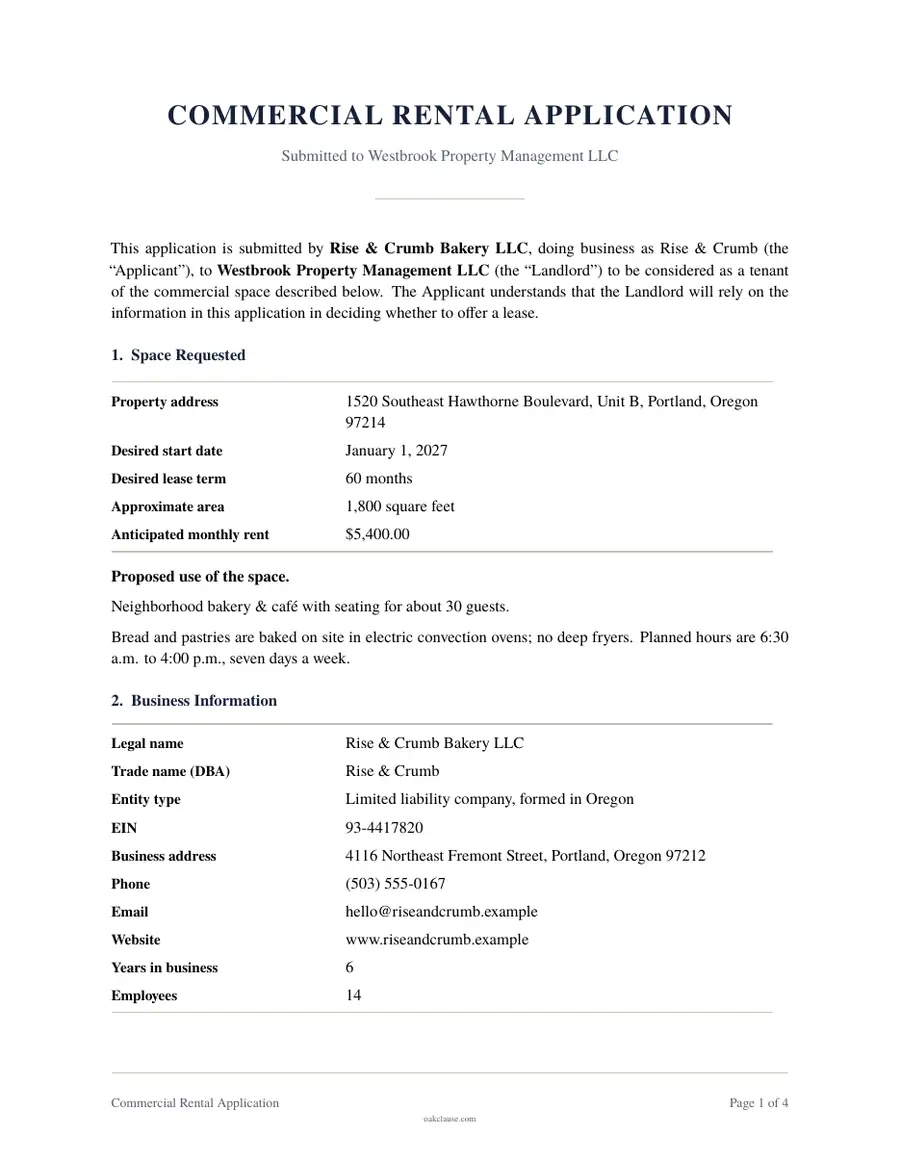
A commercial rental application is the form a business completes when it wants to lease office, retail, restaurant or industrial space. It tells the landlord who the business is, who owns and runs it, how it plans to use the space, how financially stable it is, and where it has rented before.
Landlords rely on the application to decide whether to offer a lease and on what terms. A business with a short track record may be asked for a larger deposit or a personal guaranty, while an established company with strong references may negotiate better terms. A complete, organized application helps the landlord decide faster and shows that the applicant takes the commitment seriously.
The application ends with a certification that the information is accurate and an authorization allowing the landlord to verify it, including by contacting banks, landlords and references and by obtaining business and personal credit reports. Signing it does not create a lease or oblige either side to enter into one.
When to use it
- Your business has found commercial space and the landlord has asked for a completed application.
- You want to prepare a polished application package before touring spaces so you can move quickly.
- You are a landlord or property manager and want a consistent way to collect information from prospective commercial tenants.
- A broker has asked you for business and financial information to submit along with an offer to lease.
- You are relocating or expanding and need to document your rental history and references in one place.
What is included
- Property, desired lease term and proposed use
- Business name, entity type, formation state and contact details
- Years in business, employees and description of operations
- Owners and principals with ownership percentages
- Annual revenue and banking relationship
- Bankruptcy, litigation and eviction history
- Current and prior rental history
- Trade and business references
- List of supporting documents attached
- Certification, credit authorization and signatures
How to make your Commercial Rental Application
Answer the questions
Tell us about the parties and the terms you want. Most documents take about 5 to 20 minutes.
Review the preview
Check the draft as you go and change any answer. The document updates instantly.
Download, sign and keep a copy
Download a print-ready PDF, sign it with the other parties, and give everyone a copy.
Frequently asked questions
What information do commercial landlords usually ask for?
Most ask for the business's legal name and structure, how long it has operated, who owns it, what it will do in the space, its revenue and banking information, its rental history and a few references. Many also ask for financial statements or tax returns, and for a credit check on the business and its principal owners.
Why does a commercial landlord need the owners' personal information?
Small and newer businesses often have limited credit history of their own, so landlords look at the owners' credit and experience to judge the risk. The owners may also be asked to sign a personal guaranty of the lease. Each owner who agrees to a credit check signs the authorization at the end of the application.
Is a commercial rental application the same as a lease?
No. The application only provides information for the landlord to evaluate. It does not reserve the space or bind either party to sign a lease. If the landlord approves the application, the parties usually negotiate an offer to lease or letter of intent and then a full commercial lease.
Can a landlord charge an application fee for commercial space?
Commercial landlords often charge a fee to cover credit checks and processing, and commercial applications are generally subject to fewer fee limits than residential ones. Some states and cities do regulate application fees, so landlords should check local rules. The application records whether a fee applies and whether it is refundable.
What documents should I attach?
Commonly requested documents include the last two or three years of financial statements or business tax returns, recent bank statements, a business plan for newer companies, formation documents such as articles of organization, and a government ID for each principal. You can list the documents you are attaching so nothing gets overlooked.
Will listing a past bankruptcy or lawsuit disqualify my business?
Not necessarily. Landlords consider the full picture, including how long ago it happened and how the business has performed since. Disclosing it honestly with a short explanation is usually far better than leaving it out, since the landlord's background checks may reveal it anyway and an inaccurate application can be grounds to reject it or end a lease.
Do fair housing laws apply to commercial rentals?
The federal Fair Housing Act covers housing, not commercial space. However, other federal, state and local laws prohibit certain kinds of discrimination in business dealings, including some that apply to commercial leasing. Landlords should evaluate every applicant using consistent, business-related criteria.