Personal Financial Statement
Put your whole financial picture in one organized statement: what you own, what you owe and your resulting net worth, ready to hand to a lender, landlord or business partner.
Includes 30 days of edits
- 5 to 20 minutes
- Print-ready PDF
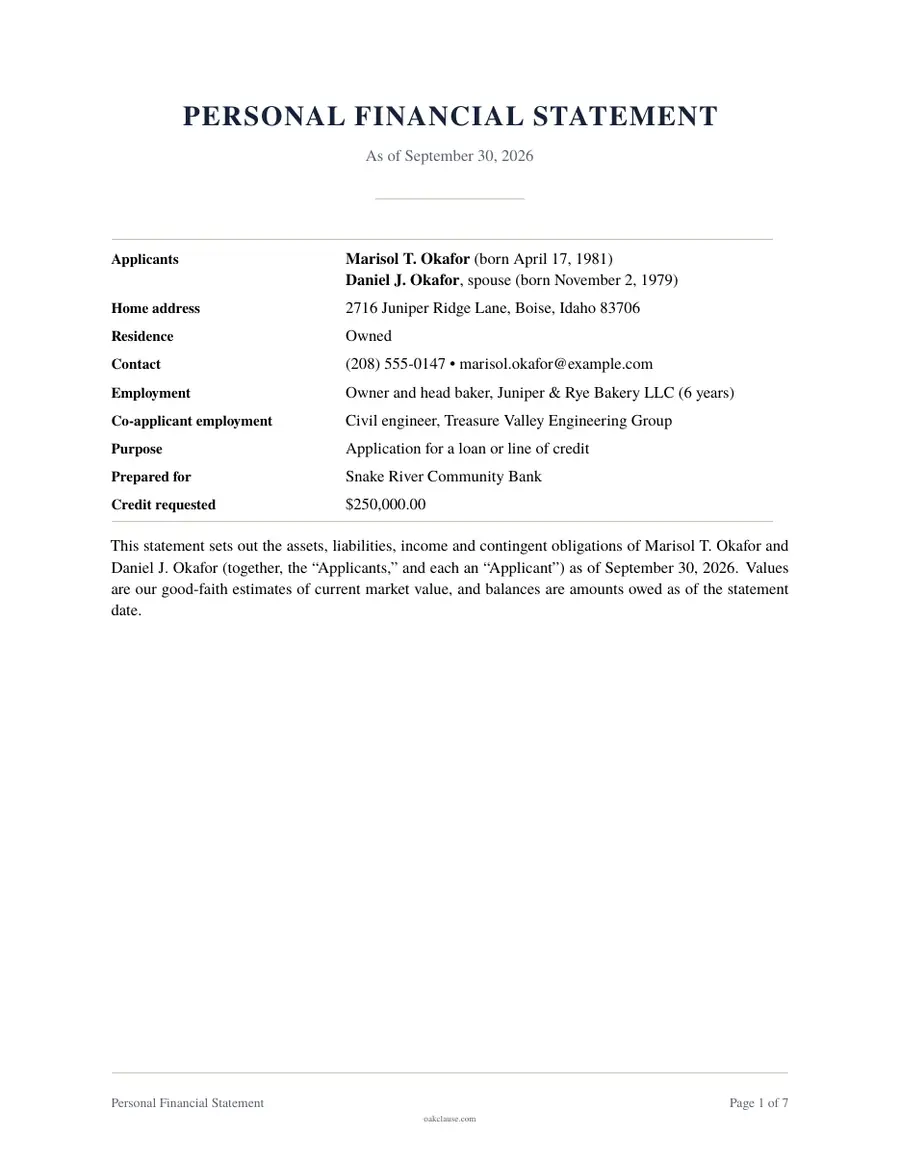
What is a Personal Financial Statement?
A personal financial statement is a dated snapshot of an individual's finances. It lists assets such as bank balances, investments, retirement savings, real estate and vehicles, then lists liabilities such as mortgages, car loans, credit cards and taxes owed. Subtracting total liabilities from total assets gives your net worth as of the statement date.
Banks, the Small Business Administration, commercial landlords, investors and prospective business partners often ask for one before extending credit or entering into a deal, because it shows whether you have the resources to back up a loan or a personal guarantee. Some lenders and government programs, including the SBA and most mortgage lenders, require their own official forms; in that case this statement can serve as a worksheet for completing the form or as a supplement to it. Many people also prepare one simply to track their own progress from year to year.
Beyond the numbers, a complete statement includes your annual income, any contingent liabilities such as loans you have guaranteed for someone else, and a signed certification that the information is true. Because lenders rely on it, accuracy matters: knowingly overstating assets or hiding debts on a statement given to obtain credit can carry serious legal consequences.
When to use it
- You are applying for a business loan, line of credit or mortgage and the lender asks for a personal financial statement, or you want a worksheet to complete a lender's or the SBA's own form.
- You are being asked to personally guarantee a commercial lease, loan or supplier account.
- You are joining a partnership or investing in a business and the other owners want to see your financial standing.
- You and your spouse want a joint snapshot of household net worth for estate or retirement planning.
- You want a yearly record of your assets and debts to measure progress toward financial goals.
What is included
- Applicant and optional co-applicant details
- Purpose of the statement and who it is prepared for
- Itemized cash, bank accounts, investments and retirement savings
- Real estate schedule with market values and mortgage balances
- Vehicles, personal property and other assets
- Credit cards, loans, taxes owed and other liabilities
- Automatically calculated totals and net worth
- Annual income and monthly debt payments
- Contingent liabilities, legal claims and bankruptcy disclosures
- Signed certification with optional notary acknowledgment
How to make your Financial Statement
Answer the questions
Tell us about the parties and the terms you want. Most documents take about 5 to 20 minutes.
Review the preview
Check the draft as you go and change any answer. The document updates instantly.
Download, sign and keep a copy
Download a print-ready PDF, sign it with the other parties, and give everyone a copy.
Frequently asked questions
What is the difference between a personal financial statement and a credit report?
A credit report is compiled by a credit bureau and shows your borrowing and payment history. A personal financial statement is prepared by you and shows the current value of everything you own and owe, including assets that never appear on a credit report, such as savings, investments and real estate equity.
How do I value my house, car and other assets?
Use a reasonable estimate of current market value, not what you originally paid. Recent comparable sales or an appraisal can help for real estate, and published used-car guides can help for vehicles. Lenders may verify values, so conservative, supportable figures are best.
Should I include my retirement accounts?
Yes, most lenders want to see retirement accounts such as 401(k)s and IRAs listed as assets. Some lenders discount them because withdrawals may trigger taxes and penalties, but leaving them off understates your net worth.
Can my spouse and I prepare one statement together?
Yes. This document lets you add a spouse or other co-applicant and present a combined statement with both signatures. Some lenders prefer separate statements when assets are owned separately, so check what the recipient expects.
What is a contingent liability?
A contingent liability is a debt you might have to pay in the future depending on what happens, for example a loan you co-signed or personally guaranteed for someone else, or a lawsuit filed against you. Lenders ask about them because they could reduce your ability to repay.
Can I use this instead of my lender's own form?
Often, but not always. Many banks, landlords and business partners accept any complete, signed statement. Some lenders and government programs require their own form, for example the SBA's personal financial statement form or the Uniform Residential Loan Application used for most mortgages. In that case, use this statement as a worksheet to gather your figures, or attach it as a supplement if the recipient allows.
Does a personal financial statement need to be notarized?
Usually not. Most lenders accept a signed and dated statement. Some programs or transactions ask for notarization, so the document includes an optional notary acknowledgment you can turn on when needed.
How current does the statement need to be?
Lenders typically want a recent statement, and many will ask you to update it if it is more than a few months old or if your finances change significantly. The statement is dated so the recipient knows exactly which point in time it reflects.
What happens if I make a mistake on the statement?
Honest errors can usually be corrected by giving the recipient an updated statement. Knowingly giving false information to a bank or federal agency to obtain credit is a different matter and can lead to civil and criminal liability, so review every figure carefully before signing.