Iowa Non-Compete Agreement
Set clear, reasonable limits on competition after an employee leaves or after you sell a business, with the time period, territory and activities spelled out.
Includes 30 days of edits
- 5 to 20 minutes
- Print-ready PDF
- Tailored to Iowa
Non-Compete rules in Iowa
Non-compete law varies more from state to state than almost any other area of contract law. A few states, including California, prohibit most non-competes for workers, and others limit them by salary level, occupation or length, require advance notice before a job offer, or require that the worker receive extra consideration. Some states will rewrite an overly broad restriction to make it reasonable, while others will strike it entirely. Agreements connected to the sale of a business are treated more leniently almost everywhere. This agreement applies the law of the state you select, limits every restriction to the extent that state's law allows and lets a court narrow terms rather than void them, but it cannot make a restriction enforceable where state law prohibits it. Check your state's current rules, which have changed frequently in recent years, before relying on a non-compete.
When you create this document for Iowa, the questionnaire uses Iowa as the governing law and adds wording that defers to Iowa requirements where they apply. Laws change, so confirm current rules with official Iowa sources or a local attorney for anything critical.
What is a Non-Compete Agreement?
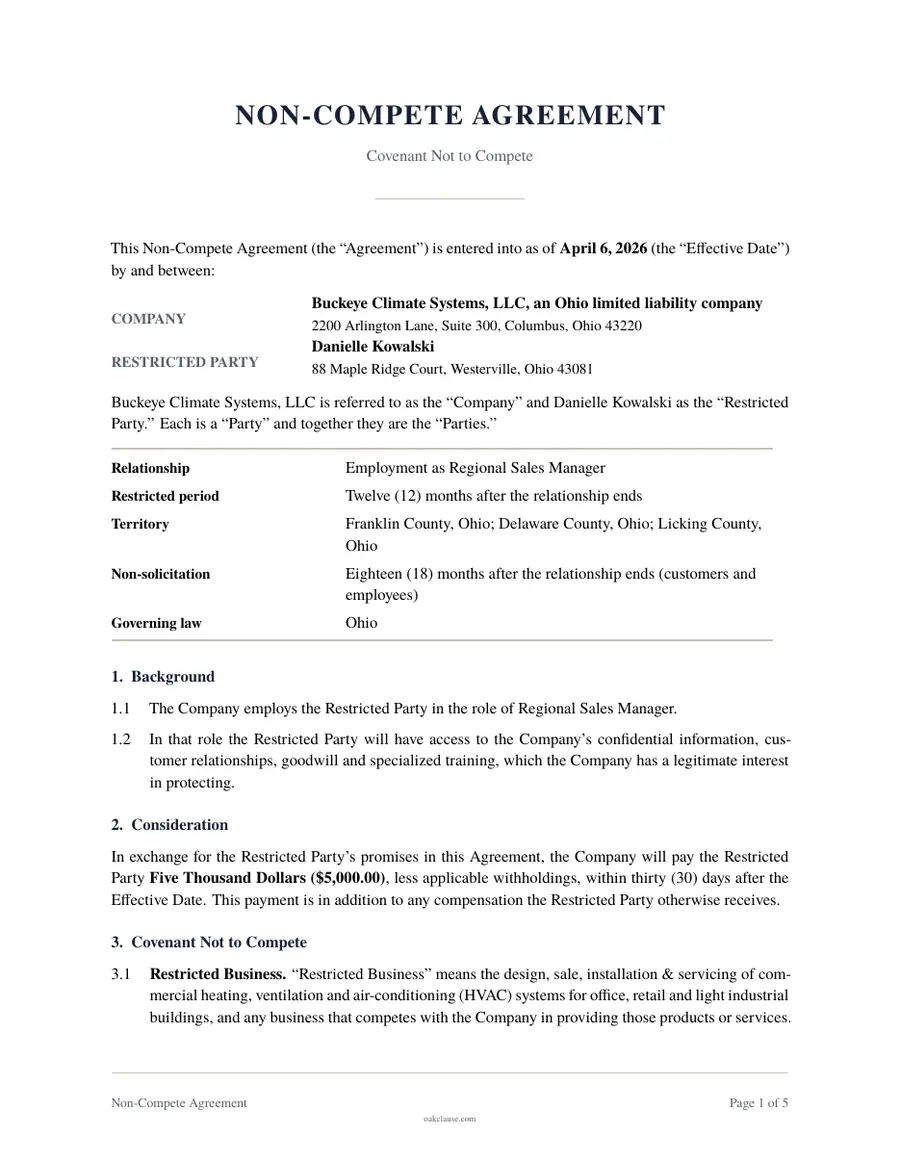
A non-compete agreement, also called a covenant not to compete or restrictive covenant, is a contract in which one person promises not to compete with a business for a defined period of time and within a defined area after their relationship with that business ends.
Businesses most often use non-competes in two situations: with employees or contractors who gain access to sensitive information, customer relationships or specialized training, and with owners who sell a business and its goodwill to a buyer. Courts generally look more favorably on non-competes tied to the sale of a business than on those signed by ordinary employees.
Because a non-compete limits someone's ability to earn a living, courts examine it closely. In states that allow them, a restriction usually has to protect a legitimate business interest, be supported by something of value, and be reasonable in length, geography and scope. Several states ban or sharply limit non-competes for workers, so the governing state matters a great deal. Many agreements pair the non-compete with narrower customer and employee non-solicitation promises and a confidentiality clause, which courts are often more willing to enforce.
When to use it
- You are hiring a key employee who will learn your trade secrets, pricing or customer relationships.
- You are buying a business and want the seller to stay out of the same market for a period of time.
- You are selling your business and the buyer has asked for a written non-compete as part of the deal.
- You are engaging a consultant or contractor who will work closely with your clients.
- You want to pair a time-limited restriction with customer and employee non-solicitation terms.
What is included
- Parties and the relationship that gives rise to the restriction
- Consideration given in exchange for the promise not to compete
- Description of the protected business and the restricted activities
- Restricted period and geographic territory
- Optional customer and employee non-solicitation covenants
- Confidentiality obligations and a federal whistleblower immunity notice
- Tolling, reformation and severability provisions
- Remedies, including injunctive relief
- State-aware governing law and dispute resolution terms
- Signature blocks for individuals and business signers
How to make your Non-Compete
Answer the questions
Tell us about the parties and the terms you want. Most documents take about 5 to 20 minutes.
Review the preview
Check the draft as you go and change any answer. The document updates instantly.
Download, sign and keep a copy
Download a print-ready PDF, sign it with the other parties, and give everyone a copy.
Non-Compete in another state
Back to the general non-compete page51 states shown
- ALAlabama
- AKAlaska
- AZArizona
- ARArkansas
- CACalifornia
- COColorado
- CTConnecticut
- DEDelaware
- DCDistrict of Columbia
- FLFlorida
- GAGeorgia
- HIHawaii
- IDIdaho
- ILIllinois
- INIndiana
- IAIowa
- KSKansas
- KYKentucky
- LALouisiana
- MEMaine
- MDMaryland
- MAMassachusetts
- MIMichigan
- MNMinnesota
- MSMississippi
- MOMissouri
- MTMontana
- NENebraska
- NVNevada
- NHNew Hampshire
- NJNew Jersey
- NMNew Mexico
- NYNew York
- NCNorth Carolina
- NDNorth Dakota
- OHOhio
- OKOklahoma
- OROregon
- PAPennsylvania
- RIRhode Island
- SCSouth Carolina
- SDSouth Dakota
- TNTennessee
- TXTexas
- UTUtah
- VTVermont
- VAVirginia
- WAWashington
- WVWest Virginia
- WIWisconsin
- WYWyoming
Frequently asked questions
Are non-compete agreements enforceable?
It depends on the state and the situation. Most states enforce non-competes that protect a legitimate business interest and are reasonable in time, territory and scope. A handful of states, including California, ban most worker non-competes, and non-competes tied to selling a business are enforced more readily almost everywhere.
How long can a non-compete last?
There is no single national limit. Employee non-competes commonly run six months to two years, while sale-of-business restrictions are often longer. Courts judge whether the period is reasonable for the interest being protected, and some states set their own maximums, so check the rules where the agreement will be enforced.
What is the difference between a non-compete and a non-solicitation agreement?
A non-compete stops someone from working for or running a competing business. A non-solicitation clause is narrower: it stops them from targeting the company's customers or recruiting its employees. Because it restricts less, a non-solicitation promise is often enforced in situations where a full non-compete would not be.
Does an employee have to get something in return for signing?
Generally yes. A contract needs consideration. For a new hire, the job itself usually counts. For a current employee, some states accept continued employment while others require something more, such as a raise, bonus or promotion. This agreement lets you describe the consideration so it is documented.
What happens if a non-compete is too broad?
Depending on the state, a court may narrow the restriction to something reasonable, enforce only the reasonable parts, or refuse to enforce it at all. This agreement asks the court to modify an overbroad term rather than discard it, where state law allows.
Can I use a non-compete with an independent contractor?
In many states, yes, although courts scrutinize them and some states that restrict employee non-competes also cover contractors. Overly restrictive terms can also suggest that a contractor is really an employee, so keep restrictions narrow.
Is a non-compete signed during the sale of a business different?
Yes. When a buyer pays for a business's goodwill, a promise by the seller not to compete protects what the buyer paid for. Courts generally allow broader and longer restrictions in this setting, and even states that ban employee non-competes usually have a sale-of-business exception.
Does a non-compete need to be notarized?
No. A non-compete is binding when signed by the parties. Some states have rules about when an employee must receive the agreement before signing or about advising the employee to consult a lawyer, so check those timing rules.
More Iowa documents
Other documents people prepare for Iowa, each with the state’s rules where we have checked them.
All Iowa documents and rules