Stock Repurchase Agreement
Document a corporation buying back shares from one of its shareholders, with the price, payment schedule, corporate approvals and releases set out clearly.
Includes 30 days of edits
- 5 to 20 minutes
- Print-ready PDF
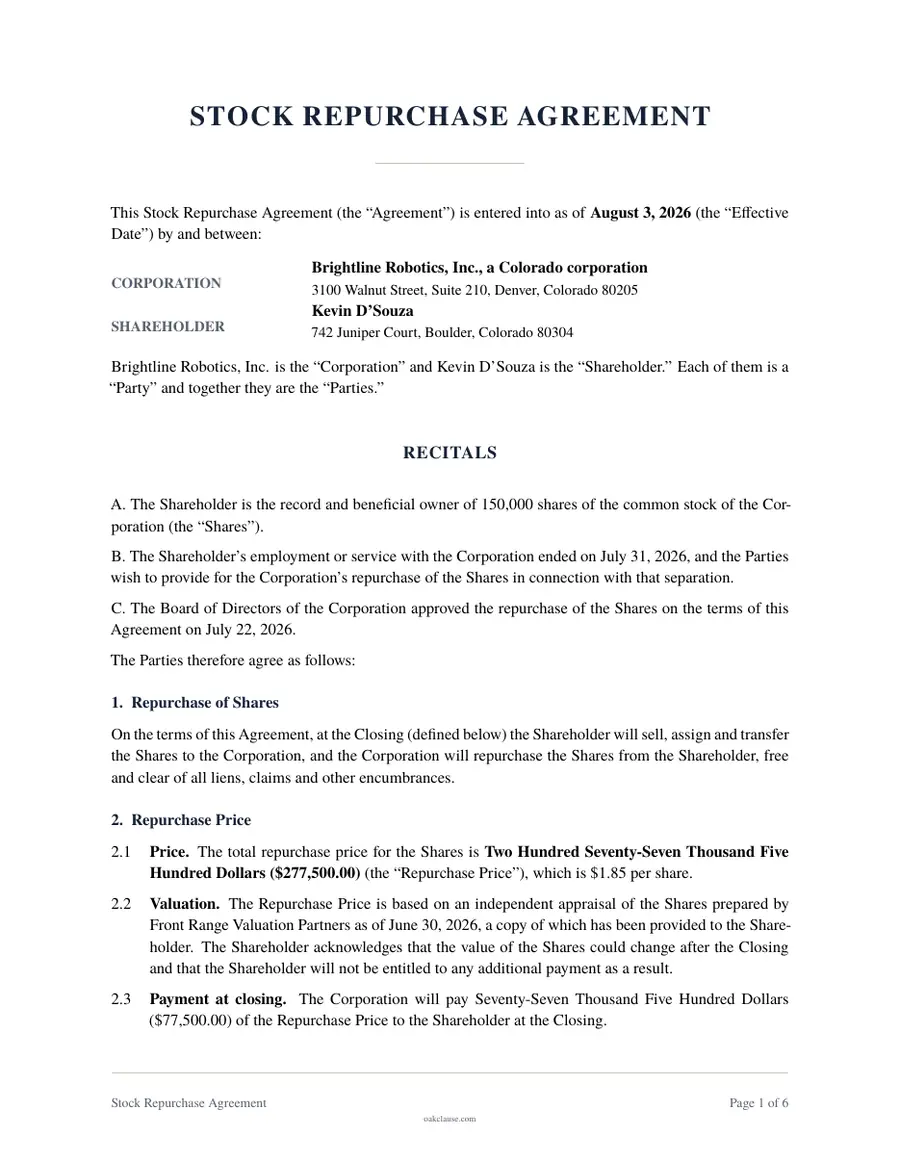
What is a Stock Repurchase Agreement?
A stock repurchase agreement, also called a share buyback or redemption agreement, is a contract in which a corporation agrees to buy some or all of its own shares from a shareholder. It states how many shares are being repurchased, the price and how it was set, how and when the corporation will pay, and what the shareholder must deliver to complete the transfer.
Repurchases are common when a founder, employee or investor leaves the business, when a buy-sell provision in a shareholders' agreement is triggered, or when a shareholder simply wants to cash out and the corporation has the funds to buy. Because the corporation is paying its own money to an owner, state corporation laws limit when a repurchase is allowed: generally the corporation must remain able to pay its debts and must satisfy any balance-sheet tests that apply in its state.
This agreement includes the corporation's confirmation that the board approved the repurchase and that it is permitted by law, the shareholder's promises about ownership of the shares, and optional terms often found in buyouts, such as installment payments secured by the shares, resignation from corporate positions, a mutual release of claims and non-disparagement.
When to use it
- A co-founder or key employee is leaving and the corporation is buying back their shares.
- A shareholders' agreement or buy-sell agreement requires or allows the corporation to purchase shares after a triggering event.
- A minority shareholder wants to exit and the corporation agrees to buy their stake.
- The corporation is consolidating ownership before a financing or sale.
- The corporation and a shareholder agreed on a buyout and want the payment terms and releases in writing.
What is included
- Corporation and selling shareholder details
- Reason for the repurchase and any underlying agreement
- Number and class of shares and whether all shares are repurchased
- Price per share, valuation method and total price
- Lump-sum or installment payment, with an optional pledge of the shares
- Board approval and confirmation the repurchase is legally permitted
- Shareholder representations about title and authority
- Optional resignation, mutual release and non-disparagement
- Status of repurchased shares as permitted by state law
- Governing law, dispute resolution, signatures and spousal consent
How to make your Stock Repurchase Agreement
Answer the questions
Tell us about the parties and the terms you want. Most documents take about 5 to 20 minutes.
Review the preview
Check the draft as you go and change any answer. The document updates instantly.
Download, sign and keep a copy
Download a print-ready PDF, sign it with the other parties, and give everyone a copy.
Frequently asked questions
What is a stock repurchase?
A stock repurchase, or redemption, is when a corporation buys back its own shares from a shareholder. After the repurchase, the shareholder no longer owns those shares, and the remaining shareholders' ownership percentages increase proportionally.
How is a repurchase different from selling shares to another person?
In a repurchase the corporation itself is the buyer and pays with company funds. In a stock purchase, another individual or business buys the shares and the corporation is not a party to the payment. A stock purchase agreement is the right document for that kind of sale.
Are there legal limits on a corporation buying back its shares?
Yes. State corporation laws treat a repurchase like a distribution to shareholders and generally prohibit it if the corporation would be unable to pay its debts as they come due or would fail other financial tests in its state. Directors who approve an unlawful distribution can face personal liability, so the board usually reviews the corporation's finances before approving.
Does the board of directors need to approve the repurchase?
In most cases the board approves a repurchase by resolution, and some bylaws, articles or shareholders' agreements also require shareholder approval. This agreement records the date of board approval and can confirm shareholder approval when needed.
How is the repurchase price determined?
The price may be negotiated, set by a formula in a shareholders' agreement, based on book value, or determined by an independent appraisal. The agreement states the method used so there is a clear record of how the price was reached.
Can the corporation pay over time?
Yes. Many repurchases are paid partly at closing and partly under a promissory note. The shareholder may ask for the repurchased shares to be held as security until the note is paid, which this agreement allows.
What happens to the repurchased shares?
Depending on state law and the corporation's articles, repurchased shares either become authorized but unissued shares or are held as treasury shares. This agreement states the intended treatment, subject to what state law allows.
Should a departing shareholder sign a release?
A mutual release is common in buyouts because it ends potential claims between the shareholder and the corporation in exchange for the payment. Releases can affect important rights, so each side often has an attorney review the terms.