New Hire Checklist
Give every new employee a smooth start with a personalized onboarding checklist covering paperwork, equipment, accounts, training and check-ins, with an owner for every task.
Includes 30 days of edits
- 5 to 20 minutes
- Print-ready PDF
What is a New Hire Checklist?
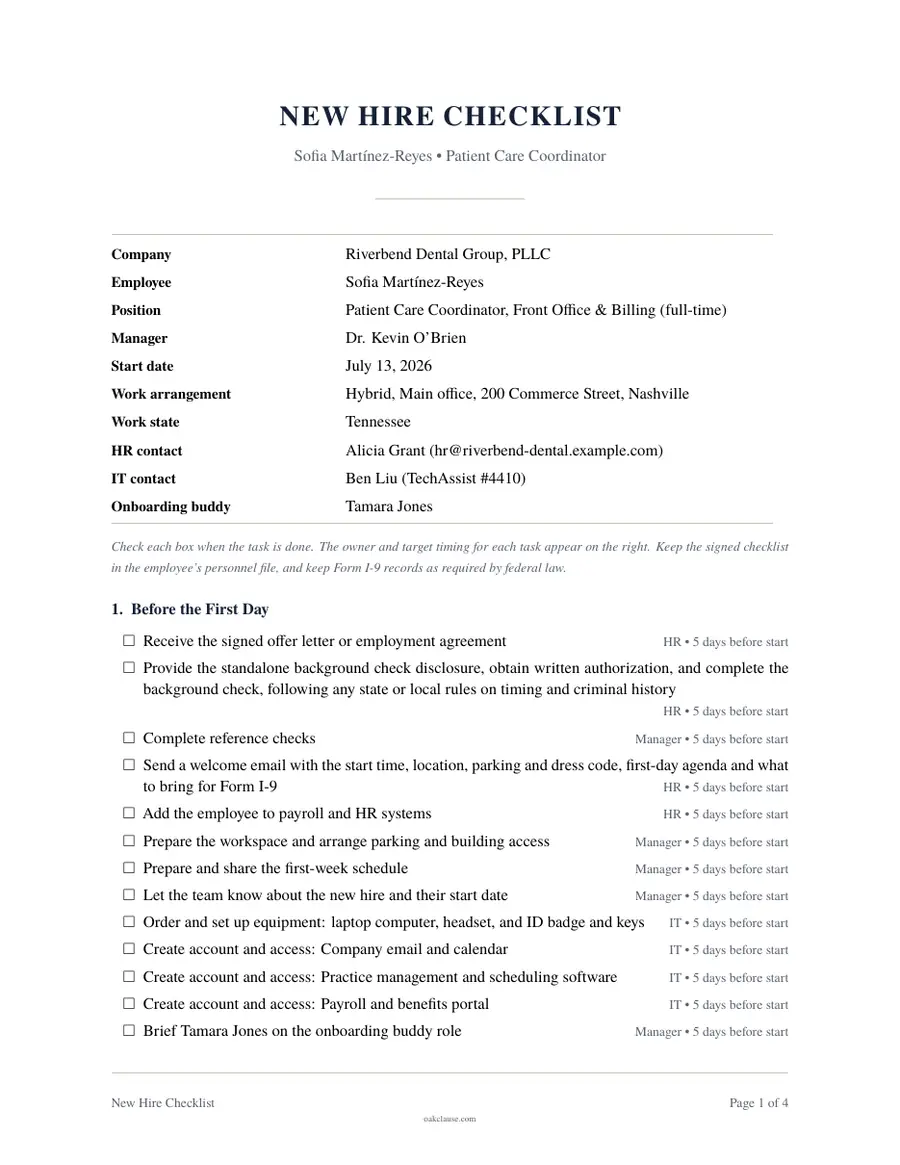
A new hire checklist is an onboarding tool that lists everything that needs to happen before and after a new employee starts: collecting required employment forms, setting up equipment and system access, introducing the employee to the team, delivering training and scheduling early check-ins.
Onboarding involves several people, usually HR, the hiring manager, IT and the new employee, and small items are easy to miss. A written checklist assigns each task to an owner and a timeframe, so nothing falls through the cracks and the employee has what they need on day one.
A checklist also helps with compliance. Some onboarding steps are required by law, such as verifying employment eligibility on Form I-9 and collecting federal tax withholding information, and many states add their own forms and new hire reporting rules. Keeping a signed checklist in the employee's file creates a simple record that each step was completed.
When to use it
- You are hiring your first employee and want to be sure the required paperwork is covered.
- You want a consistent onboarding process for every new hire across teams or locations.
- A hiring manager, HR and IT need to coordinate tasks before a start date.
- You are onboarding a remote employee and need to ship equipment and set up access in advance.
- You want a signed record showing that onboarding steps and policy acknowledgments were completed.
What is included
- Employee, role, start date and work arrangement summary
- Onboarding contacts, including HR, IT and an optional buddy
- Pre-boarding tasks to complete before the first day
- Employment forms and policy acknowledgments, including Form I-9 and Form W-4
- Equipment and system access setup
- First-day and first-week activities
- Required training with target dates
- 30, 60 and 90-day check-ins and benefits enrollment
- Custom tasks with owners and due dates
- Sign-off by the employee, manager and HR
How to make your New Hire Checklist
Answer the questions
Tell us about the parties and the terms you want. Most documents take about 5 to 20 minutes.
Review the preview
Check the draft as you go and change any answer. The document updates instantly.
Download, sign and keep a copy
Download a print-ready PDF, sign it with the other parties, and give everyone a copy.
Frequently asked questions
What paperwork does a new employee need to fill out?
Almost every US employer needs a completed Form I-9 to verify identity and work authorization and a Form W-4 for federal income tax withholding. Depending on the state and the employer, new hires may also complete a state withholding form, direct deposit authorization, emergency contact form, benefits enrollment and policy acknowledgments.
When does Form I-9 have to be completed?
The employee must complete Section 1 no later than the first day of employment. The employer must review the employee's documents and complete Section 2 within three business days after the employee's first day of work. The checklist includes both steps.
Do employers have to report new hires to the state?
Yes. Federal law requires employers to report newly hired employees to a state new hire registry, which is used mainly to enforce child support orders. Each state sets its own reporting method and deadline, so check your state's registry for the details.
Is a new hire checklist a legal document?
Not in the way a contract is. It is an internal tool that organizes onboarding and creates a record that steps were completed. Some items on it, such as Form I-9, are legally required, but the checklist itself does not create obligations between the employer and the employee.
Can I use this checklist for remote employees?
Yes. When you choose a remote or hybrid arrangement, the checklist adds tasks such as shipping equipment, confirming a home office setup and planning virtual introductions. Remember that Form I-9 still requires an in-person or authorized alternative review of documents.
Who should be responsible for onboarding tasks?
Most onboarding is shared. HR typically handles forms, payroll and benefits; the manager handles introductions, goals and training; IT handles equipment and accounts; and the employee completes their own forms. This checklist assigns an owner to every task so responsibilities are clear.
Why schedule 30, 60 and 90-day check-ins?
Regular early check-ins give the employee a chance to ask questions and give feedback, and give the manager a chance to adjust goals or training before small issues grow. Many organizations find that structured early check-ins improve retention.
Should a background check be done before the start date?
If you run background checks, they are usually completed after an offer and before the start date. Federal law requires a standalone written disclosure and the candidate's written authorization before obtaining a background report from a screening company, and some states and cities limit when and how criminal history can be considered.