Joint Venture Agreement
Put a shared project on solid footing.
Includes 30 days of edits
- 5 to 20 minutes
- Print-ready PDF
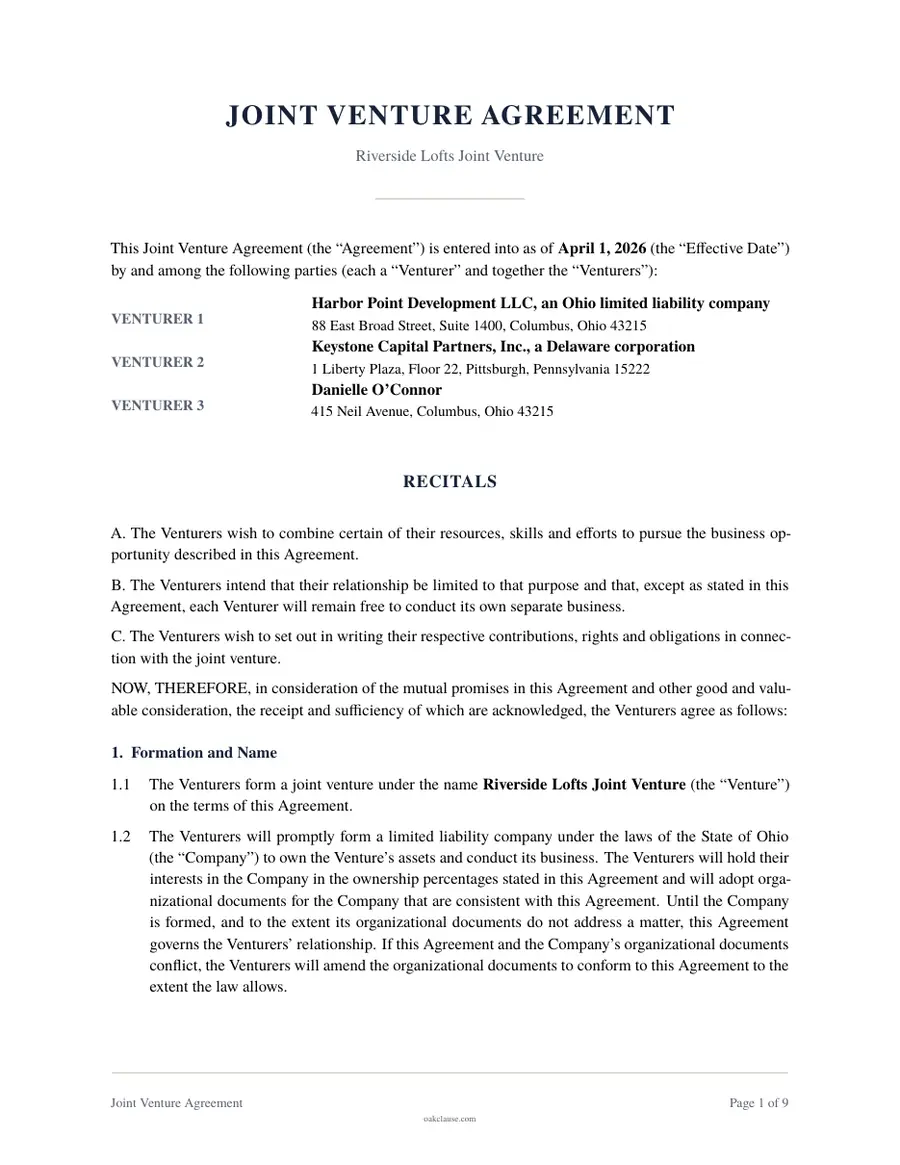
What is a Joint Venture Agreement?
A joint venture agreement is a contract between two or more businesses or individuals who agree to pool money, property, skills or relationships to pursue a specific project or business opportunity together, while otherwise remaining independent of one another.
Unlike a merger or a general partnership covering all of the parties' business, a joint venture is usually limited in scope and time: it may cover a single real estate development, a product launch, a research project or a regional distribution effort. Some ventures operate purely by contract, while others form a new company, often an LLC, to hold the project.
Because the participants share control and money, misunderstandings can be costly. A written agreement records each party's contributions and ownership percentage, sets up a decision-making process, lists the decisions that need everyone's approval, and explains what happens if a party wants out, breaches the agreement or the project simply ends.
When to use it
- Two companies want to develop, market or sell a product together without merging.
- Investors and an operator are teaming up on a real estate project or a single property.
- A business with a product is partnering with another business that has distribution or customers.
- Several parties are bidding on or performing a large contract that none of them could handle alone.
- You want a trial collaboration with clear exit rules before committing to a long-term partnership.
What is included
- Venture name, purpose, scope and territory
- Parties, capital contributions and ownership percentages
- Additional capital and how it is called
- Management committee or managing venturer, voting and major decisions
- Profit and loss allocation, distributions and accounting records
- Ownership of contributed and newly developed intellectual property
- Confidentiality, non-competition and non-solicitation options
- Transfer restrictions, withdrawal, default and dissolution
- Dispute resolution, governing law and general provisions
- Signature blocks for every venturer
How to make your Joint Venture Agreement
Answer the questions
Tell us about the parties and the terms you want. Most documents take about 5 to 20 minutes.
Review the preview
Check the draft as you go and change any answer. The document updates instantly.
Download, sign and keep a copy
Download a print-ready PDF, sign it with the other parties, and give everyone a copy.
Frequently asked questions
What is the difference between a joint venture and a partnership?
A general partnership usually covers an ongoing business with no fixed end, while a joint venture is typically formed for a specific project or limited period. The legal treatment can be similar, and in many states an unincorporated joint venture is treated much like a partnership for that project.
Do we need to form a new company for a joint venture?
Not necessarily. Many joint ventures operate under a contract alone. Others form an LLC or corporation to hold assets, sign contracts and limit liability. This agreement works for a contract-only venture and can also record the parties' plan to form a new entity, which would then need its own formation documents and operating agreement.
Are joint venturers liable for each other's actions?
It depends on the structure and state law. In a contract-only venture, outsiders may be able to hold each venturer responsible for venture obligations, much as in a partnership. Using a separate entity and including indemnity clauses can reduce that exposure. An attorney can explain the risk for your situation.
How are profits and losses usually divided?
Most ventures split profits and losses in proportion to each party's ownership percentage, which often tracks their contributions. Parties can agree to a different split, for example when one side contributes expertise rather than cash. This agreement lets you set the percentages and choose how losses are shared.
Who owns intellectual property created by a joint venture?
Only what the agreement says. Without a clear clause, ownership of jointly developed technology, designs or content can become disputed. This agreement lets you choose whether new IP belongs to the venture, to the parties jointly, or to the party that created it, while each party keeps the IP it brought in.
How is a joint venture taxed?
A venture with two or more owners that is not a corporation is generally treated as a partnership for federal income tax purposes, which may require a partnership return. Tax treatment can be complex, so the parties usually involve a tax professional before the venture begins operating.
What happens when the joint venture ends?
The agreement sets out when the venture ends, such as when the project is completed, on a set date or by mutual agreement. The venture then winds up: it collects money owed, pays its debts, returns or divides property and distributes what is left according to the ownership percentages.
Does a joint venture agreement need to be notarized?
Generally no. It becomes binding when the parties sign it. Notarization may be needed for related documents, such as a deed transferring real estate into the venture, or if a lender or other third party requires it.