Massachusetts Change of Registered Agent
Record a new registered agent or registered office address for your corporation, LLC or partnership.
Includes 30 days of edits
- 5 to 20 minutes
- Print-ready PDF
- Tailored to Massachusetts
Registered Agent rules in Massachusetts
Registered agent rules come from each state's business entity laws, and the details differ. States vary on who can serve as an agent, whether the agent's written consent must be filed or only kept on record, which officers or members may sign the statement, the filing fee, whether the filing office requires its own form, and whether an agent can file a change of its own address for all of the companies it represents. Some states also allow the registered agent change to be made in an annual report. This document uses the state you select for its wording and defers to that state's law on each of these points. Before filing, check the Secretary of State's website for the current form, fee and signing requirements.
When you create this document for Massachusetts, the questionnaire uses Massachusetts as the governing law and adds wording that defers to Massachusetts requirements where they apply. Laws change, so confirm current rules with official Massachusetts sources or a local attorney for anything critical.
What is a Change of Registered Agent?
Every corporation, LLC and limited partnership registered with a state must keep a registered agent: a person or company with a physical address in that state who is available during business hours to receive lawsuits, subpoenas and official notices for the business. The agent's name and address, known as the registered office, are part of the public record at the state filing office.
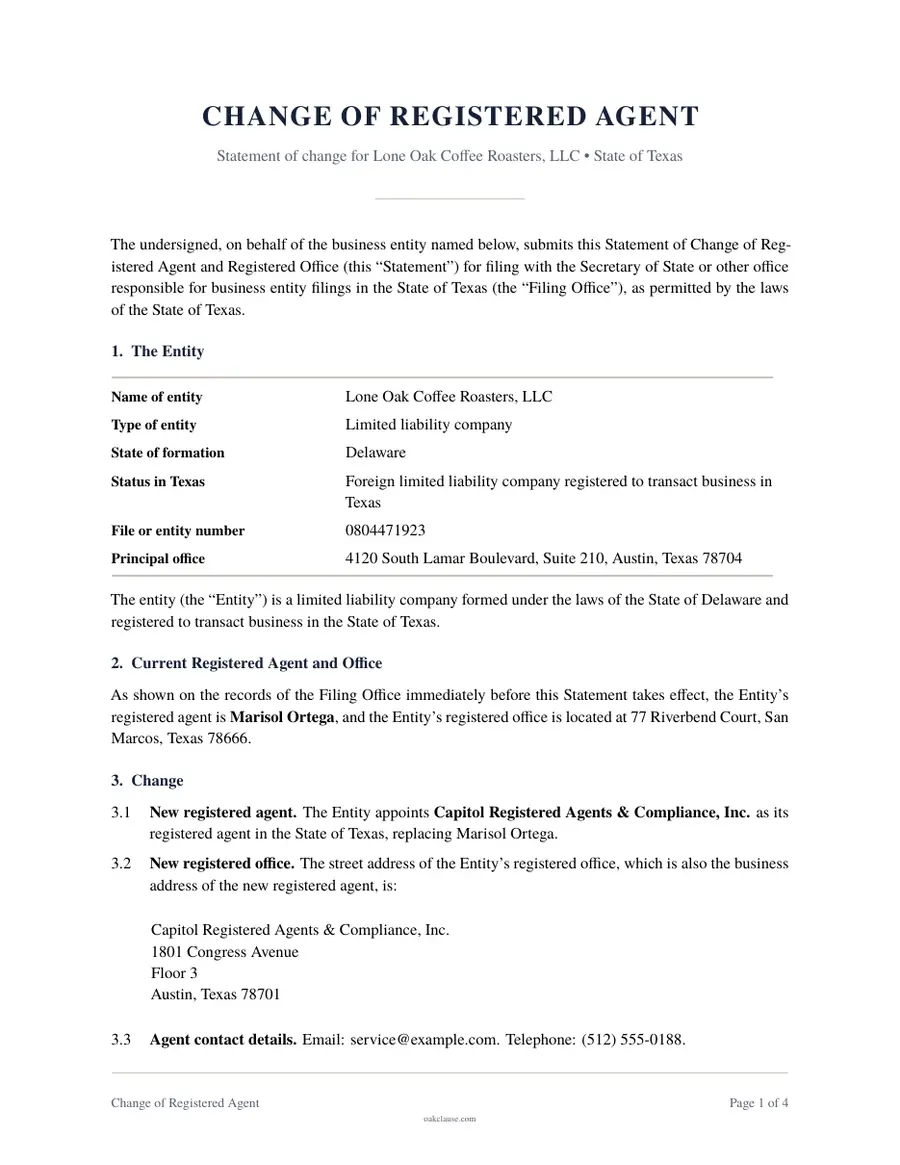
When a business switches to a different agent, or its agent moves to a new street address, the state's records must be updated. This document prepares a statement of change that sets out the entity's details, the current and new agent and office, how the change was authorized and when it takes effect. It also includes a page for the new agent to accept the appointment and a letter telling the former agent that its role has ended.
Most states make the change official only when a statement of change is filed with the Secretary of State or similar office, often on that office's own form and with a filing fee. The statement prepared here gathers every detail those forms ask for, documents the company's internal approval for the minute book, and can be filed directly where a state accepts a statement in this format.
When to use it
- You are replacing your current registered agent with a commercial registered agent service.
- You have been acting as your own registered agent and want someone else to take over, or the reverse.
- Your registered agent is moving to a new street address in the same state.
- Your current agent has resigned or is no longer reliable at receiving legal papers.
- A business registered as a foreign entity in another state needs to change its agent in that state.
What is included
- Entity name, type, state of formation and state file number
- Current registered agent and registered office address
- New registered agent, or new registered office for the current agent
- Statements about the physical street address and agent's consent
- Record of approval by the board, members, managers or partners
- Effective on filing or on a later date
- Signature of an authorized officer, manager or partner
- Acceptance of appointment signed by the new registered agent
- Optional notice letter to the former registered agent
How to make your Registered Agent
Answer the questions
Tell us about the parties and the terms you want. Most documents take about 5 to 20 minutes.
Review the preview
Check the draft as you go and change any answer. The document updates instantly.
Download, sign and keep a copy
Download a print-ready PDF, sign it with the other parties, and give everyone a copy.
Registered Agent in another state
Back to the general registered agent page51 states shown
- ALAlabama
- AKAlaska
- AZArizona
- ARArkansas
- CACalifornia
- COColorado
- CTConnecticut
- DEDelaware
- DCDistrict of Columbia
- FLFlorida
- GAGeorgia
- HIHawaii
- IDIdaho
- ILIllinois
- INIndiana
- IAIowa
- KSKansas
- KYKentucky
- LALouisiana
- MEMaine
- MDMaryland
- MAMassachusetts
- MIMichigan
- MNMinnesota
- MSMississippi
- MOMissouri
- MTMontana
- NENebraska
- NVNevada
- NHNew Hampshire
- NJNew Jersey
- NMNew Mexico
- NYNew York
- NCNorth Carolina
- NDNorth Dakota
- OHOhio
- OKOklahoma
- OROregon
- PAPennsylvania
- RIRhode Island
- SCSouth Carolina
- SDSouth Dakota
- TNTennessee
- TXTexas
- UTUtah
- VTVermont
- VAVirginia
- WAWashington
- WVWest Virginia
- WIWisconsin
- WYWyoming
Frequently asked questions
What does a registered agent do?
A registered agent receives service of process, meaning lawsuits and other legal papers, and official mail such as annual report reminders and tax notices on behalf of a business. The agent must have a physical street address in the state and be available there during normal business hours, so the business does not miss important deadlines.
Can I be my own registered agent?
In most states, an owner, officer or employee can serve as the registered agent if they have a physical address in the state and are reliably available there during business hours. Many businesses use a commercial agent instead for privacy, because the agent's address is public, and so legal papers are not delivered in front of customers or employees.
Does changing the registered agent take effect right away?
Generally, the change becomes effective when the state filing office accepts the statement of change, or on a later effective date if the state allows one and the statement specifies it. Until then, the former agent remains the agent on record, so it is wise to keep your arrangement with them in place until the filing is accepted.
Is there a fee to change a registered agent?
Most states charge a filing fee for a statement of change, and the amount varies by state and entity type. Some states charge nothing when the change is made as part of an annual report. Check the current fee schedule on your Secretary of State's website before filing.
Does the new registered agent need to consent?
Yes. A person or company should not be named as an agent without agreeing to it. Some states require the agent's signature or written consent to be filed with the statement, while others only require the business to confirm that consent was obtained. This document includes an acceptance page the new agent can sign either way.
Do I need to tell my old registered agent?
It is good practice. Telling the outgoing agent the effective date lets them forward any papers they receive in the meantime and close out your account. If you used a commercial service, you may also need to cancel the service separately to stop renewal charges.
What if my business is registered in more than one state?
A business registered in several states has a separate registered agent in each one, and each state keeps its own record. You need to file a change in every state where the agent or address is changing. Prepare a separate document for each state.
Can a P.O. box be used as a registered office?
Generally no. States require the registered office to be a physical street address where the agent can be found and papers can be handed over in person. A mailing address may sometimes be listed in addition, but not in place of the street address.
More Massachusetts documents
Other documents people prepare for Massachusetts, each with the state’s rules where we have checked them.
All Massachusetts documents and rules