Certificate of Incumbency
Show a bank, lender or business partner exactly who holds your company's director and officer positions, with specimen signatures and an optional notary block.
Includes 30 days of edits
- 5 to 20 minutes
- Print-ready PDF
What is a Certificate of Incumbency?
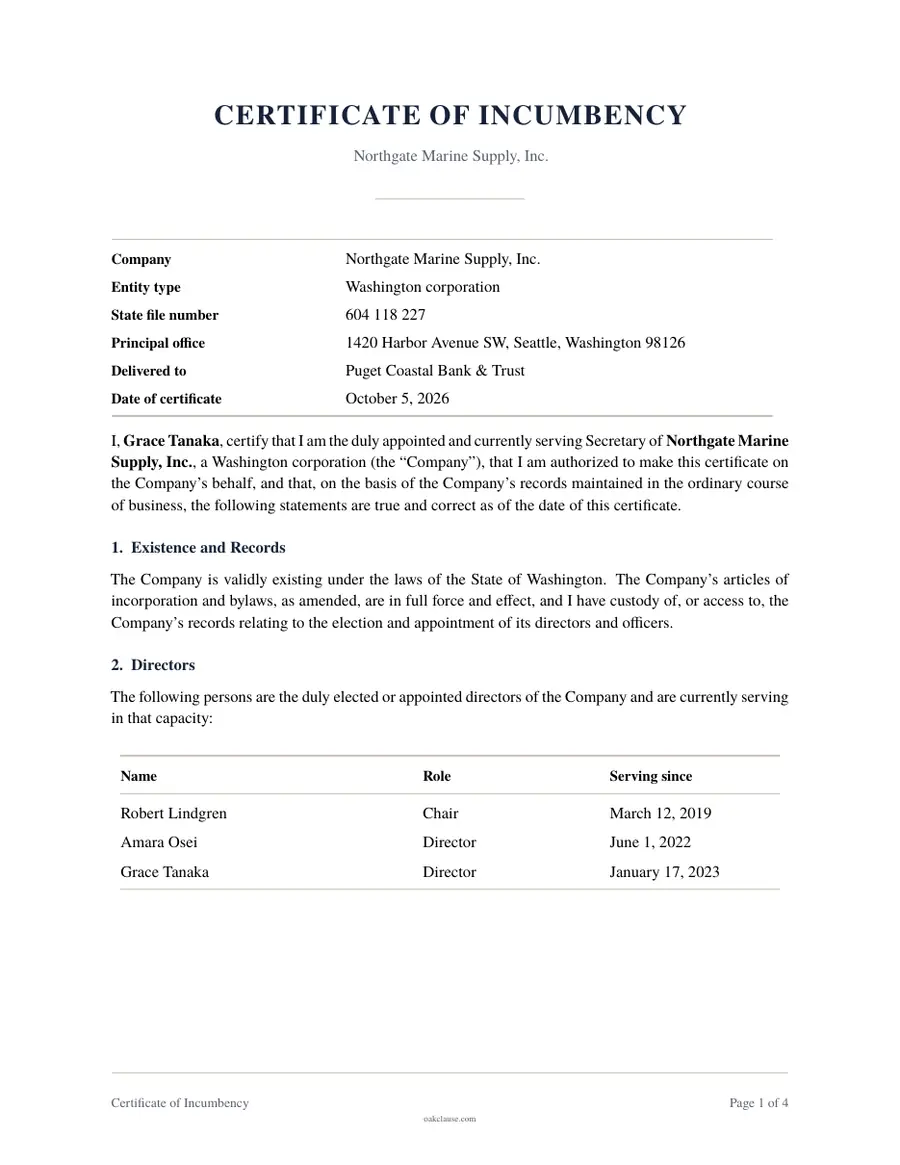
A certificate of incumbency, sometimes called an incumbency certificate or officer's certificate, is a short document in which a company officer, usually the secretary, formally confirms who currently holds the company's key positions. It typically lists the directors and officers, their titles and, often, a sample of each officer's signature.
Third parties use it to confirm that the people signing documents on a company's behalf really have the authority to do so. Banks ask for one when opening accounts or approving loans, title companies and lenders ask for one at closings, and foreign authorities or counterparties often ask for one, sometimes notarized or apostilled, before recognizing a US company's signatories.
Because the certifying officer cannot reliably vouch for their own position, the certificate can be countersigned by a second officer who confirms the certifying officer's role. The document is based on the company's own records, such as its bylaws or operating agreement, minutes and resolutions, so those records should be up to date before it is signed.
When to use it
- Your bank asks for proof of who may sign on the company's accounts.
- A lender, title company or escrow agent needs to confirm the signers at a closing.
- A customer, supplier or investor asks you to confirm the company's current officers.
- You need a notarized officer certificate for a foreign transaction or apostille.
- Officers or directors have changed and you want to give partners an updated list.
What is included
- Company name, entity type, state of formation and file number
- Certifying officer's name and title
- Current directors or managers
- Current officers with titles and specimen signature lines
- Statement of authority to sign on the company's behalf
- Optional reference to an authorizing resolution or specific transaction
- Optional countersignature confirming the certifying officer
- Optional notary acknowledgment
How to make your Certificate of Incumbency
Answer the questions
Tell us about the parties and the terms you want. Most documents take about 5 to 20 minutes.
Review the preview
Check the draft as you go and change any answer. The document updates instantly.
Download, sign and keep a copy
Download a print-ready PDF, sign it with the other parties, and give everyone a copy.
Frequently asked questions
Who signs a certificate of incumbency?
Usually the corporate secretary, because the secretary keeps the company's records. Another officer, such as an assistant secretary, president or, for an LLC, a manager or member, can sign if the company's governing documents allow it.
Why would a second officer countersign the certificate?
A person cannot convincingly certify their own appointment. A countersignature by a second officer confirming that the certifying officer holds that office closes the loop, and many banks and lenders expect it.
Does a certificate of incumbency need to be notarized?
Not always. Many domestic banks and partners accept a signed certificate without notarization. Notarization is common, and sometimes required, when the certificate will be used abroad, will be apostilled, or is requested by a lender or title company. Ask the recipient what they require.
What is a specimen signature?
It is a sample of an officer's actual signature placed next to their name. The recipient can compare it with signatures on later documents to confirm they were signed by the authorized person.
How long is a certificate of incumbency valid?
It speaks only as of the date it is signed. Many banks and lenders want one dated within a recent period, often a few weeks or months, and you should give recipients a new certificate whenever directors or officers change.
Can an LLC issue a certificate of incumbency?
Yes. An LLC can certify its current managers, managing members and officers in the same way. This form lets you choose a corporation or an LLC and adjusts the terminology.
What is the difference between a certificate of incumbency and a certificate of good standing?
A certificate of incumbency is issued by the company itself and lists its officers and directors. A certificate of good standing is issued by the state and confirms that the company exists and is current with state filings and fees. Recipients often ask for both.