South Dakota Activity Waiver
Make sure participants understand the risks before they take part.
Includes 30 days of edits
- 5 to 20 minutes
- Print-ready PDF
- Tailored to South Dakota
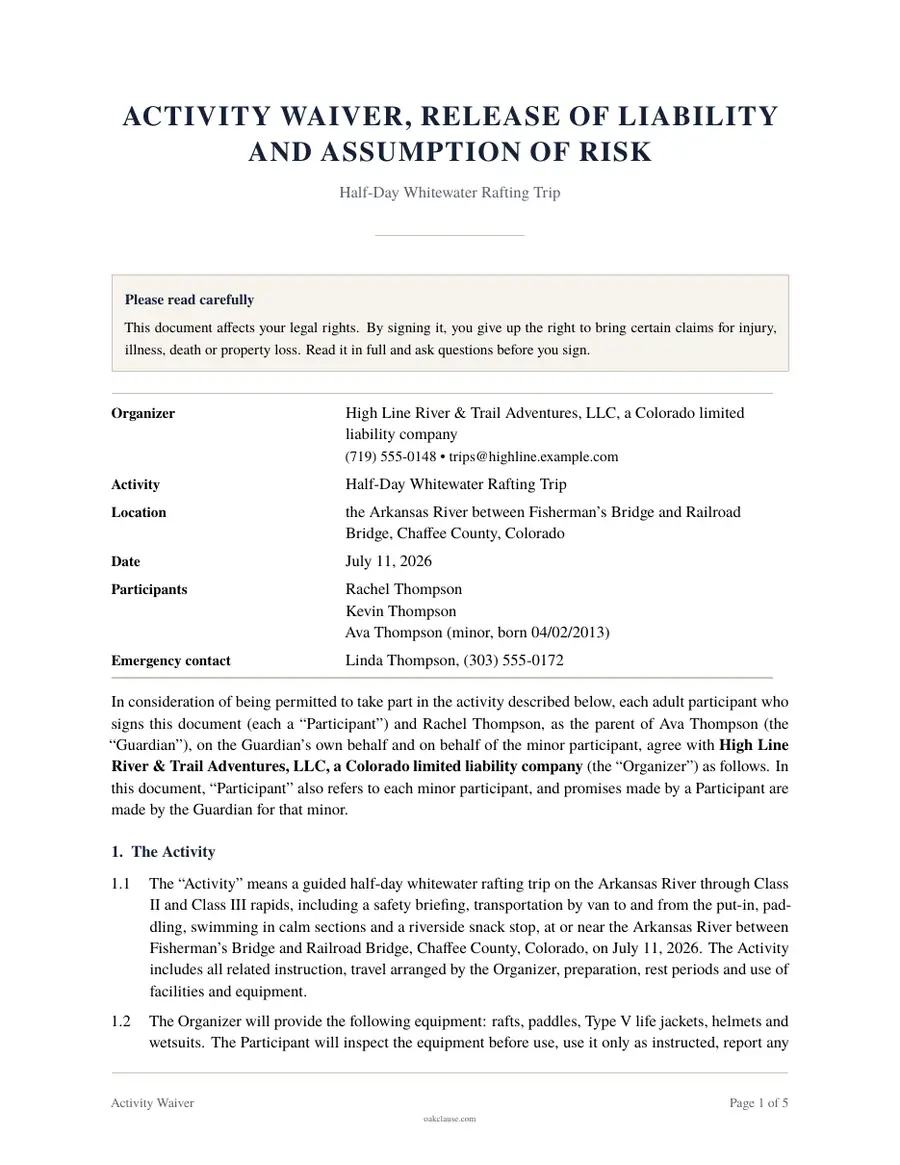
Activity Waiver rules in South Dakota
Whether a waiver is enforceable depends heavily on state law. States differ on whether a participant can release the organizer's own ordinary negligence, how clearly and prominently that release must be written, whether a parent can sign away a child's claims, and whether certain activities or businesses are treated differently. A few states are known for rarely enforcing pre-injury releases, while many others enforce them when they are clear. Every state refuses to enforce a waiver of gross negligence or intentional misconduct. This waiver uses conspicuous, plain-language wording, excludes gross negligence and willful misconduct, and applies its release only to the extent permitted by the law of the state you choose.
When you create this document for South Dakota, the questionnaire uses South Dakota as the governing law and adds wording that defers to South Dakota requirements where they apply. Laws change, so confirm current rules with official South Dakota sources or a local attorney for anything critical.
What is an Activity Waiver?
An activity waiver, also called a participant waiver or assumption of risk agreement, is a document that participants sign before taking part in an activity, class, trip or event. By signing, they confirm that they understand the risks involved, accept those risks, and give up certain legal claims against the organizer if they are injured.
Waivers are used for everything from fitness classes, climbing gyms and horseback riding to volunteer projects, sports leagues, field trips and adventure tours. A good waiver describes the activity in plain terms, lists the specific risks, sets out the rules participants agree to follow and records each participant's signature. Many also include permission for emergency medical treatment and, where needed, a parent or guardian signature for minors.
Courts look carefully at waivers, and the rules differ from state to state. Some states enforce releases of the organizer's ordinary negligence when the language is clear and conspicuous, while others limit them, and no state allows a waiver to excuse gross negligence or intentional harm. A waiver still has value even where a release is limited, because a signed assumption of risk shows the participant was told about the dangers.
When to use it
- You run a gym, studio, climbing wall, trampoline park or other recreational facility.
- You organize a race, tournament, adventure trip, tour or outdoor excursion.
- You lead classes, camps or workshops where participants could be hurt.
- Your nonprofit or community group relies on volunteers for physical work or events.
- You rent equipment such as bikes, kayaks or paddleboards and want riders to acknowledge the risks.
What is included
- Description of the activity, location and dates
- List of specific risks the participant acknowledges
- Participant rules and conduct requirements
- Assumption of risk and release of claims, with initials lines
- Optional release of the organizer's ordinary negligence and indemnity
- Health declaration and emergency medical treatment consent
- Optional photo and video release
- Parent or guardian consent and signature for minor participants
- Emergency contact, governing law and signatures for every adult participant
How to make your Activity Waiver
Answer the questions
Tell us about the parties and the terms you want. Most documents take about 5 to 20 minutes.
Review the preview
Check the draft as you go and change any answer. The document updates instantly.
Download, sign and keep a copy
Download a print-ready PDF, sign it with the other parties, and give everyone a copy.
Activity Waiver in another state
Back to the general activity waiver page51 states shown
- ALAlabama
- AKAlaska
- AZArizona
- ARArkansas
- CACalifornia
- COColorado
- CTConnecticut
- DEDelaware
- DCDistrict of Columbia
- FLFlorida
- GAGeorgia
- HIHawaii
- IDIdaho
- ILIllinois
- INIndiana
- IAIowa
- KSKansas
- KYKentucky
- LALouisiana
- MEMaine
- MDMaryland
- MAMassachusetts
- MIMichigan
- MNMinnesota
- MSMississippi
- MOMissouri
- MTMontana
- NENebraska
- NVNevada
- NHNew Hampshire
- NJNew Jersey
- NMNew Mexico
- NYNew York
- NCNorth Carolina
- NDNorth Dakota
- OHOhio
- OKOklahoma
- OROregon
- PAPennsylvania
- RIRhode Island
- SCSouth Carolina
- SDSouth Dakota
- TNTennessee
- TXTexas
- UTUtah
- VTVermont
- VAVirginia
- WAWashington
- WVWest Virginia
- WIWisconsin
- WYWyoming
Frequently asked questions
Are activity waivers legally enforceable?
Often, but not always. Many states enforce waivers that are clear, specific and prominently worded, especially for recreational activities. Some states limit or refuse releases of an organizer's own negligence, and no state lets a waiver excuse gross negligence or intentional harm. Checking your state's approach is worthwhile.
What is the difference between a waiver and an assumption of risk?
An assumption of risk is the participant's acknowledgment that the activity has inherent dangers and that they accept them. A waiver or release is the participant's promise not to sue over injuries. This document includes both, because each can help where the other is limited.
Can a parent sign a waiver for a child?
A parent or guardian can sign to consent to a child's participation and to medical treatment, but states disagree about whether a parent can give up a child's right to sue. Some states enforce parental waivers, some only for certain activities, and others do not enforce them at all. This waiver includes a parent signature and applies only as far as state law allows.
Should I list specific risks in the waiver?
Yes. Courts are more likely to uphold a waiver when the participant was told about the particular dangers involved, rather than relying only on general language. Choose the risks that apply and add any that are unique to your activity.
Does a waiver protect me if I am careless?
It may cover ordinary negligence in states that allow it, if the waiver says so clearly. It will not protect against gross negligence, reckless conduct or intentional harm. A waiver is not a substitute for safe practices, trained staff, well-maintained equipment and liability insurance.
Can one waiver cover several people?
Yes. This waiver can list several participants, such as a family, with each adult signing for themselves and a parent or guardian signing for any minors. Many organizers still prefer one waiver per adult for clearer records.
Does an activity waiver need to be notarized or witnessed?
Generally no. A signature from each adult participant and from the parent or guardian of each minor is usually enough. An optional witness line is available if you want extra proof of signing.
How long should I keep signed waivers?
Keep them at least as long as someone could bring a claim. Deadlines for injury lawsuits vary by state, and for minors they often do not start running until the child becomes an adult, so many organizers keep waivers for many years.
More South Dakota documents
Other documents people prepare for South Dakota, each with the state’s rules where we have checked them.
All South Dakota documents and rules