Connecticut Warranty Deed
Sell or transfer real estate with the seller's written promise that the title is good and will be defended.
Includes 30 days of edits
- 5 to 20 minutes
- Print-ready PDF
- Tailored to Connecticut
Connecticut rules at a glance
Deed signing and recording
- Notary acknowledgment
- Required to record
- Witnesses
- 2 witnesses
- Transfer tax
- State tax applies
- Exemptions may apply
A Connecticut deed must be acknowledged by the grantor and attested by two witnesses, and a state and municipal real estate conveyance tax applies to transfers for consideration of $2,000 or more.
When you create this warranty deed for Connecticut, the questionnaire uses Connecticut as the governing law and adds wording that defers to Connecticut requirements where they apply.
General information, not legal advice. Laws change, and cities can add their own rules, so check the current statute before you rely on it.
What is a Warranty Deed?
A warranty deed is the document a property owner (the grantor) signs to transfer real estate to a new owner (the grantee) while guaranteeing the title. In it, the grantor promises that they own the property, have the right to sell it, that it is free of liens and claims other than those listed in the deed, and that they will defend the grantee if someone later challenges the title.
There are two main versions. A general warranty deed covers the entire history of the property, so the grantor stands behind the title even for problems that arose before they owned it. A special warranty deed, sometimes called a limited warranty deed, only covers problems created while the grantor owned the property. General warranty deeds are common in residential sales; special warranty deeds are often used by businesses, banks and fiduciaries.
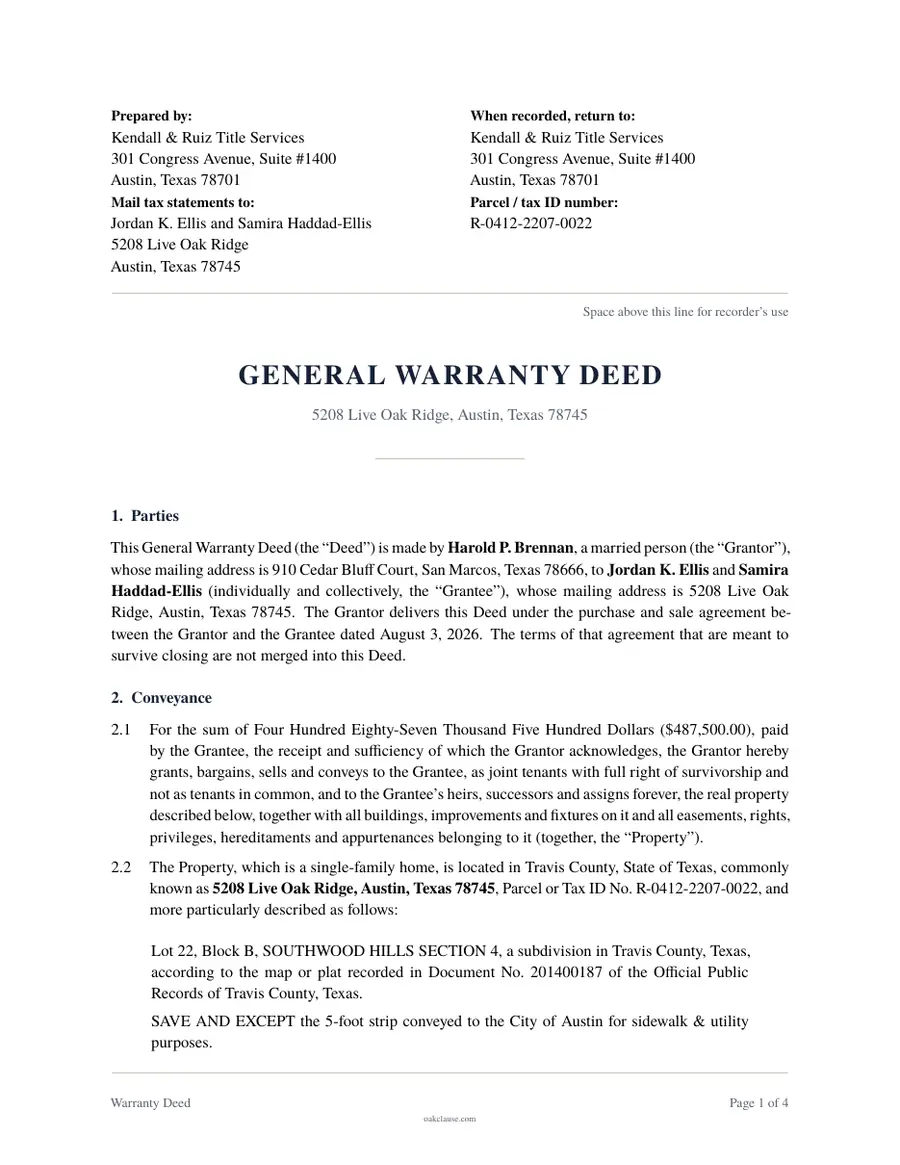
Like every deed, a warranty deed must describe the property precisely, be signed by the grantor, acknowledged before a notary and recorded in the county where the land is located. This document includes a recording block, a full legal description, a schedule of permitted exceptions, the title covenants, optional spousal joinder, witness lines and a notary acknowledgment.
When to use it
- You are selling a home or land and the buyer expects a deed that guarantees the title.
- Your purchase contract calls for the seller to deliver a general or special warranty deed at closing.
- Your company, or an estate or trust you manage, is selling property and will only warrant title for the period it owned it.
- You are transferring property to a family member or business partner and want to give them the same title protection a buyer would get.
- You want the deed to list the exact easements, taxes and mortgages the new owner is taking the property subject to.
What is included
- Recording block with preparer, return address and tax statement address
- Grantor and grantee details for individuals, businesses and trustees
- Purchase price or nominal consideration recital
- Legal description, parcel number and prior deed reference
- Co-ownership wording for multiple grantees
- Schedule of permitted exceptions, including assumed mortgages
- General or special warranty covenants
- Spousal joinder to release marital or homestead rights
- Signature lines with optional witnesses
- Notary acknowledgment
How to make your Warranty Deed
Answer the questions
Tell us about the parties and the terms you want. Most documents take about 5 to 20 minutes.
Review the preview
Check the draft as you go and change any answer. The document updates instantly.
Download, sign and keep a copy
Download a print-ready PDF, sign it with the other parties, and give everyone a copy.
Warranty Deed in another state
Back to the general warranty deed page51 states shown
- ALAlabama
- AKAlaska
- AZArizona
- ARArkansas
- CACalifornia
- COColorado
- CTConnecticut
- DEDelaware
- DCDistrict of Columbia
- FLFlorida
- GAGeorgia
- HIHawaii
- IDIdaho
- ILIllinois
- INIndiana
- IAIowa
- KSKansas
- KYKentucky
- LALouisiana
- MEMaine
- MDMaryland
- MAMassachusetts
- MIMichigan
- MNMinnesota
- MSMississippi
- MOMissouri
- MTMontana
- NENebraska
- NVNevada
- NHNew Hampshire
- NJNew Jersey
- NMNew Mexico
- NYNew York
- NCNorth Carolina
- NDNorth Dakota
- OHOhio
- OKOklahoma
- OROregon
- PAPennsylvania
- RIRhode Island
- SCSouth Carolina
- SDSouth Dakota
- TNTennessee
- TXTexas
- UTUtah
- VTVermont
- VAVirginia
- WAWashington
- WVWest Virginia
- WIWisconsin
- WYWyoming
Frequently asked questions
Does a deed need to be notarized in Connecticut?
Yes, in general. A Connecticut deed must be acknowledged by the grantor and attested by two witnesses, and a state and municipal real estate conveyance tax applies to transfers for consideration of $2,000 or more.
How many witnesses does a deed need in Connecticut?
Two. A Connecticut deed must be acknowledged by the grantor and attested by two witnesses, and a state and municipal real estate conveyance tax applies to transfers for consideration of $2,000 or more.
Is there a real estate transfer tax in Connecticut?
Yes. Connecticut charges a state transfer tax or similar fee when a deed is recorded. Some transfers may be exempt, so check the current statute.
Where do the Connecticut rules for deeds come from?
They come from Conn. Gen. Stat. ch. 821 (incl. 47-5) and Conn. Gen. Stat. ch. 223 (incl. 12-494). We last checked them in October 2026. Laws change, so check the current statute before you rely on it.
What is the difference between a general and a special warranty deed?
A general warranty deed guarantees the title against every defect, no matter when it arose. A special warranty deed guarantees only against defects that arose while the grantor owned the property, such as a lien the grantor created. Buyers usually prefer a general warranty deed, while sellers such as banks, estates and companies often offer only a special warranty.
Is a warranty deed better than a quitclaim deed?
For the grantee, yes. A warranty deed comes with promises about the title and a right to sue the grantor if those promises are broken. A quitclaim deed comes with no promises at all. Quitclaim deeds are mostly used between family members or to clear up title issues, not in ordinary sales.
Do I still need title insurance if I get a warranty deed?
Many buyers and nearly all mortgage lenders still want title insurance. A warranty deed is only as valuable as the grantor's ability to pay if a claim arises, while a title insurance policy is backed by an insurance company and usually includes a title search before closing.
What are permitted exceptions?
They are the matters the grantee agrees to take the property subject to, such as recorded utility easements, homeowners association restrictions, zoning laws and property taxes that are not yet due. Listing them in the deed means the grantor is not breaking the warranty because those items exist.
Who prepares the warranty deed in a sale?
The seller is normally responsible for delivering the deed, though in practice it is often drafted by a closing attorney, title company or escrow agent. Individuals can prepare their own deed in many states, but some states restrict who may prepare deeds for others. Check local rules if you are preparing one for someone else.
Does a warranty deed have to be notarized and recorded?
The grantor's signature is almost always acknowledged before a notary, because recording offices require it. Recording is what puts the public on notice of the new owner, so an unrecorded deed can leave the grantee exposed to later claims. A few states also require witnesses.
Can I use a warranty deed if there is still a mortgage on the property?
Yes, but the deed should say how the mortgage is handled. In most sales the mortgage is paid off at closing. If the grantee is taking the property subject to the existing mortgage or assuming it, list it as a permitted exception. Many mortgages allow the lender to demand full repayment if the property is transferred.
What happens if a title problem shows up after closing?
If the problem is covered by the deed's warranties, the grantee can ask the grantor to defend the title or pay for the loss, and may sue if the grantor refuses. If the grantee has title insurance, the claim usually goes to the insurer first. How far back the warranty reaches depends on whether it is a general or special warranty deed.
More Connecticut documents
Other documents people prepare for Connecticut, each with the state’s rules where we have checked them.
All Connecticut documents and rules