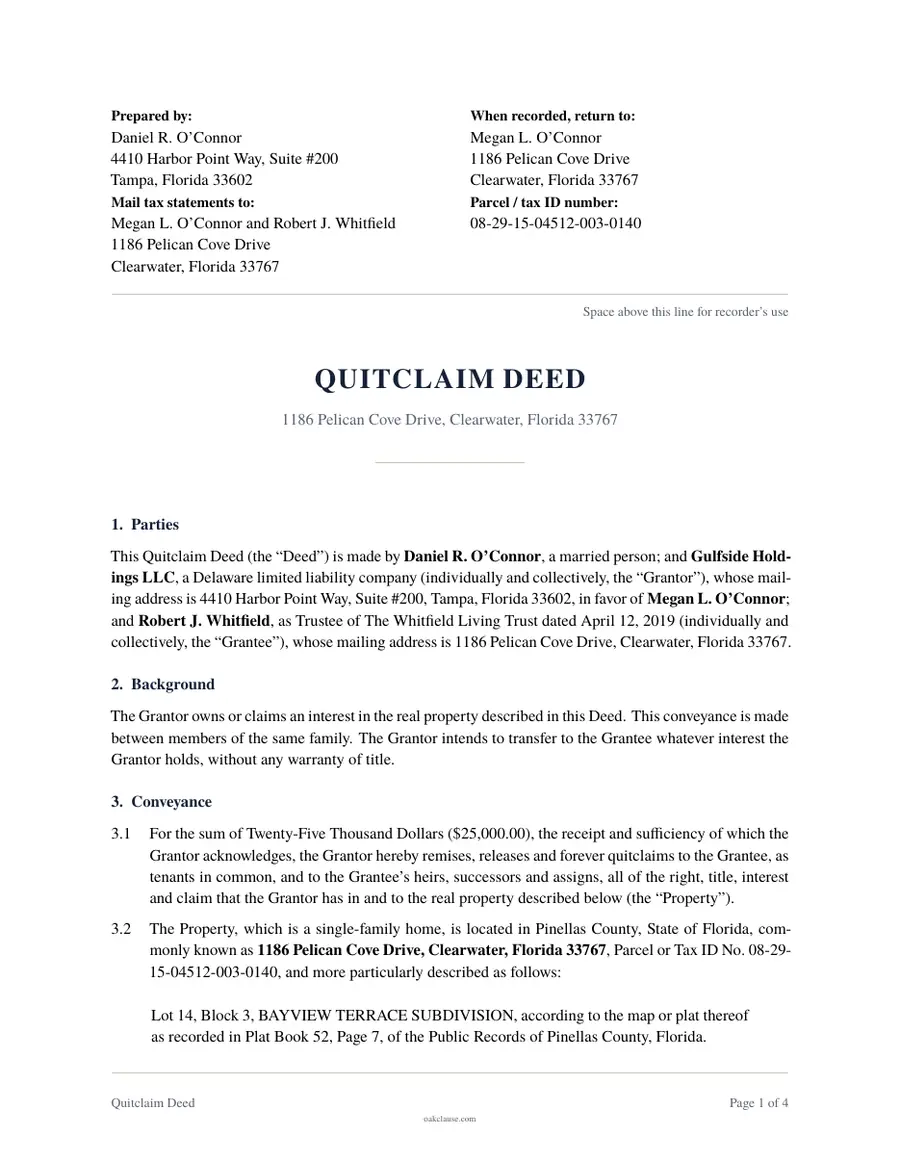
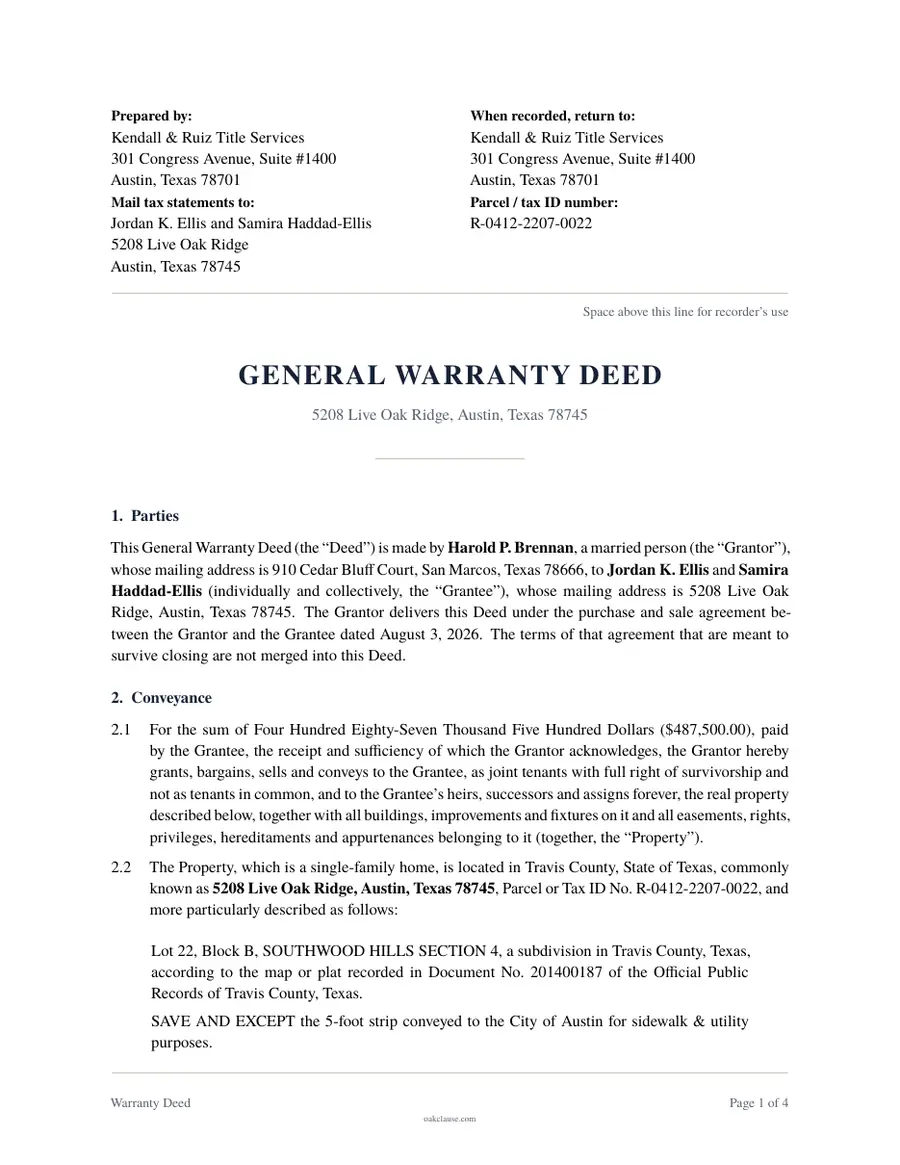
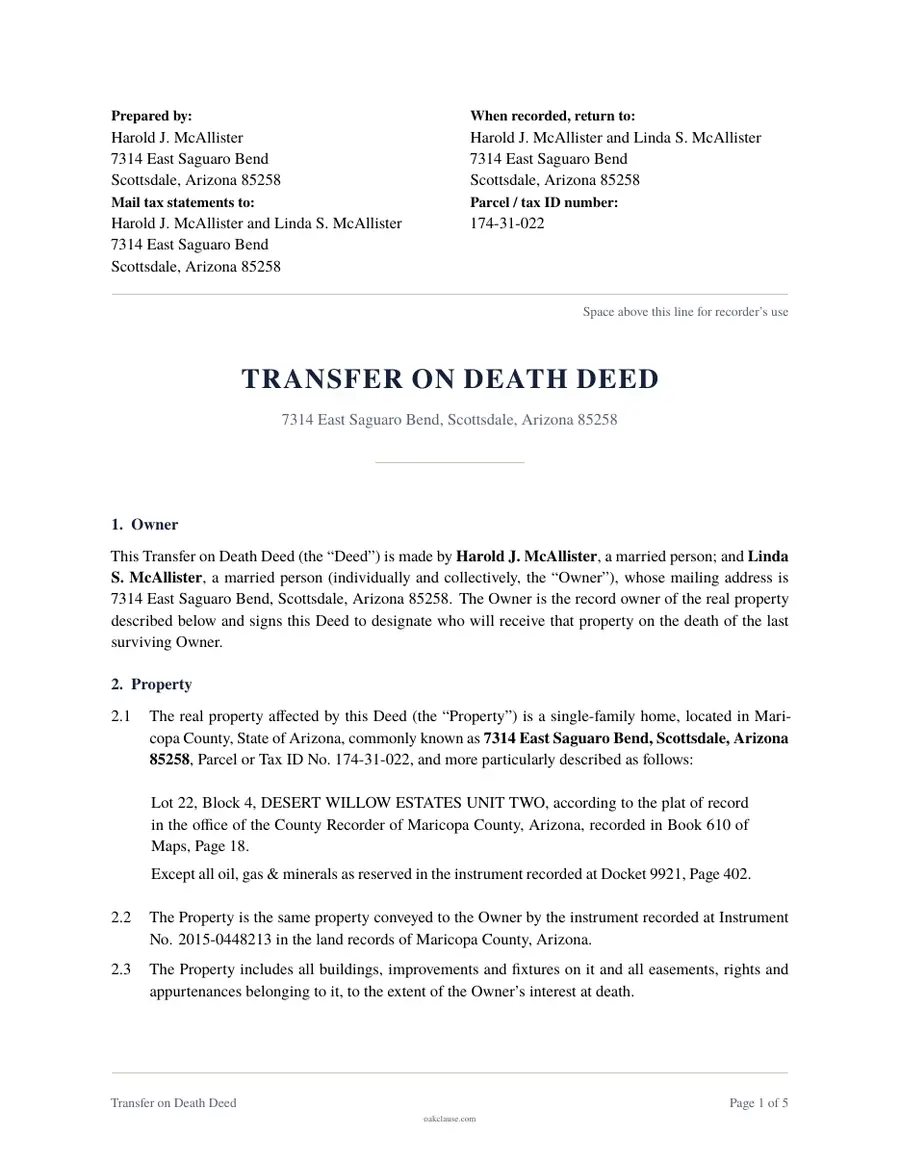
South Dakota Survivorship Deed
Put real estate in the names of two or more co-owners so that, when one of them dies, the survivors automatically own the whole property without going through probate. Create a survivorship deed for your state in minutes.
Includes 30 days of edits
- 5 to 20 minutes
- Print-ready PDF
- Tailored to South Dakota
South Dakota rules at a glance
Deed signing and recording
- Notary acknowledgment
- Required to record
- Witnesses
- None
- Transfer tax
- State tax applies
- Exemptions may apply
South Dakota requires a deed to be acknowledged (or proved) before it can be recorded, and a state real estate transfer fee of 50 cents per $500 of value is paid by the grantor.
When you create this survivorship deed for South Dakota, the questionnaire uses South Dakota as the governing law and adds wording that defers to South Dakota requirements where they apply.
General information, not legal advice. Laws change, and cities can add their own rules, so check the current statute before you rely on it.
What is a Survivorship Deed?
A survivorship deed transfers real property to two or more people as joint owners with a right of survivorship. When one co-owner dies, that person's interest does not pass under their will or through probate. Instead, it ends, and the surviving co-owners continue to own the entire property. When only one co-owner is left, that person owns it outright.
Survivorship deeds are often used by married couples, by a parent adding an adult child to the title, and by unmarried partners or relatives who buy a home together. Depending on the state and the relationship of the owners, the co-ownership may be called a joint tenancy with right of survivorship, a tenancy by the entirety (for married couples in states that recognize it) or community property with right of survivorship.
The survivorship feature only works if the deed clearly says the owners take title with a right of survivorship, so this document states that intention expressly and explains how the survivors confirm their ownership in the public records. It also includes the recording block, legal description, a choice of title warranty, optional spousal joinder, witness lines and a notary acknowledgment.
When to use it
- You want to add your spouse to the title of a home you own so it passes to them automatically at your death.
- You and another person are buying or already own property together and want the survivor to keep it.
- You are a parent who wants an adult child to receive the family home without probate.
- You want to change an existing tenancy in common into a joint tenancy with right of survivorship.
- You and your spouse want to hold title as tenants by the entirety in a state that offers it.
What is included
- Recording block with preparer, return address and tax statement address
- Grantor details for individuals, businesses and trustees
- Two or more co-owners as grantees, including the current owner if desired
- Joint tenancy, tenancy by the entirety or community property with survivorship
- Express right of survivorship clause and how survivors confirm title
- Legal description, parcel number and prior deed reference
- Choice of no warranty, special warranty or general warranty
- Spousal joinder to release marital or homestead rights
- Signature lines with optional witnesses
- Notary acknowledgment
How to make your Survivorship Deed
Answer the questions
Tell us about the parties and the terms you want. Most documents take about 5 to 20 minutes.
Review the preview
Check the draft as you go and change any answer. The document updates instantly.
Download, sign and keep a copy
Download a print-ready PDF, sign it with the other parties, and give everyone a copy.
Survivorship Deed in another state
Back to the general survivorship deed page51 states shown
- ALAlabama
- AKAlaska
- AZArizona
- ARArkansas
- CACalifornia
- COColorado
- CTConnecticut
- DEDelaware
- DCDistrict of Columbia
- FLFlorida
- GAGeorgia
- HIHawaii
- IDIdaho
- ILIllinois
- INIndiana
- IAIowa
- KSKansas
- KYKentucky
- LALouisiana
- MEMaine
- MDMaryland
- MAMassachusetts
- MIMichigan
- MNMinnesota
- MSMississippi
- MOMissouri
- MTMontana
- NENebraska
- NVNevada
- NHNew Hampshire
- NJNew Jersey
- NMNew Mexico
- NYNew York
- NCNorth Carolina
- NDNorth Dakota
- OHOhio
- OKOklahoma
- OROregon
- PAPennsylvania
- RIRhode Island
- SCSouth Carolina
- SDSouth Dakota
- TNTennessee
- TXTexas
- UTUtah
- VTVermont
- VAVirginia
- WAWashington
- WVWest Virginia
- WIWisconsin
- WYWyoming
Frequently asked questions
Does a deed need to be notarized in South Dakota?
Yes, in general. South Dakota requires a deed to be acknowledged (or proved) before it can be recorded, and a state real estate transfer fee of 50 cents per $500 of value is paid by the grantor.
How many witnesses does a deed need in South Dakota?
None. South Dakota does not require witnesses to sign a deed.
Is there a real estate transfer tax in South Dakota?
Yes. South Dakota charges a state transfer tax or similar fee when a deed is recorded. Some transfers may be exempt, so check the current statute.
Where do the South Dakota rules for deeds come from?
They come from SDCL 43-28-8 Instruments which must be acknowledged or proved before record and SDCL 43-4-21 Imposition and amount of real estate transfer fee. We last checked them in October 2026. Laws change, so check the current statute before you rely on it.
What is the difference between joint tenancy and tenancy in common?
Joint tenants share equal ownership and have a right of survivorship, so a deceased owner's share passes automatically to the surviving owners. Tenants in common can own unequal shares, and each owner's share passes under their will or estate when they die. A survivorship deed creates the first kind of ownership.
Does a survivorship deed avoid probate?
For the property it covers, generally yes. When a joint owner dies, the survivors usually only need to record a death certificate or an affidavit, as state law requires, to show they now own the property. However, when the last surviving owner dies, the property will pass through their estate unless other planning is in place.
Can I add my child to my home's title with a survivorship deed?
Yes, and it is a common use. Be aware of the trade-offs: your child becomes a present co-owner, their creditors may be able to reach their share, you may need their signature to sell or refinance, and there can be gift and income tax consequences. Some people consider a transfer-on-death deed instead, where that option is available.
What is tenancy by the entirety?
It is a form of survivorship ownership available only to married couples, and in some states to registered partners, in the states that recognize it. It works like joint tenancy but usually cannot be ended by one spouse acting alone and, in many of those states, offers protection from creditors of only one spouse.
Can a joint tenant leave their share in a will?
Generally no. Because of the right of survivorship, a joint tenant's interest ends at death and passes to the surviving owners, regardless of what their will says. A joint tenant who wants to leave their share to someone else would usually need to sever the joint tenancy first, as permitted by state law.
Do all co-owners have to sign the survivorship deed?
Every current owner who is transferring an interest must sign as a grantor. The new co-owners usually do not need to sign, although some states or title companies ask the grantees to accept the deed. In some states a non-owner spouse must sign to release homestead or marital rights.
Will a survivorship deed trigger a reassessment or transfer tax?
It might. Some states reassess property or charge transfer tax when an owner is added, while many exempt transfers between spouses, between parents and children, or for no consideration. Ask the county assessor or recorder which forms or exemption statements to file with the deed.
What happens if co-owners die at the same time?
Most states have laws addressing simultaneous deaths. Typically, if it cannot be shown that one owner survived the other, the property is split and each owner's share passes through their own estate. This is a good reason to keep a will even if your home is held with survivorship rights.
More South Dakota documents
Other documents people prepare for South Dakota, each with the state’s rules where we have checked them.
All South Dakota documents and rules