Oregon Eviction Notice
Prepare a clear written notice telling a residential tenant to pay overdue rent, correct a lease violation, or move out by a stated deadline, with wording that defers to your state's rules.
Includes 30 days of edits
- 5 to 20 minutes
- Print-ready PDF
- Tailored to Oregon
Oregon rules at a glance
Eviction notice periods
- Notice for unpaid rent
- 10 days
- 10-day notice of nonpayment (served on or after the 8th day of the rental period) or 13-day notice (served on or after the 5th day)
- Notice for a lease violation
- 14 days
- 30-day notice of termination for cause with 14 days to cure
- Ending a month-to-month tenancy
- 30 days
- 30 days' written notice during the first year of occupancy; after the first year only for cause or a qualifying landlord reason with 90 days' notice
In Oregon a landlord must give a 10-day or 13-day nonpayment notice depending on when it is served, a lease violation requires a 30-day notice with 14 days to cure, and month-to-month tenancies can be ended without cause only during the first year with 30 days' notice.
When you create this eviction notice for Oregon, the questionnaire uses Oregon as the governing law and adds wording that defers to Oregon requirements where they apply.
General information, not legal advice. Laws change, and cities can add their own rules, so check the current statute before you rely on it.
What is an Eviction Notice?
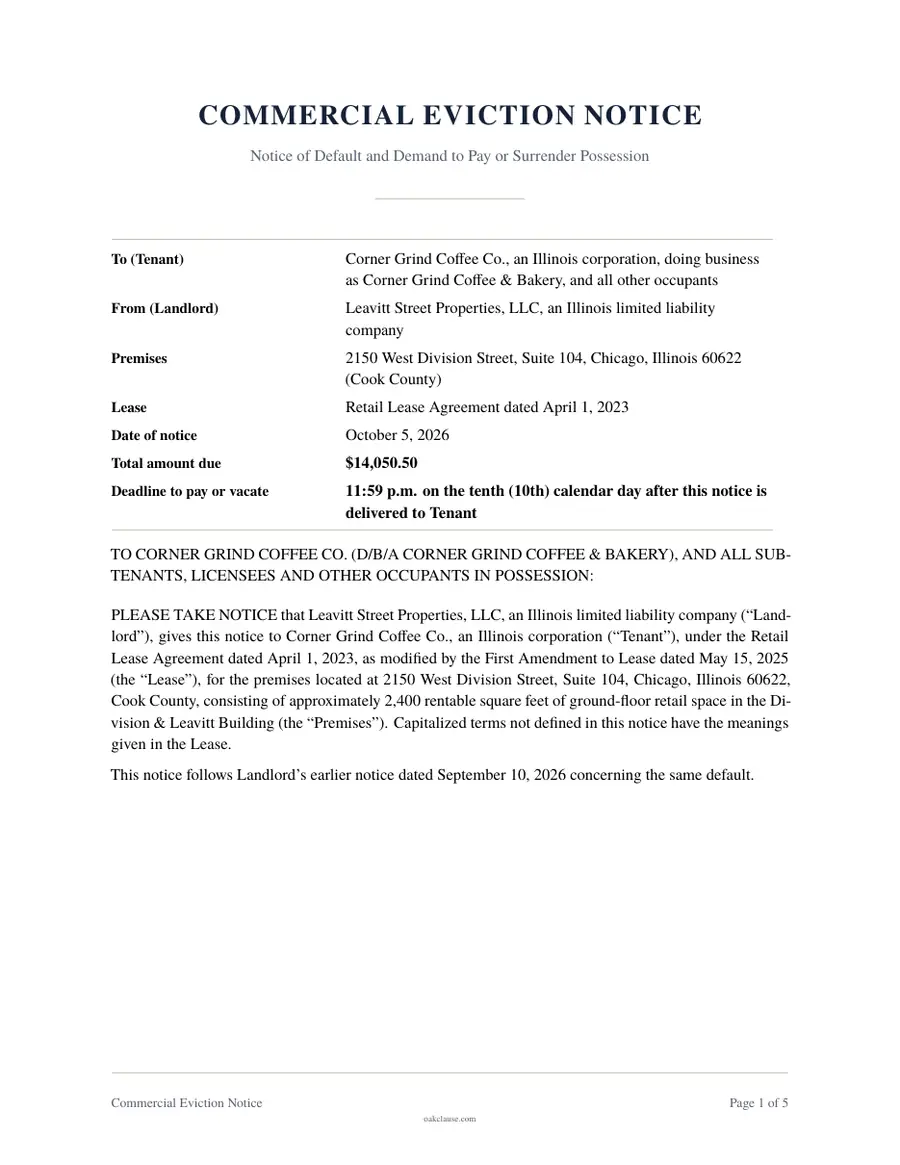
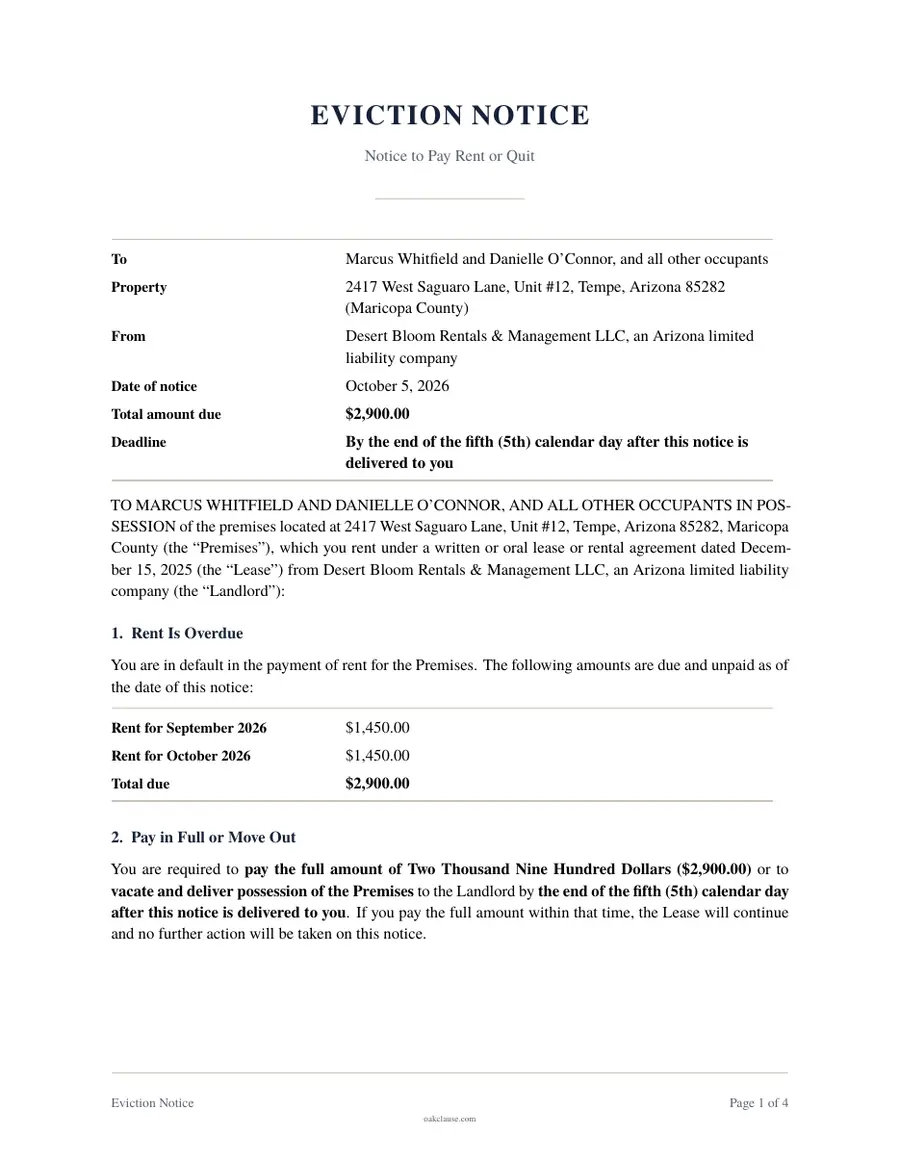
An eviction notice is the written warning a landlord gives a tenant before going to court to recover a rental home. Depending on the situation it may be called a notice to pay rent or quit, a notice to cure or quit, a notice to quit, or a notice of termination. It tells the tenant what the problem is, what they can do about it, and the date by which they must act or leave.
In almost every state, a landlord cannot file an eviction case until the right notice has been properly given and the deadline in it has passed. Courts look closely at the notice: if it names the wrong people, demands the wrong amount, gives too little time or was delivered the wrong way, the case can be dismissed and the landlord may have to start over.
This notice is a starting point for that first step. It does not remove anyone from the property, and it does not replace the court process. Only a judge can order a tenant out, and only a sheriff, marshal or similar officer can carry out that order.
When to use it
- A tenant has fallen behind on rent and you want to demand payment before taking further steps.
- A tenant is breaking a lease rule, such as an unauthorized pet or occupant, and you want to give them a chance to fix it.
- A serious violation has occurred and your state allows a notice to vacate without an opportunity to cure.
- You want to end a month-to-month tenancy and need to give written notice of the end date.
- You need a written record of the demand and of how and when it was delivered.
What is included
- Names of every tenant and a reference to all other occupants
- Property address and date of the notice
- Notice type: pay or quit, cure or quit, quit, or termination of tenancy
- Itemized amount of overdue rent and how to pay it
- Description of the lease violation and how to fix it
- Deadline to comply or vacate, deferring to state minimums
- Statement that only a court can order the tenant to leave
- Landlord or agent signature and contact details
- Optional proof of service with delivery method checkboxes
How to make your Eviction Notice
Answer the questions
Tell us about the parties and the terms you want. Most documents take about 5 to 20 minutes.
Review the preview
Check the draft as you go and change any answer. The document updates instantly.
Download, sign and keep a copy
Download a print-ready PDF, sign it with the other parties, and give everyone a copy.
Eviction Notice in another state
Back to the general eviction notice page51 states shown
- ALAlabama
- AKAlaska
- AZArizona
- ARArkansas
- CACalifornia
- COColorado
- CTConnecticut
- DEDelaware
- DCDistrict of Columbia
- FLFlorida
- GAGeorgia
- HIHawaii
- IDIdaho
- ILIllinois
- INIndiana
- IAIowa
- KSKansas
- KYKentucky
- LALouisiana
- MEMaine
- MDMaryland
- MAMassachusetts
- MIMichigan
- MNMinnesota
- MSMississippi
- MOMissouri
- MTMontana
- NENebraska
- NVNevada
- NHNew Hampshire
- NJNew Jersey
- NMNew Mexico
- NYNew York
- NCNorth Carolina
- NDNorth Dakota
- OHOhio
- OKOklahoma
- OROregon
- PAPennsylvania
- RIRhode Island
- SCSouth Carolina
- SDSouth Dakota
- TNTennessee
- TXTexas
- UTUtah
- VTVermont
- VAVirginia
- WAWashington
- WVWest Virginia
- WIWisconsin
- WYWyoming
Frequently asked questions
How much notice does a landlord have to give for unpaid rent in Oregon?
Oregon rule: 10-day notice of nonpayment (served on or after the 8th day of the rental period) or 13-day notice (served on or after the 5th day).
How much notice is required to evict for a lease violation in Oregon?
Oregon rule: 30-day notice of termination for cause with 14 days to cure.
How much notice is needed to end a month-to-month tenancy in Oregon?
Oregon rule: 30 days' written notice during the first year of occupancy; after the first year only for cause or a qualifying landlord reason with 90 days' notice.
Where do the Oregon rules for eviction notices come from?
They come from ORS 90.394 Termination of tenancy for failure to pay rent, ORS 90.392 Termination of tenancy for cause and ORS 90.427 Termination of periodic tenancies. We last checked them in October 2026. Laws change, so check the current statute before you rely on it.
What is the difference between a pay or quit notice and a cure or quit notice?
A pay or quit notice is used when rent is overdue: the tenant can stay by paying the stated amount before the deadline. A cure or quit notice is used for other lease violations: the tenant can stay by fixing the problem, such as removing an unauthorized pet, before the deadline. In both cases the tenant may instead move out.
How much time does a tenant get after an eviction notice?
It depends on the state, the reason for the notice and sometimes the city. Some states allow only a few days for unpaid rent, while others require a much longer period, and ending a month-to-month tenancy usually takes longer still. Check your state's current law and enter a deadline that meets or exceeds the minimum.
Can I change the locks or remove the tenant's belongings after the deadline passes?
In nearly every state, no. Changing locks, shutting off utilities or removing a tenant's belongings without a court order is generally treated as an illegal self-help eviction and can expose a landlord to damages. After the deadline, the next step is filing an eviction case in the local court.
Should late fees be included in the amount demanded?
Many states limit a pay or quit notice to rent only, and including late fees, utilities or other charges can make the notice defective. This notice lets you list each amount separately so you can include only what your state allows. When in doubt, many landlords demand rent alone and pursue other charges separately.
How should an eviction notice be delivered?
States list the methods that count, which commonly include handing it to the tenant, leaving it with another adult at the home and mailing a copy, or posting it on the door and mailing a copy. Some states also require certified mail or allow other methods. Keep a record of exactly how and when you delivered it; the proof of service page helps with that.
Do I need to name every adult who lives in the unit?
It is good practice to name every tenant on the lease and to address the notice to all other occupants as well. Leaving someone out can complicate a later court case, because the court order may only cover the people who were properly notified.
Can a landlord accept partial rent after serving a pay or quit notice?
Accepting partial payment can, in some states, cancel the notice or waive the right to evict for that period unless the landlord follows specific steps. This notice lets you state whether partial payments will be accepted, but the effect of accepting money varies by state and is worth checking before you do it.
Is an eviction notice the same as an eviction?
No. The notice is only the first step. If the tenant does not pay, fix the problem or move out by the deadline, the landlord must file a case with the court, the tenant has a chance to respond, and only a court order allows a law enforcement officer to remove the tenant.
More Oregon documents
Other documents people prepare for Oregon, each with the state’s rules where we have checked them.
All Oregon documents and rules