Texas Prenuptial Agreement
Agree before the wedding on what stays separate, what you will share and how property, debts and support would be handled if the marriage ends.
Includes 30 days of edits
- 5 to 20 minutes
- Print-ready PDF
- Tailored to Texas
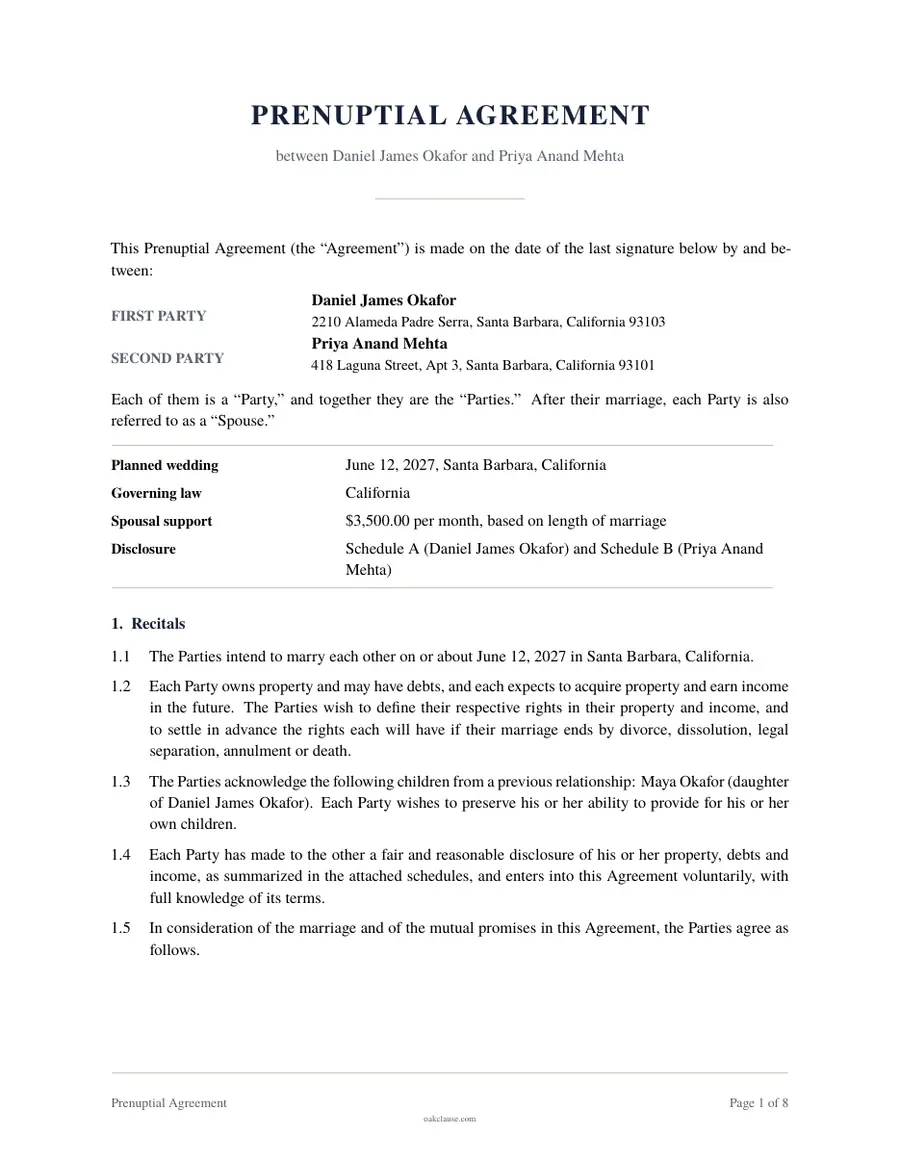
Prenup rules in Texas
Prenuptial agreements are governed by state law, and the rules differ in important ways. Many states have adopted a version of the Uniform Premarital Agreement Act or the Uniform Premarital and Marital Agreements Act, while others rely on their own statutes and court decisions. States differ on how much financial disclosure is required, whether a spousal support waiver is allowed and when it can be set aside, whether each person must have independent counsel, how long before the wedding the agreement should be presented, and whether notarization or witnesses are required. Community property states (Arizona, California, Idaho, Louisiana, Nevada, New Mexico, Texas, Washington and Wisconsin) also start from different default rules than other states. When you choose your state, the agreement uses that state's law as the governing law and adjusts its property wording, and its clauses defer to that state's requirements rather than stating specific rules.
When you create this document for Texas, the questionnaire uses Texas as the governing law and adds wording that defers to Texas requirements where they apply. Laws change, so confirm current rules with official Texas sources or a local attorney for anything critical.
What is a Prenuptial Agreement?
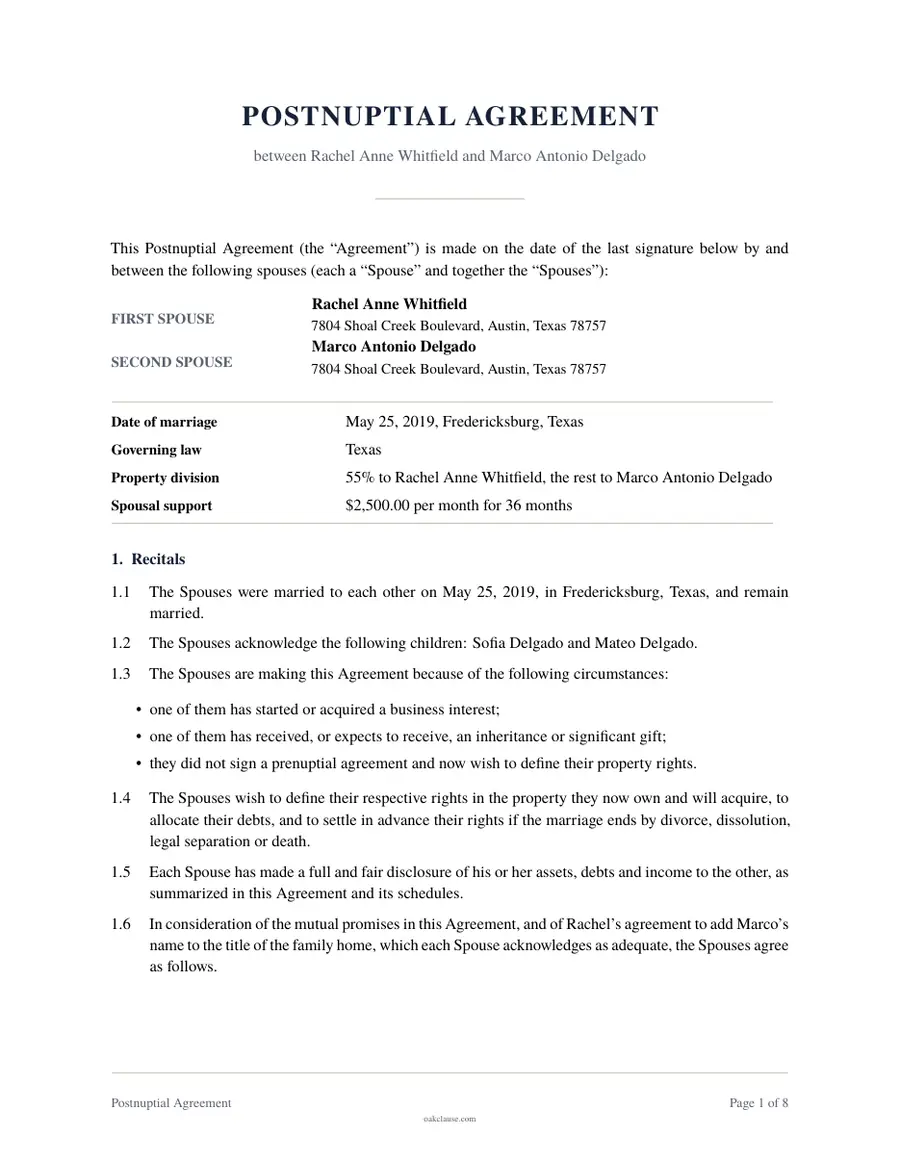
A prenuptial agreement, often called a prenup or premarital agreement, is a written contract two people sign before they marry. It sets out which property each of them keeps as their own, how income and assets acquired during the marriage will be treated, who is responsible for which debts, and what happens to property and spousal support if the marriage ends in divorce or one spouse dies.
Without a prenup, the laws of your state decide those questions for you. Depending on the state, that may mean an equitable division of marital property, an equal split of community property, or a spousal share at death that overrides a will. A prenup lets the couple replace many of those default rules with arrangements they have chosen together, which can be especially useful when one partner owns a business, has children from an earlier relationship, expects an inheritance or brings significant assets or debts into the marriage.
Courts generally enforce prenups that are in writing, signed voluntarily by both people, based on fair and full financial disclosure, and not grossly unfair when signed or when enforced. This document includes recitals, clear definitions of separate and marital property, disclosure schedules for each person, acknowledgments about legal counsel and voluntariness, and signature and notary pages.
When to use it
- You are engaged and want to agree in advance how property and debts would be divided if the marriage ends.
- One of you owns a business, real estate, investments or retirement savings that you want to keep separate.
- You have children from a previous relationship and want to protect assets for them.
- One of you is bringing significant debt into the marriage and the other does not want to share responsibility for it.
- You want to set expectations about spousal support, or decide whether it will be waived, limited or left to a court.
- You expect a future inheritance or family gift and want it to stay with you.
What is included
- Parties, wedding date and recitals explaining the purpose of the agreement
- Definitions of separate property and marital or community property
- Treatment of income and growth from separate property and earnings during the marriage
- Marital home, joint accounts and retirement account provisions
- Premarital and marital debt allocation
- Property division if the marriage ends
- Spousal support waiver, fixed amount or reservation to the court
- Rights at death, including an optional waiver of elective share and life insurance
- Financial disclosure schedules, legal counsel and voluntariness acknowledgments
- Optional sunset clause, confidentiality, dispute resolution, and notary pages
How to make your Prenup
Answer the questions
Tell us about the parties and the terms you want. Most documents take about 5 to 20 minutes.
Review the preview
Check the draft as you go and change any answer. The document updates instantly.
Download, sign and keep a copy
Download a print-ready PDF, sign it with the other parties, and give everyone a copy.
Prenup in another state
Back to the general prenup page51 states shown
- ALAlabama
- AKAlaska
- AZArizona
- ARArkansas
- CACalifornia
- COColorado
- CTConnecticut
- DEDelaware
- DCDistrict of Columbia
- FLFlorida
- GAGeorgia
- HIHawaii
- IDIdaho
- ILIllinois
- INIndiana
- IAIowa
- KSKansas
- KYKentucky
- LALouisiana
- MEMaine
- MDMaryland
- MAMassachusetts
- MIMichigan
- MNMinnesota
- MSMississippi
- MOMissouri
- MTMontana
- NENebraska
- NVNevada
- NHNew Hampshire
- NJNew Jersey
- NMNew Mexico
- NYNew York
- NCNorth Carolina
- NDNorth Dakota
- OHOhio
- OKOklahoma
- OROregon
- PAPennsylvania
- RIRhode Island
- SCSouth Carolina
- SDSouth Dakota
- TNTennessee
- TXTexas
- UTUtah
- VTVermont
- VAVirginia
- WAWashington
- WVWest Virginia
- WIWisconsin
- WYWyoming
Frequently asked questions
When should we sign a prenuptial agreement?
As early as possible, and well before the wedding. Signing at the last minute can support an argument that one person felt pressured, and some states set a minimum waiting period between receiving the final agreement and signing it. Giving each person time to review the draft and consult a lawyer makes the agreement much harder to challenge.
Does each of us need our own lawyer?
Not every state requires it, but it is strongly recommended. Separate attorneys help show that each person understood the agreement and signed it voluntarily, and some states apply stricter rules to spousal support waivers when a party had no lawyer. One lawyer should never represent both of you.
Can a prenup decide child custody or child support?
No. Courts decide custody, parenting time and child support based on the child's best interests at the time of divorce, and parents cannot waive a child's right to support in advance. This agreement states expressly that it does not limit those matters.
What makes a prenuptial agreement invalid?
Common reasons include signing under pressure or duress, hiding or understating assets or debts, terms that are unconscionable or would leave a spouse dependent on public assistance, and failing to meet the state's signing formalities. Full financial disclosure, time to review and independent counsel are the best protections.
Do we really need to disclose all of our finances?
Yes. Fair and reasonable disclosure of assets, debts and income is one of the main things courts look for. The disclosure schedules attached to this agreement list each person's significant assets, debts and approximate income. Many couples also exchange tax returns or account statements.
Can we change or cancel a prenup after the wedding?
Yes. Most states allow spouses to amend or revoke a premarital agreement by a later written agreement signed by both of them. This document requires any change to be in writing and signed by both spouses, and you can also include a sunset clause that ends the agreement after a set number of years.
What is the difference between a prenup and a postnup?
A prenuptial agreement is signed before the wedding and takes effect when you marry. A postnuptial agreement covers similar topics but is signed by people who are already married. Courts in many states review postnups more closely because spouses already owe each other duties of fairness.
Does a prenup replace a will?
No. A prenup can waive or limit the rights a spouse would otherwise have at death, but it does not distribute your property by itself. You will usually want a will or trust, and updated beneficiary designations, that match what the prenup says.
Is a prenup only for wealthy people?
No. Couples use prenups to protect a small business, a home bought before the marriage, retirement savings, family heirlooms or expected inheritances, and to keep one partner from becoming responsible for the other's student loans or credit card debt.
More Texas documents
Other documents people prepare for Texas, each with the state’s rules where we have checked them.
All Texas documents and rules