Washington Power of Attorney for a Child
Give a trusted relative or friend temporary legal authority to care for your child, enroll them in school and approve medical care while you are away, without going to court.
Includes 30 days of edits
- 5 to 20 minutes
- Print-ready PDF
- Tailored to Washington
Child POA rules in Washington
Delegating parental authority is governed by state law, and the rules differ in important ways. Many states limit how long a parent's delegation can last before it must be renewed, and some allow a longer period for parents on military deployment. Some states have a statutory form or a separate caregiver's affidavit for school enrollment and medical care, some require notarization or witnesses, and some require notice to a parent who is not signing. Most states do not let a parent delegate consent to the child's marriage or adoption. This document names the state you choose and defers to its law on duration, delegable powers and notice, using general wording rather than a state statutory form, specific time limits, or witness or notice rules. If you pick an end date later than your state allows, the document provides that it ends at the state limit instead. Some states require their own statutory form, so check your state's current requirements or ask a local attorney before relying on it.
When you create this document for Washington, the questionnaire uses Washington as the governing law and adds wording that defers to Washington requirements where they apply. Laws change, so confirm current rules with official Washington sources or a local attorney for anything critical.
What is a Power of Attorney for a Child?
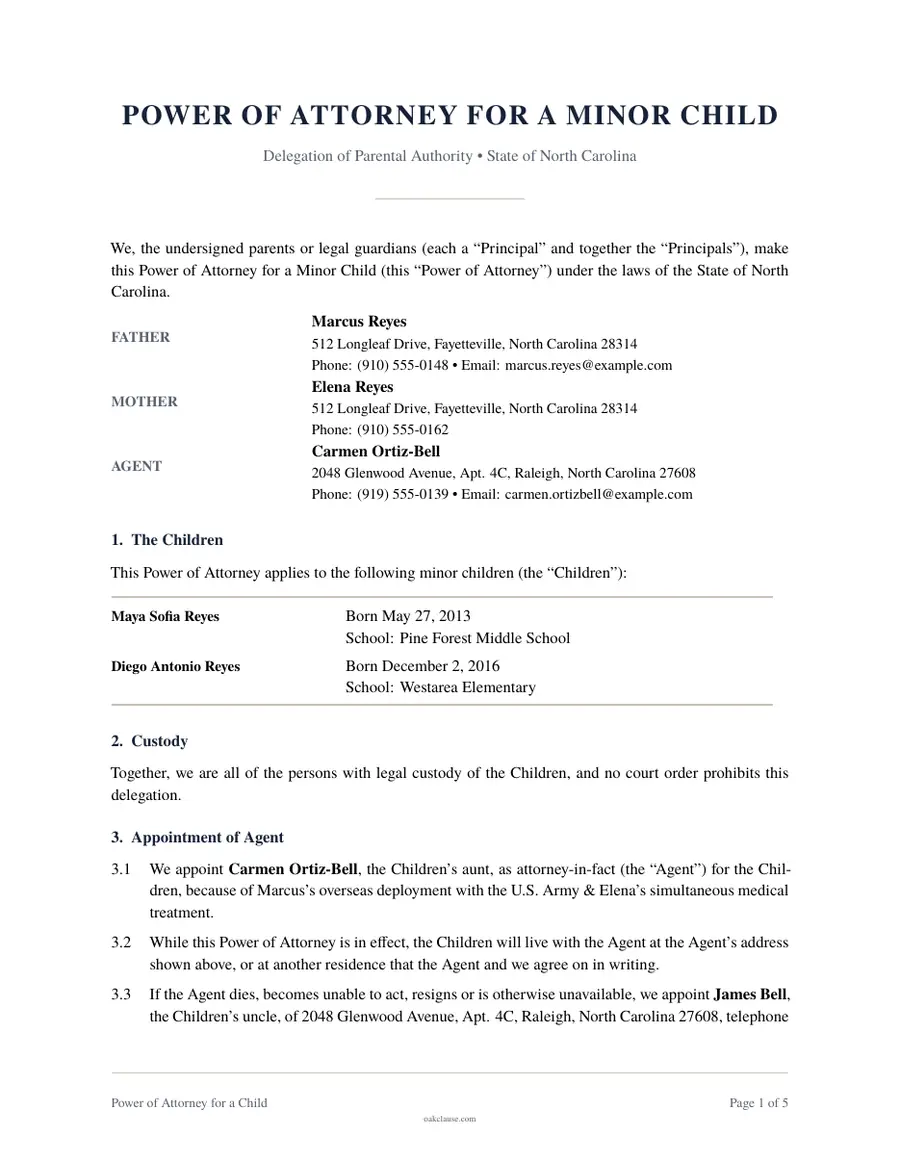
A power of attorney for a child, sometimes called a delegation of parental authority, is a document in which a parent or legal guardian gives another adult (the agent) temporary authority to make decisions for a minor child. The agent can then handle the everyday matters a parent normally handles, such as school enrollment, medical consent, activities and travel, while the parent is unavailable.
Parents use it during military deployment, extended work assignments, a hospital stay or treatment, travel, or any period when the child lives with a grandparent or other relative. Unlike a court-ordered guardianship, it can be set up quickly and privately, the parent keeps full parental rights, and the parent can revoke it at any time.
Most states allow parents to delegate parental powers this way, but they set their own rules on how long the delegation may last, which powers may be delegated, and how the document must be signed. Certain decisions, such as consent to a child's marriage or adoption, generally cannot be delegated. This document names the selected state and defers to that state's law on duration, delegable powers and notice, rather than reproducing a state's statutory form. Some states require their own statutory form, so check your state's requirements. Optional notary, witness and agent acceptance pages are included.
When to use it
- You are deploying with the military and your child will stay with a relative or friend.
- You will be hospitalized, in treatment or otherwise unable to care for your child for a period of time.
- Your child will live with grandparents or another relative to attend school in a different area.
- You are traveling or working abroad for an extended period and your child is staying behind.
- You want a back-up plan so a trusted adult can act immediately if something unexpected happens.
What is included
- Parents or guardians granting authority and a custody statement
- Each child covered, with school details
- Agent and optional alternate agent
- Full delegation or a choice of specific powers
- Limits on non-delegable decisions and your own restrictions
- Start date, end date and state-law duration limits
- Revocation, retained parental rights and third-party reliance
- Support, expenses and agent duties
- Parent signatures, optional witnesses and notary acknowledgment
- Agent's acceptance of appointment
How to make your Child POA
Answer the questions
Tell us about the parties and the terms you want. Most documents take about 5 to 20 minutes.
Review the preview
Check the draft as you go and change any answer. The document updates instantly.
Download, sign and keep a copy
Download a print-ready PDF, sign it with the other parties, and give everyone a copy.
Child POA in another state
Back to the general child poa page51 states shown
- ALAlabama
- AKAlaska
- AZArizona
- ARArkansas
- CACalifornia
- COColorado
- CTConnecticut
- DEDelaware
- DCDistrict of Columbia
- FLFlorida
- GAGeorgia
- HIHawaii
- IDIdaho
- ILIllinois
- INIndiana
- IAIowa
- KSKansas
- KYKentucky
- LALouisiana
- MEMaine
- MDMaryland
- MAMassachusetts
- MIMichigan
- MNMinnesota
- MSMississippi
- MOMissouri
- MTMontana
- NENebraska
- NVNevada
- NHNew Hampshire
- NJNew Jersey
- NMNew Mexico
- NYNew York
- NCNorth Carolina
- NDNorth Dakota
- OHOhio
- OKOklahoma
- OROregon
- PAPennsylvania
- RIRhode Island
- SCSouth Carolina
- SDSouth Dakota
- TNTennessee
- TXTexas
- UTUtah
- VTVermont
- VAVirginia
- WAWashington
- WVWest Virginia
- WIWisconsin
- WYWyoming
Frequently asked questions
Does a power of attorney for a child give up my parental rights?
No. You keep all of your parental rights and can still make decisions for your child yourself. The agent acts alongside you, and you can revoke the authority at any time by notifying the agent in writing.
How long does a power of attorney for a child last?
It lasts for the period you choose, but many states cap how long a parental delegation can remain in effect, after which you must sign a new one. Some states allow longer periods for service members who are deployed. This document lets you choose an end date or the longest period your state allows.
Does it need to be notarized?
Many states require a power of attorney for a child to be signed in front of a notary, and schools and doctors commonly expect it. Some states also require witnesses or use a specific statutory form. The notary block is included by default; check your state's rules before signing.
Do both parents need to sign?
It depends on the state and your custody situation. When parents share legal custody, having both sign avoids disputes. Some states require that a parent who is not signing be given notice or allow that parent to object. If you have sole custody, keep a copy of the custody order with the document.
What decisions can the agent make?
You can delegate broad authority over the child's care, schooling, medical treatment, activities and travel, or choose only certain powers. Most states do not allow a parent to delegate consent to the child's marriage or adoption, and this document excludes those decisions.
How is this different from guardianship?
A guardianship is created by a court order, takes longer and usually lasts until a court ends it. A power of attorney for a child is a private document you sign yourself, takes effect quickly and can be revoked at any time. For a long-term arrangement or where the parents cannot act, guardianship may be more appropriate.
Will schools and doctors accept it?
Most schools and health care providers accept a properly signed and notarized power of attorney for a child, although some have their own forms or require a state-specific affidavit. Give the agent the original or a certified copy along with the child's insurance card and records.
Can I name a backup agent?
Yes. This document lets you name an alternate agent who can act if your first choice is unable or unwilling to serve. Both the agent and the alternate can sign an acceptance page.
More Washington documents
Other documents people prepare for Washington, each with the state’s rules where we have checked them.
All Washington documents and rules