Nebraska Transfer on Death Deed
Name the people who will receive your home or land when you die, keep full control while you are alive, and help your family avoid probate for that property. Build a recordable deed for your state in minutes.
Includes 30 days of edits
- 5 to 20 minutes
- Print-ready PDF
- Tailored to Nebraska
Nebraska rules at a glance
Deed signing and recording
- Notary acknowledgment
- Required to record
- Witnesses
- None
Nebraska deeds must be signed by the grantor and acknowledged or proved before recording, and a documentary stamp tax of $2.32 per $1,000 of value is imposed on the grantor.
When you create this transfer on death deed for Nebraska, the questionnaire uses Nebraska as the governing law and adds wording that defers to Nebraska requirements where they apply.
General information, not legal advice. Laws change, and cities can add their own rules, so check the current statute before you rely on it.
What is a Transfer on Death Deed?
A transfer on death deed, sometimes called a TOD deed or beneficiary deed, lets the owner of real estate name one or more beneficiaries who will receive the property automatically when the owner dies. It works much like a payable-on-death designation on a bank account: nothing changes during the owner's lifetime, and on death the property passes directly to the named beneficiaries without going through probate.
The owner keeps complete ownership and control while alive. The beneficiaries have no present interest, cannot block a sale or mortgage, and do not need to sign or even be told about the deed. The owner can change the beneficiaries or cancel the designation at any time by recording a new deed or a revocation, and a later sale of the property simply ends the designation.
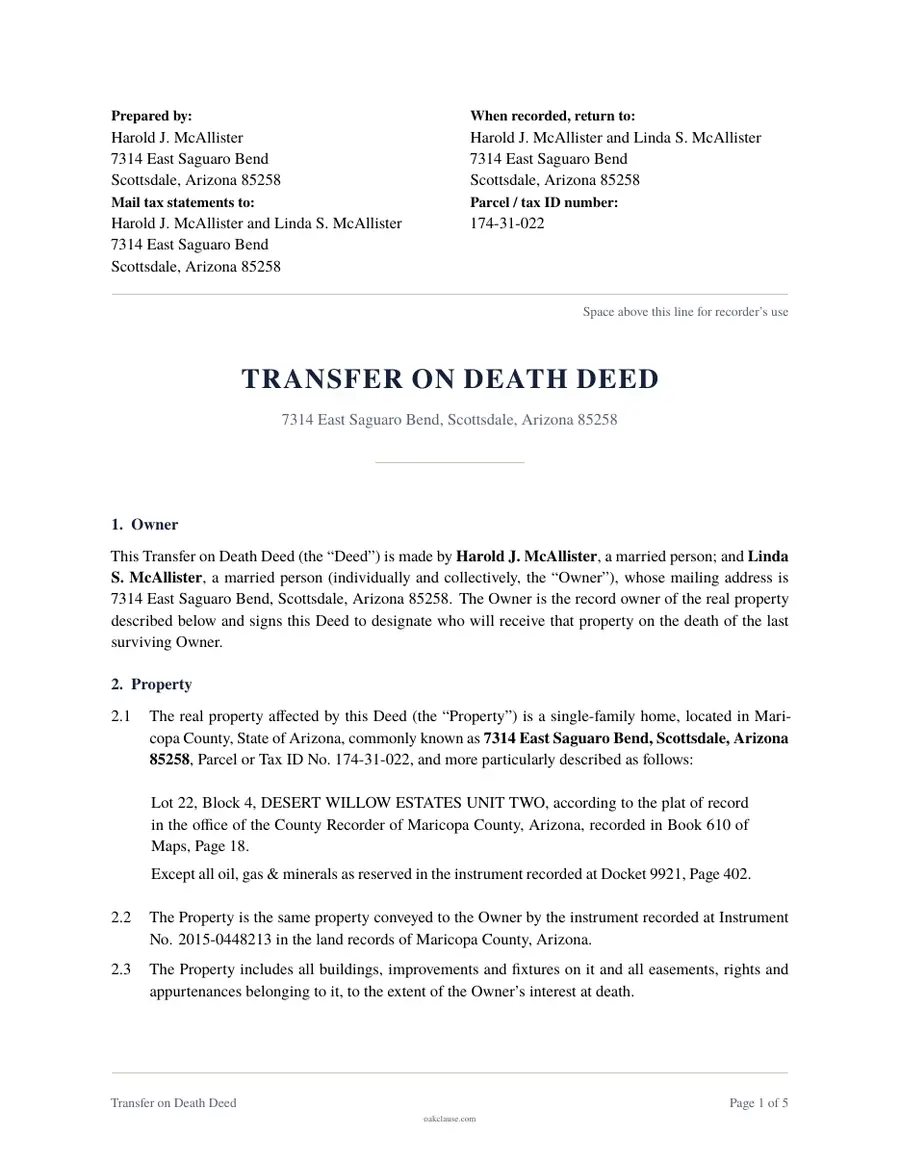
Transfer on death deeds are recognized in many, but not all, states, and the states that allow them set their own rules on wording, signing and recording. In every state that allows them, the deed must be signed and recorded with the county land records office before the owner dies to be effective. This document includes the recording information block, beneficiary shares, backup beneficiaries, a survival requirement, witness lines and a notary acknowledgment.
When to use it
- You want a house, condo or parcel of land to pass to your children or another person without probate.
- You want to keep full ownership and the freedom to sell, refinance or change your mind during your lifetime.
- You own property with a spouse or partner and want it to pass to your chosen beneficiaries after you both die.
- You want a simpler alternative to a living trust for a single piece of real estate.
- You want to name backup beneficiaries in case a primary beneficiary dies before you.
What is included
- Recording block with preparer, return address and tax statement address
- Owner details, marital status and spousal consent where needed
- Legal description, parcel number and prior deed reference
- Primary beneficiaries with equal or custom shares
- Backup plan if a beneficiary dies first, including alternate beneficiaries
- Optional survival period
- Statement of the owner's retained rights and power to revoke
- Liens, mortgages and creditor claims language
- Signature lines with optional witnesses
- Notary acknowledgment
How to make your TOD Deed
Answer the questions
Tell us about the parties and the terms you want. Most documents take about 5 to 20 minutes.
Review the preview
Check the draft as you go and change any answer. The document updates instantly.
Download, sign and keep a copy
Download a print-ready PDF, sign it with the other parties, and give everyone a copy.
TOD Deed in another state
Back to the general tod deed page51 states shown
- ALAlabama
- AKAlaska
- AZArizona
- ARArkansas
- CACalifornia
- COColorado
- CTConnecticut
- DEDelaware
- DCDistrict of Columbia
- FLFlorida
- GAGeorgia
- HIHawaii
- IDIdaho
- ILIllinois
- INIndiana
- IAIowa
- KSKansas
- KYKentucky
- LALouisiana
- MEMaine
- MDMaryland
- MAMassachusetts
- MIMichigan
- MNMinnesota
- MSMississippi
- MOMissouri
- MTMontana
- NENebraska
- NVNevada
- NHNew Hampshire
- NJNew Jersey
- NMNew Mexico
- NYNew York
- NCNorth Carolina
- NDNorth Dakota
- OHOhio
- OKOklahoma
- OROregon
- PAPennsylvania
- RIRhode Island
- SCSouth Carolina
- SDSouth Dakota
- TNTennessee
- TXTexas
- UTUtah
- VTVermont
- VAVirginia
- WAWashington
- WVWest Virginia
- WIWisconsin
- WYWyoming
Frequently asked questions
Does a deed need to be notarized in Nebraska?
Yes, in general. Nebraska deeds must be signed by the grantor and acknowledged or proved before recording, and a documentary stamp tax of $2.32 per $1,000 of value is imposed on the grantor.
How many witnesses does a deed need in Nebraska?
None. Nebraska does not require witnesses to sign a deed.
Where do the Nebraska rules for deeds come from?
They come from Neb. Rev. Stat. 76-211, Deeds; execution; record and Neb. Rev. Stat. 76-901, Documentary stamp tax on grantor; rate. We last checked them in October 2026. Laws change, so check the current statute before you rely on it.
Does a transfer on death deed avoid probate?
In states that recognize these deeds, the property passes directly to the named beneficiaries when the owner dies, without going through probate. Other assets the owner holds in their own name may still need probate, and the beneficiaries may need to record a death certificate or affidavit to show the transfer has happened.
Is a transfer on death deed available in every state?
No. Many states allow them, but some do not, and the rules differ among those that do. Before relying on a transfer on death deed, check that the state where the property is located recognizes them. If it does not, a living trust or other planning tool may serve a similar purpose.
Do the beneficiaries have any rights while I am alive?
No. The beneficiaries have no ownership interest until the owner dies. The owner can live in, rent, sell, mortgage or give away the property without the beneficiaries' permission, and the owner's creditors, not the beneficiaries', can reach the property during the owner's life.
Can I change or cancel a transfer on death deed?
Yes. You can revoke it or name new beneficiaries at any time during your life, usually by signing and recording a new transfer on death deed or a revocation. In most states, a will cannot override or revoke a recorded transfer on death deed, so changes need to be made through the land records.
When does the deed have to be recorded?
The deed must be recorded in the land records of the county where the property is located before the owner dies. A transfer on death deed that is signed but not recorded during the owner's lifetime generally has no effect.
What happens if a beneficiary dies before me?
That depends on what the deed says. This document lets you choose whether the share goes to that beneficiary's descendants, to the other beneficiaries, or to alternate beneficiaries you name. If no named beneficiary survives you, the property generally becomes part of your estate.
What happens to the mortgage when the owner dies?
The property passes subject to any mortgage, lien or other debt secured by it. The beneficiaries do not become personally liable for the loan simply by receiving the property, but they would need to keep paying it, refinance or sell if they want to avoid foreclosure.
Does a transfer on death deed affect taxes or Medicaid?
Because the owner keeps full control during life, the property is generally still treated as the owner's for many tax and benefit purposes. Some states can make claims against property passing under these deeds to recover public benefits. A tax or elder law professional can explain how the rules apply to you.
More Nebraska documents
Other documents people prepare for Nebraska, each with the state’s rules where we have checked them.
All Nebraska documents and rules