Medical Records Release
Give a doctor, hospital or other provider written permission to send your health records to a person or organization you choose.
Includes 30 days of edits
- 5 to 20 minutes
- Print-ready PDF
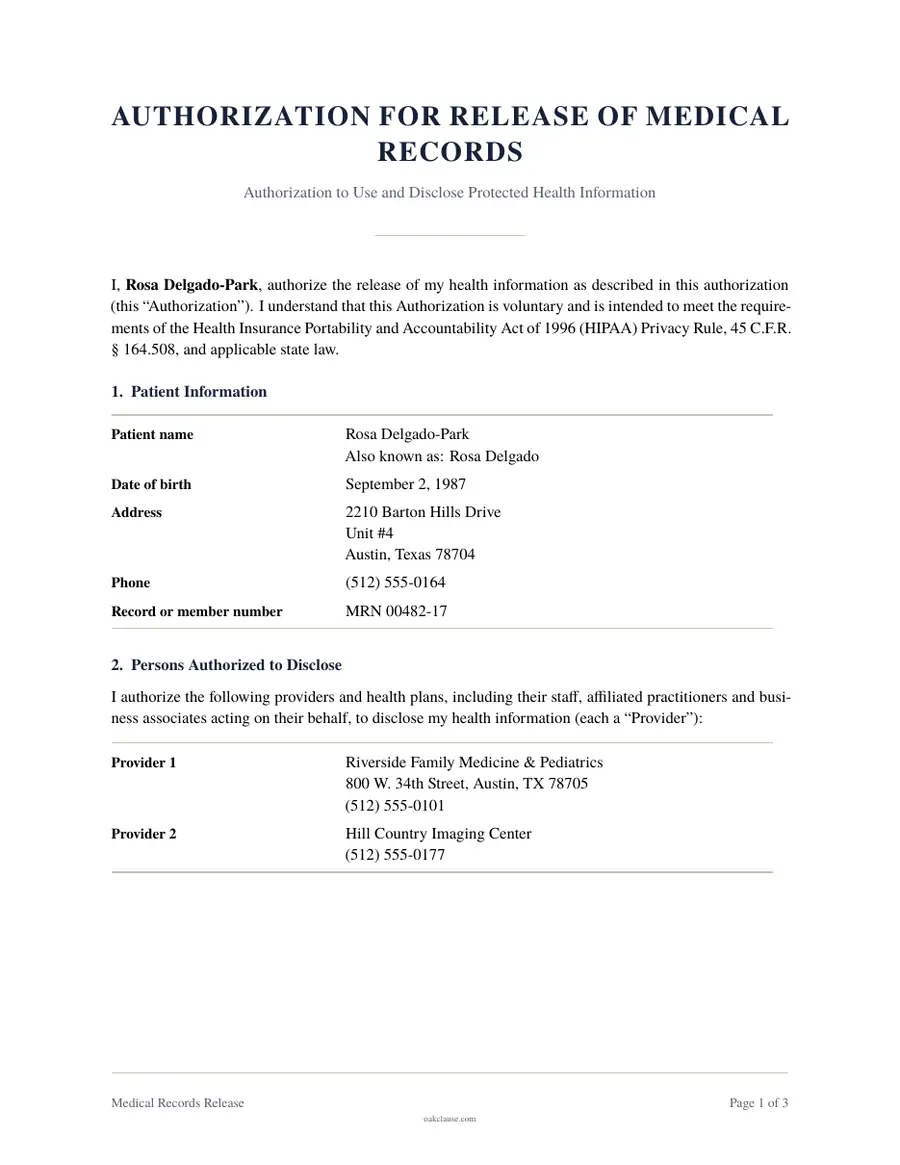
What is a Medical Records Release?
A medical records release, also called a HIPAA authorization or authorization to release health information, is a signed form that lets a health care provider or health plan share your protected health information with someone else. That might be a family member who helps with your care, a new doctor, an attorney, an insurer or a school.
Under the federal HIPAA Privacy Rule, providers generally need your written authorization before they disclose your health information for purposes other than treatment, payment and routine health care operations. A valid authorization has to contain specific elements: what information may be shared, who may share it, who receives it, the purpose, an expiration date or event, your signature and date, and statements about your right to revoke it and about how the information may be shared further.
This form includes all of those elements. It also lets you choose exactly which records are covered, set a date range, decide whether especially sensitive records such as mental health, substance use or HIV information are included, and sign as the patient or as the patient's personal representative.
When to use it
- You want a family member or caregiver to be able to talk with your doctors and receive your records.
- You are switching doctors or seeing a specialist and want your records sent over.
- Your attorney or insurance company needs records for a claim, lawsuit or disability application.
- You are handling health matters for a minor child or an adult you are legally authorized to represent.
- A school, employer or program has asked for specific health information and you agree to share it.
What is included
- Patient identification, including other names used and record numbers
- One or more providers or health plans authorized to disclose
- The person or organization who receives the records
- All records or only selected types, with an optional date range
- Separate opt-ins for sensitive information
- Purpose of the disclosure and preferred delivery method
- Expiration date or event
- Required statements on revocation, treatment conditioning and redisclosure
- Signature block for the patient or a personal representative
How to make your Records Release
Answer the questions
Tell us about the parties and the terms you want. Most documents take about 5 to 20 minutes.
Review the preview
Check the draft as you go and change any answer. The document updates instantly.
Download, sign and keep a copy
Download a print-ready PDF, sign it with the other parties, and give everyone a copy.
Frequently asked questions
Is this the same as a HIPAA authorization?
Yes. A medical records release that meets the federal requirements is often called a HIPAA authorization. It includes the core elements and statements that the HIPAA Privacy Rule requires for a valid authorization, so most providers will accept it, although some may still ask you to use their own form.
Do I need a release to get my own medical records?
No. Under HIPAA you generally have a right to access your own records, usually by submitting a records request to the provider. A release is used when you want the provider to send your information to someone else.
How long does a medical records release last?
It lasts until the expiration date or event you choose, such as a specific date or the end of a legal case. You can also revoke it earlier in writing, though a revocation does not undo disclosures already made in reliance on it.
Can a provider refuse to treat me if I do not sign?
Generally no. Providers and health plans usually cannot condition treatment, payment, enrollment or eligibility for benefits on whether you sign an authorization. There are narrow exceptions, for example when the treatment is part of a research study or the health care is provided solely to create information for a third party.
Are mental health or substance use records included automatically?
Not with this form. Many states give extra protection to mental health, HIV, genetic and reproductive health information, and federal rules add protections for certain substance use disorder treatment records. This form asks you to opt in to each sensitive category separately. Psychotherapy notes require their own separate authorization and are excluded.
Can I sign a release for someone else?
Yes, if you are their personal representative, such as the parent of a minor, a court-appointed guardian, an agent under a health care power of attorney, or the executor of a deceased patient's estate. The form lets you state your authority, and the provider may ask for proof of it.
Does the provider charge for sending records?
Providers may charge a reasonable fee for copying and sending records, and the rules on fees vary depending on who is requesting the records and on state law. Ask the provider about any fees when you submit the form.
Can the recipient share my records with others?
Once your information is released to someone who is not covered by HIPAA, such as a relative or an employer, the federal privacy rule may no longer protect it, and it could be shared further. That is why the form includes a redisclosure statement and why it is important to choose recipients you trust.