Arizona Codicil to Will
Update one or two parts of your existing will, such as your executor, a guardian or a specific gift, without starting over.
Includes 30 days of edits
- 5 to 20 minutes
- Print-ready PDF
- Tailored to Arizona
Arizona rules at a glance
Will signing and witnesses
- Witnesses
- 2 witnesses
- Self-proving affidavit
- Allowed
- Handwritten (holographic) wills
- Recognized
An Arizona will must be signed by the testator and at least two witnesses, can be made self-proved before a notary, and a holographic will is valid if the signature and material provisions are in the testator's handwriting.
When you create this codicil to will for Arizona, the questionnaire uses Arizona as the governing law and adds wording that defers to Arizona requirements where they apply.
General information, not legal advice. Laws change, and cities can add their own rules, so check the current statute before you rely on it.
What is a Codicil to Will?
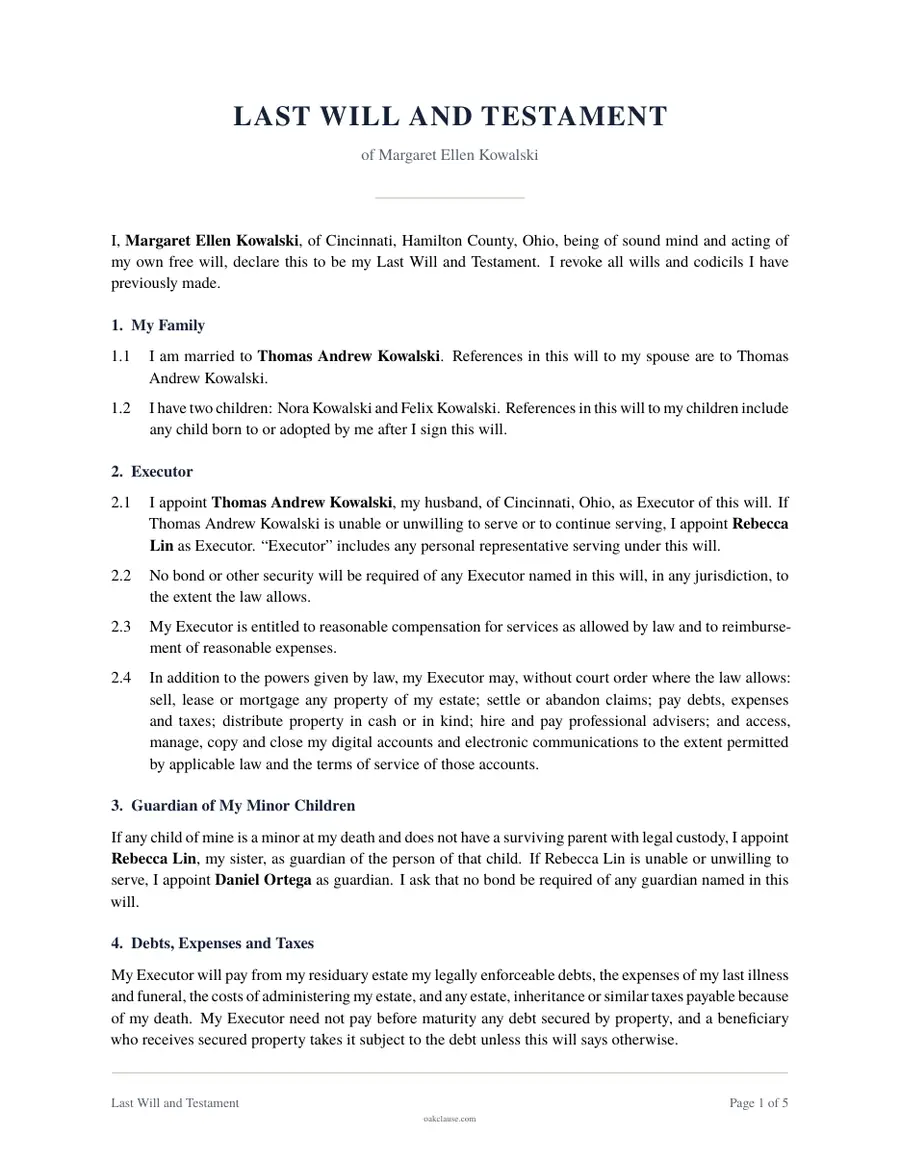
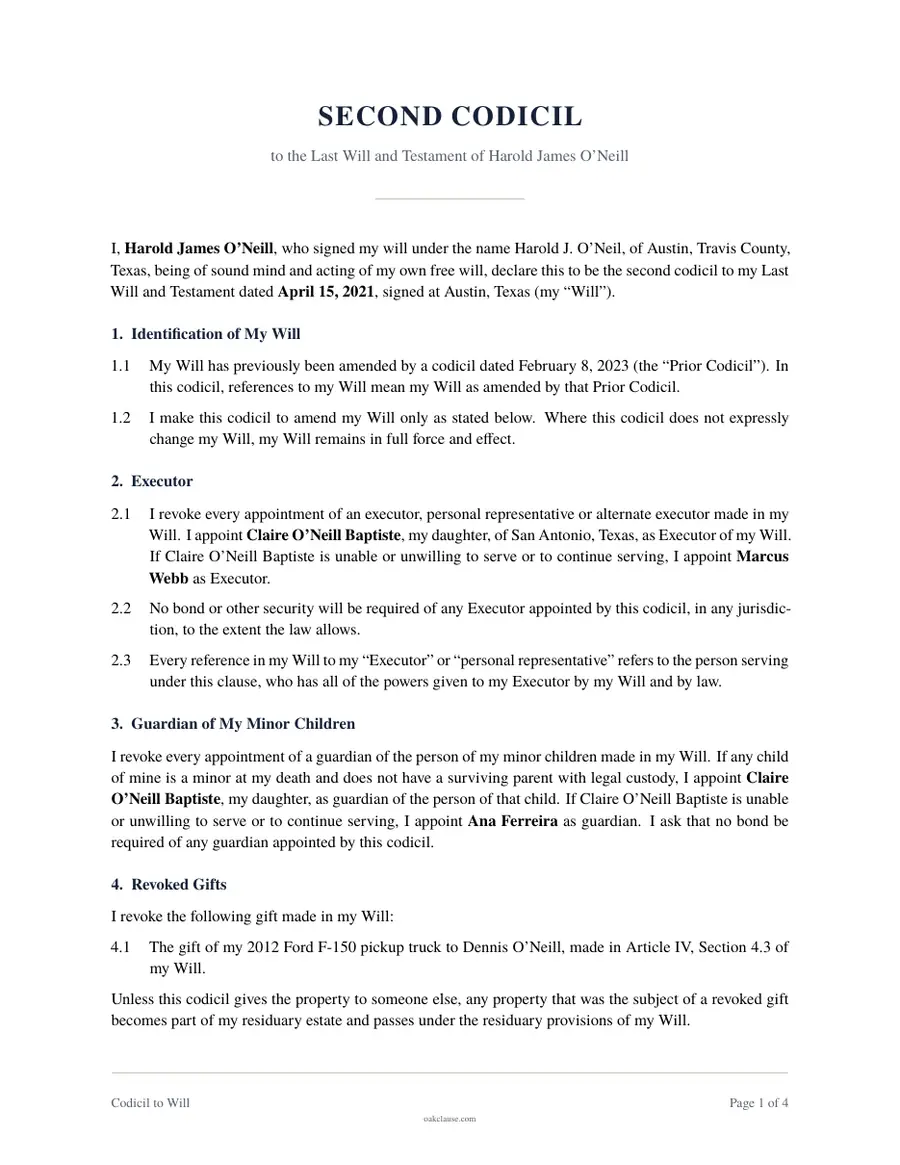
A codicil is a written amendment to a will you have already signed. Instead of replacing the entire will, it changes, removes or adds particular provisions and then confirms that everything else in the original will still applies. The will and every codicil to it are read together as one estate plan.
People typically use a codicil for targeted updates: naming a new executor after the original choice moves away, choosing a different guardian for young children, adding a gift to a grandchild or charity, or cancelling a gift of property that has since been sold. Because the changes are kept short and clearly tied to the original document, the rest of your plan stays exactly as you wrote it.
A codicil must be signed with the same formalities as a will in your state. In most states that means signing in front of two adult witnesses, and many states also allow a self-proving affidavit signed before a notary. This document identifies your original will and any earlier codicils, sets out each change in its own numbered clause, republishes the unchanged parts of your will, and includes attestation and optional self-proving pages.
When to use it
- You want to replace your executor or alternate executor named in your current will.
- You want to name a different guardian for your minor children.
- You want to add a new gift or cancel a gift of property you no longer own.
- You need to correct or reword a single provision of your will.
- Your will is otherwise up to date and you prefer not to sign a completely new one.
What is included
- Identification of your original will and any earlier codicils
- Replacement executor, alternate executor and bond instructions
- Replacement guardian and alternate guardian for minor children
- New specific gifts with backup instructions if a beneficiary dies first
- Revocation of gifts you no longer want to make
- Free-form changes to replace, delete or add any provision
- Republication clause confirming the rest of your will
- Governing law, interpretation and severability provisions
- Attestation clause with two or three witness blocks
- Optional self-proving affidavit with notary block
How to make your Codicil
Answer the questions
Tell us about the parties and the terms you want. Most documents take about 5 to 20 minutes.
Review the preview
Check the draft as you go and change any answer. The document updates instantly.
Download, sign and keep a copy
Download a print-ready PDF, sign it with the other parties, and give everyone a copy.
Codicil in another state
Back to the general codicil page51 states shown
- ALAlabama
- AKAlaska
- AZArizona
- ARArkansas
- CACalifornia
- COColorado
- CTConnecticut
- DEDelaware
- DCDistrict of Columbia
- FLFlorida
- GAGeorgia
- HIHawaii
- IDIdaho
- ILIllinois
- INIndiana
- IAIowa
- KSKansas
- KYKentucky
- LALouisiana
- MEMaine
- MDMaryland
- MAMassachusetts
- MIMichigan
- MNMinnesota
- MSMississippi
- MOMissouri
- MTMontana
- NENebraska
- NVNevada
- NHNew Hampshire
- NJNew Jersey
- NMNew Mexico
- NYNew York
- NCNorth Carolina
- NDNorth Dakota
- OHOhio
- OKOklahoma
- OROregon
- PAPennsylvania
- RIRhode Island
- SCSouth Carolina
- SDSouth Dakota
- TNTennessee
- TXTexas
- UTUtah
- VTVermont
- VAVirginia
- WAWashington
- WVWest Virginia
- WIWisconsin
- WYWyoming
Frequently asked questions
How many witnesses does a will need in Arizona?
Two. An Arizona will must be signed by the testator and at least two witnesses, can be made self-proved before a notary, and a holographic will is valid if the signature and material provisions are in the testator's handwriting.
Can a will be self-proved in Arizona?
Yes. Arizona allows a self-proving affidavit, which lets a court accept the will without calling the witnesses to testify.
Is a handwritten will valid in Arizona?
Yes. Arizona recognizes handwritten (holographic) wills that meet its requirements.
Where do the Arizona rules for wills come from?
They come from A.R.S. 14-2502, A.R.S. 14-2503 and A.R.S. 14-2504. We last checked them in October 2026. Laws change, so check the current statute before you rely on it.
What is the difference between a codicil and a new will?
A codicil changes only the parts of your will you specify and leaves the rest in place, while a new will replaces the old one entirely. A codicil is convenient for one or two small updates. If you are making many changes, or major ones like changing who inherits most of your estate, a new will is usually clearer and easier for your family and the court to follow.
Does a codicil need witnesses?
In nearly every state, yes. A codicil must be signed with the same formalities as a will, which typically means two adult witnesses who see you sign. Choosing witnesses who do not inherit anything under your will or codicil helps avoid problems later.
Can I just write changes on my original will?
It is best not to. Handwritten notes, cross-outs or initials on a signed will can be ignored, can invalidate part of the will, or can create disputes about what you intended. A properly signed codicil or a new will is the reliable way to make changes.
Do I need to have a codicil notarized?
Notarization is not usually what makes a codicil valid; the witnesses are. However, many states let you add a self-proving affidavit signed by you and your witnesses before a notary, which can make it easier to admit the will and codicil to probate later without tracking down the witnesses.
How many codicils can I add to a will?
There is no general legal limit, but every codicil adds another document that must be found, read together with the will and proven in probate. Many people sign a new will once they have more than one or two codicils so that their wishes are in a single document.
Where should I keep my codicil?
Keep the signed original codicil with your original will, ideally attached or stored in the same envelope or safe. Let your executor know where both documents are. A codicil that cannot be found after your death may not be given effect.
Can a codicil change who inherits the rest of my estate?
Legally, a codicil can change any provision, including the residuary clause. Because the residuary clause usually covers most of an estate, though, many people find a new will clearer for that kind of change. If you expect anyone to object, consider speaking with an estate planning attorney.
Does a codicil change the date of my will?
A codicil generally republishes the will as of the date the codicil is signed, which means the will and codicil are treated as speaking from that later date. This can matter for things like references to people or property, so describe changes clearly and completely.
More Arizona documents
Other documents people prepare for Arizona, each with the state’s rules where we have checked them.
All Arizona documents and rules