Contract Termination Agreement
End a contract cleanly when both sides agree it should stop.
Includes 30 days of edits
- 5 to 20 minutes
- Print-ready PDF
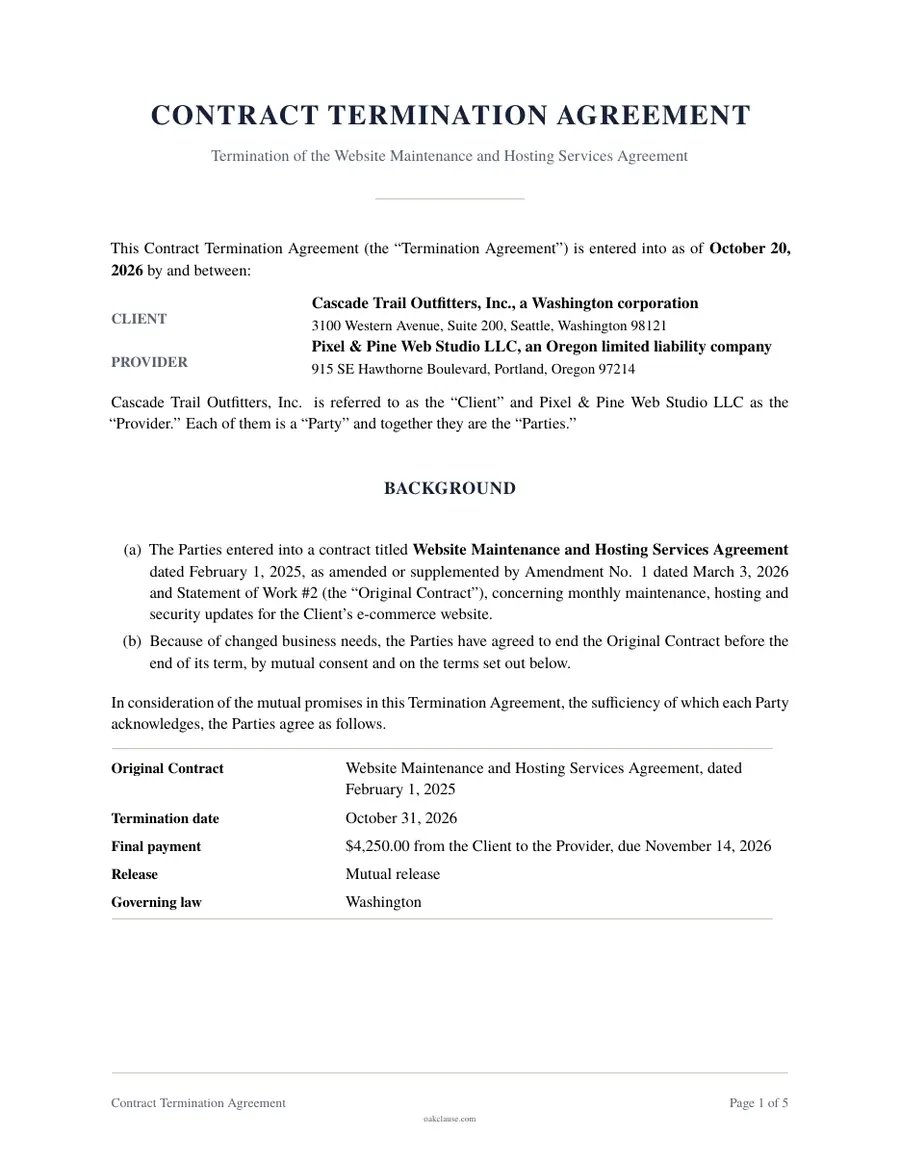
What is a Contract Termination Agreement?
A contract termination agreement, sometimes called a mutual termination agreement or mutual release, is a short contract in which the parties to an existing agreement agree to end it early. Instead of one side walking away and risking a breach-of-contract claim, both sides sign a document that fixes the termination date and explains how everything still open will be wrapped up.
The agreement identifies the original contract, sets the date it ends, and lists any final payments, deliverables or returns of property still owed. It states which clauses of the original contract continue after termination, such as confidentiality or indemnification, and it can include a release so that neither side can later sue over the original contract except to enforce the termination terms.
Ending a contract by mutual agreement is often faster and cheaper than relying on a termination clause or arguing over whether the other side breached. A clear written record also helps when you need to show a bank, insurer, landlord or new business partner that an old obligation has ended.
When to use it
- You and the other party agree that a service, supply, consulting or other business contract should end before its scheduled term.
- The original contract has no termination clause, or its notice period is longer than both parties want.
- You want to settle final invoices, refunds or deliverables as part of ending the relationship.
- You want both parties to release claims under the old contract so the relationship ends without loose ends.
- A deal is being replaced by a new agreement and the old one must be formally ended first.
What is included
- Identification of the parties and the original contract, including amendments
- Termination effective date and end of future obligations
- Final payment, refund or settlement amount and due date
- List of remaining obligations and who must perform them
- Return or destruction of property and confidential information
- Surviving clauses from the original contract
- Mutual or one-way release of claims, with optional carve-outs
- Optional non-disparagement and confidentiality of terms
- Governing law, dispute resolution and general provisions
- Signature blocks for individuals or business signers
How to make your Contract Termination
Answer the questions
Tell us about the parties and the terms you want. Most documents take about 5 to 20 minutes.
Review the preview
Check the draft as you go and change any answer. The document updates instantly.
Download, sign and keep a copy
Download a print-ready PDF, sign it with the other parties, and give everyone a copy.
Frequently asked questions
Can a contract be ended early if both parties agree?
Yes. Parties who made a contract can generally agree to end it at any time, even if the contract does not mention early termination. Putting that agreement in writing and having both parties sign it is the best way to prove the contract ended and on what terms.
What is the difference between a termination agreement and a termination letter?
A termination letter is usually sent by one party to end a contract under its own termination clause, and the other side does not have to agree. A termination agreement is signed by both parties, so it can settle final payments, release claims and decide which obligations survive.
Does a termination agreement release all claims?
Only if it says so. This agreement lets you choose a mutual release, a one-way release, or no release at all. You can also exclude specific claims, such as unpaid invoices or indemnification for third-party claims, from the release.
Which clauses usually survive termination?
Confidentiality, indemnification, ownership of intellectual property, payment of amounts already earned, limitation of liability and dispute resolution clauses commonly continue after a contract ends. The agreement lets you pick which clauses of the original contract survive.
Should I pay or receive money as part of the termination?
It depends on what was already performed and what was promised. Many terminations include a final payment for work done, a refund of prepaid fees, or a negotiated termination fee. The agreement records the amount, who pays it and when, and can make the release effective only once payment is made.
Can I use this to end a lease or an employment contract?
Leases and employment relationships have their own legal rules. A lease termination agreement or an employee separation agreement is usually a better fit, since releases of employment claims in particular may need specific terms and review periods to be valid.
Does a contract termination agreement need to be notarized?
Usually not. It is valid when signed by both parties. If the original contract was notarized or recorded, for example because it involved real estate, the termination may need the same formalities, so you can add a notary acknowledgment.