Move-In/Move-Out Inspection Checklist
Document a rental's condition room by room when a tenant moves in and again at move-out, so security deposit deductions rest on a shared record instead of memory.
Includes 30 days of edits
- 5 to 20 minutes
- Print-ready PDF
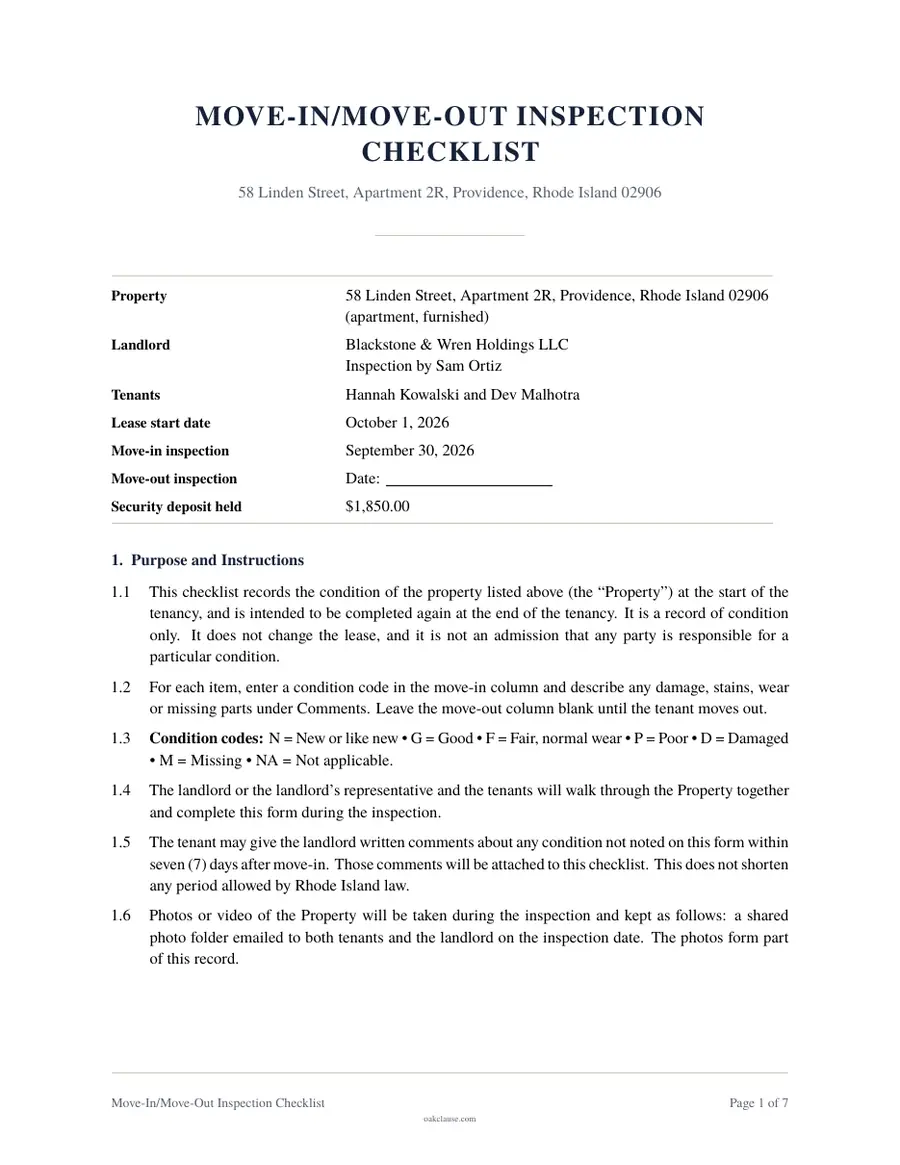
What is a Move-In/Move-Out Inspection Checklist?
A move-in/move-out inspection checklist is a written condition report for a rental home. The landlord and tenant walk through the property together, room by room, and note the condition of walls, floors, fixtures, appliances and other items. Both sign it, and each keeps a copy. At the end of the tenancy, the same form is used again so the two inspections can be compared side by side.
Most security deposit disputes come down to one question: was this damage already there when the tenant moved in? A signed checklist, ideally backed by dated photos, answers that question. It helps landlords support legitimate deductions for damage beyond normal wear and tear, and it helps tenants show that a problem existed before they arrived.
This checklist is built from the rooms you list. Each room gets a table of the items typically found there, with columns for the move-in and move-out condition and comments, plus your own notes on existing damage. It can also record keys, smoke and carbon monoxide detector checks, utility meter readings, furnishings and a move-out summary with a forwarding address.
When to use it
- A new tenant is about to move in and you want an agreed record of the home's condition.
- A tenant is moving out and you need to compare the home's condition to move-in.
- Your state or city requires a written condition statement at the start of a tenancy.
- You are renting a furnished home and want an inventory of the furniture and contents.
- A tenant wants proof of existing damage so it is not charged against the deposit later.
What is included
- Property, landlord and tenant details
- Condition rating key
- Room-by-room tables with move-in and move-out columns
- Notes on existing damage for each room
- Keys and access devices issued
- Smoke and carbon monoxide detector check
- Utility meter readings
- Furnishings inventory for furnished rentals
- Move-out summary with forwarding address
- Signatures at move-in and move-out
How to make your Inspection Checklist
Answer the questions
Tell us about the parties and the terms you want. Most documents take about 5 to 20 minutes.
Review the preview
Check the draft as you go and change any answer. The document updates instantly.
Download, sign and keep a copy
Download a print-ready PDF, sign it with the other parties, and give everyone a copy.
Frequently asked questions
Is a move-in inspection checklist required by law?
Some states require landlords to give tenants a written statement of the property's condition at move-in, or to offer a move-out inspection before deducting from the deposit, and a few prescribe specific wording or deadlines. Many others do not require one at all. Even where it is optional, it is one of the most useful records a landlord or tenant can keep.
Who should be present for the inspection?
Ideally the landlord or property manager and every tenant walk through together, so both sides agree on what is written down. If that is not possible, one side can complete the form and give the other a set time to review it and add comments.
What is the difference between normal wear and tear and damage?
Normal wear and tear is the gradual deterioration that comes from ordinary living, such as lightly faded paint, minor scuffs or carpet worn along walkways. Damage goes beyond that, such as large holes in walls, broken fixtures, burns or pet stains. Landlords can generally deduct only for damage beyond normal wear and tear, as state law defines it.
Should we take photos as well?
Yes, photos and videos make the checklist much stronger. Take dated pictures of each room and close-ups of any existing damage, and note on the form where the photos are stored so both sides can find them later.
Can the tenant add items after moving in?
Many landlords allow a short window after move-in for tenants to note problems they did not see during the walk-through, such as a slow drain. This checklist lets you set that review period. Some states set their own rules on this, so check what applies where the rental is located.
How does the checklist relate to the security deposit?
At move-out, the landlord compares the property's condition to the move-in record. Deductions are generally limited to unpaid amounts and damage beyond normal wear and tear, and most states require an itemized statement of deductions within a set time. The checklist does not replace that statement, but it supports it.
Does the tenant have to sign the checklist?
Signing simply confirms the form reflects the condition observed. A tenant who disagrees with an entry can write a comment next to it before signing. Each side should keep a signed copy.
Can I use one form for both move-in and move-out?
Yes. That is how this checklist is designed: each item has a move-in column and a move-out column, so the same pages can be completed at the start and end of the tenancy and compared line by line.